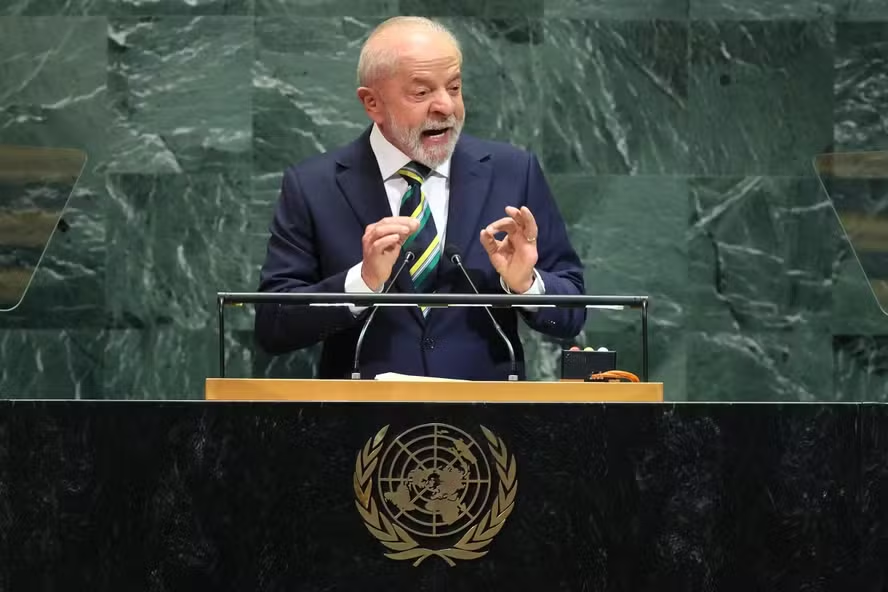
Russian Foreign Minister Sergey Lavrov said on Saturday (27) at the UN General Assembly that granting Brazil a permanent seat on the UN Security Council would represent a “correction of a historical injustice.” The idea of expanding the council’s permanent membership has been discussed for years, including by Brazil itself, as part of broader proposals to reform the United Nations.
Alongside Brazil, Lavrov also expressed support for permanent seats for India and South Africa. He argued that the current geopolitical landscape is vastly different from 80 years ago, when the UN was created, pointing to decolonization movements that reshaped global politics.
“The majority of the world today demands recognition of its rights. The Shanghai Cooperation Organization and Brics play a central role in coordinating the interests of the Global South and the East. The influence of the African Union, as well as other regional blocs, has grown significantly. Yet these new realities have not been adequately reflected in the UN’s institutional framework. In this context, reforming the Security Council is of crucial importance,” he said.
“We support permanent seats for India and Brazil, as well as correcting the historical injustice suffered by Africa, in line with the consensus reached by African nations themselves.”
Lavrov emphasized that reforming the UN is only part of the changes needed in today’s world. “This includes the effective democratization of the IMF, the World Bank, and the WHO, in line with the weight and role of the South and the East in the global economy, trade, and finance. These reforms cannot ignore reality: the situation of international security is deteriorating,” he concluded.
He criticized NATO’s expansion beyond Europe into the Pacific, the South China Sea, and the Taiwan Strait, saying such moves threaten global stability by weakening regional mechanisms and attempting to “encircle the Eurasian region.”
According to Lavrov, Moscow and its allies defend the creation of an “indivisible security architecture” that includes not only Western military alliances but also organizations such as the Shanghai Cooperation Organization, the CSTO, and the Gulf Cooperation Council.
In his speech, Lavrov also demanded greater transparency and adherence to the UN Charter’s principles. He warned against the resurgence of Nazism in Europe and growing militarization under what he described as an anti-Russian banner, criticizing EU and NATO leaders whose rhetoric, he said, verges on contemplating a third world war.
“These actions undermine any effort to build a healthy balance among members of the international community, as they seek to impose unilateral decisions on others in direct violation of the UN Charter’s fundamental principles — especially respect for the sovereign equality of states. This equality is the foundation of the emerging multipolarity. We do not seek revolutions against anyone; we ourselves have suffered, more than others, from imposed revolutions,” he said.