

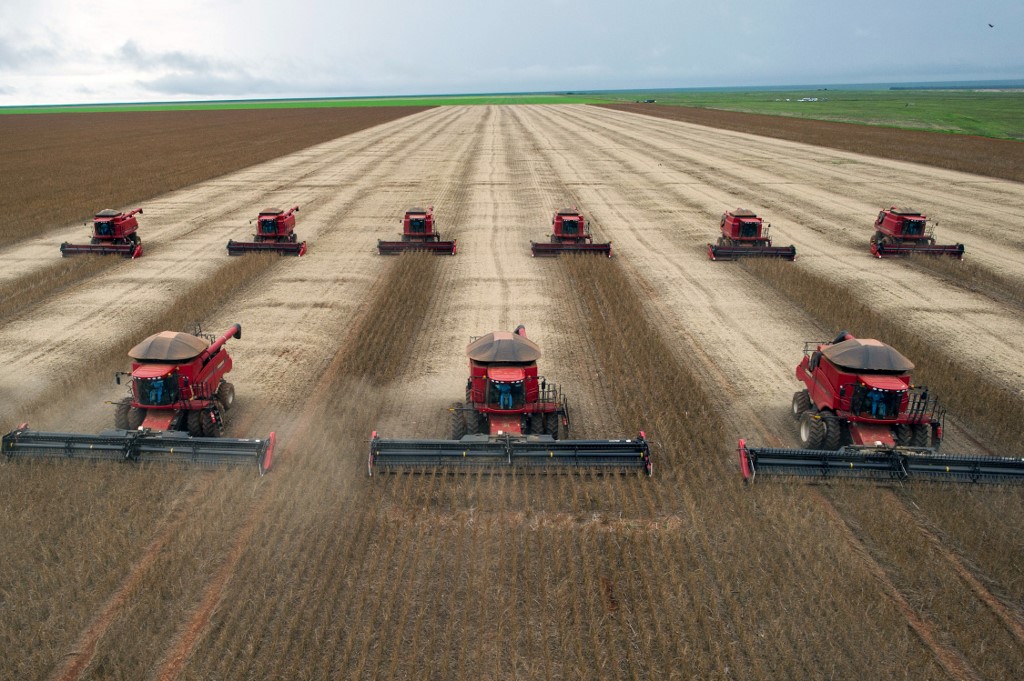
Agribusiness has chainsawed its way over the past few decades to make Brazil the leading exporter of meats and animal feeds. All the world’s biggest food and agribusiness corporations reaped huge profits from the boom, including some home grown ones like the meat giant JBS, with a climate footprint that rivals Bangladesh or Spain. The combination of deforestation, land grabbing, cattle ranching and fields soaked with pesticides and fertiliser has made Brazil famous for climate destruction. Yet, while the industry accounts for three-quarters of Brazil’s GHG emissions, the sector is excluded from the country’s national carbon law.
Agribusiness exercises a tight grip over the Brazilian state, whether governed by the left or right, Lula or Bolsonaro. So it’s no surprise that this year’s COP is shaping up to be a monumental exercise in agro-greenwashing.
The centre piece is an “Agri Zone” near to the official COP proceedings. While everyone else fights it out for space in the overcrowded “Green Zone”, junk food giants Nestle and PepsiCo and agro-chemical majors Bayer and Yara get a space all to their own to dazzle COP delegates. Top industry lobby groups, like CropLife and the US Dairy Export Council, will be hosting sessions, as will Bill Gates, whose foundation, as a major Agri Zone sponsor, will be showcasing Africa as the next agribusiness frontier. Netafim, an Israeli irrigation company singled out by the UN Special Rapporteur for its involvement in the illegal occupation of Palestinian lands, will also be hosting a session.
The Brazilian people may not know this, but they are footing most of the bill for this corporate extravaganza. The event is being hosted by Brazil’s national agricultural research agency, Embrapa, which is already partnering with corporations to rebrand Brazilian agribusiness through programmes like “net zero dairy farming” with Nestlé and “low-carbon soy” with Bayer. Even the Brazilian ministry responsible for small-scale farming, which is not implementing agrarian reform because of a supposed lack of funds, is a contributing sponsor. A few other governments will be participating too, namely Australia, Canada, France, Germany, Japan, the Netherlands, and the UK.
The objective here is not just to greenwash agribusiness. Climate COPs have become deal-making venues, on par with Davos, and this year the Brazilian agribusiness juggernaut has one huge deal on the table.
At COP28 in Dubai, with Brazil already picked to host COP30, the Brazilian government announced its plans for a massive, US$100 billion public-private partnership to convert 40 million hectares of degraded pastures into monocultures of soybeans and other export crops. It claims that the farming of these crops will build back carbon in the soil and that corporations can invest as a way to offset their fossil fuel emissions.
Since then, the Brazilian government and the agribusiness lobby have been sending missions around the world– including Riyadh, Beijing and New York– to sign up foreign investors for the project, now dubbed Caminho Verde Brasil. Saudi Arabia’s sovereign wealth fund, which owns a controlling stake in the Brazilian meat giant Minerva, has stated its interest, and is already acquiring carbon credits. So too is the UAE’s sovereign wealth fund, Mubadala, through a Brazilian subsidiary that is planting 180,000 hectares of the Cerrado with macaúba trees to produce biofuels for jet planes as part of the programme. Big agribusiness lenders are signed up as well– like Rabobank of the Netherlands and Brazil’s BTG, both of which are buying up land for tree plantations to produce carbon credits for Microsoft.
The government is now trying to entice foreign investors with equity stakes in farms, using a new financial instrument, called Fiagros, that would allow them to circumvent restrictions on foreign ownership of land. “Offtake agreements” are also in the works with Chinese companies, where up front cash investments would be paid back in soybeans, sugar and meat.
This new “green way” is just an expansion of the old way of doing agribusiness in Brazil. The sale of deforested pasture lands for conversion into intensive farms of soybeans, sugarcane, eucalyptus or cattle will incentivise more deforestation and land grabbing with cattle displacement, and will increase the use of chemical pesticides and fertilisers, with drastic impacts on public health, specially on peasant and indigenous communities. All the production will be for export, and all of the profits will continue to be pocketed by bankers, land barons and the shareholders of multinational corporations. Real emissions will rise faster, further and longer than whatever carbon the programme manages to temporarily sequester in the soils.
If there is hope for this year’s COP to be different, it will be found a few kilometers away from the Agri Zone, at the People’s Summit, where communities that have long suffered the Brazilian agribusiness boom are organising their own space. Here, organisations and social movements will be working together to build food systems that can truly respond to the climate emergency and the other environmental, health and social crises fueled by agribusiness.
*Larissa Packer focuses on agribusiness trends in Latin America, especially in relation to digitalisation, agrarian reform, climate greenwashing and land grabbing. Lately, she has been getting involved in work on seed laws and broader struggles for food sovereignty in the region. She represents GRAIN in the Alianza Biodiversidad (Biodiversity Alliance), a coalition of 10 organisations/movements fighting for food sovereignty across Latin America.
**This is an op-ed article and does not necessarily represent the editorial guidelines of BdF.
