

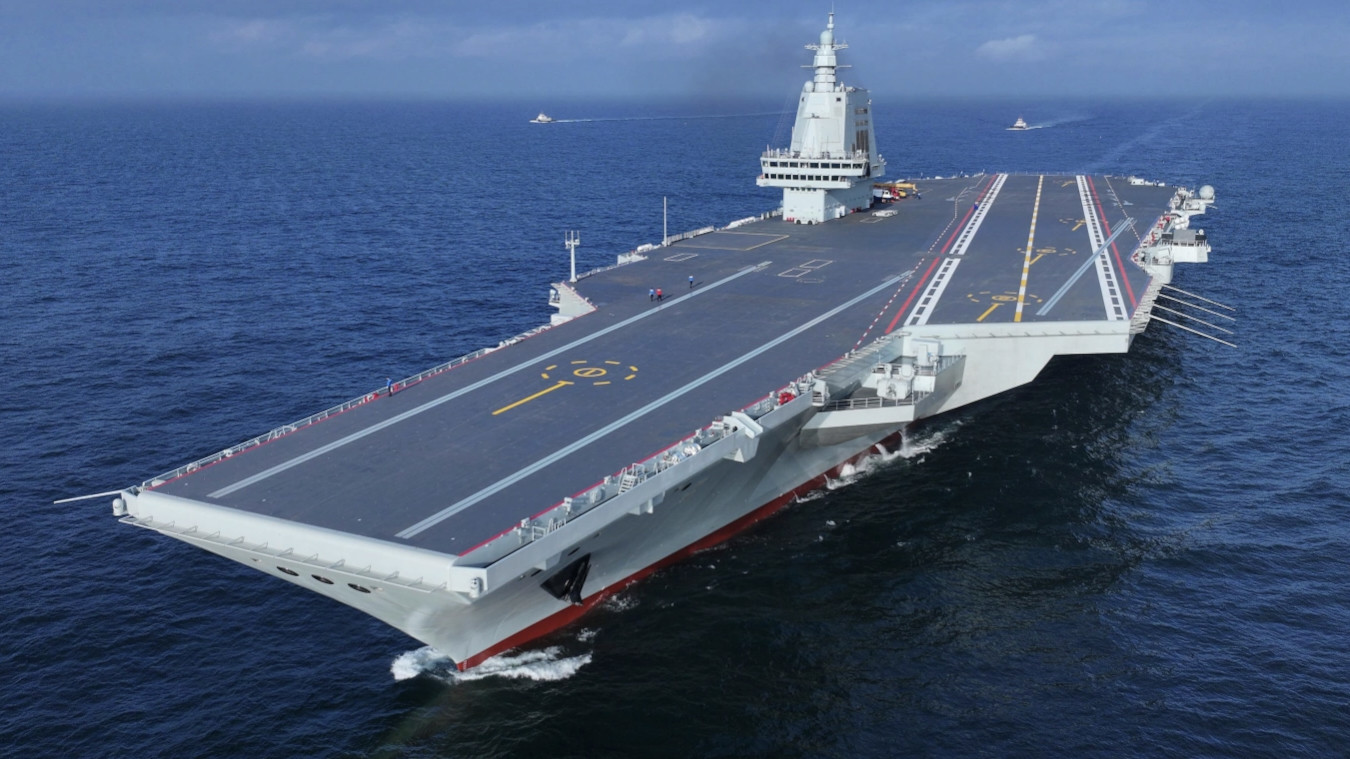
China announced on Friday (7) the commissioning of the Fujian aircraft carrier into its naval fleet, the country’s third carrier-class vessel and the first equipped with an indigenously developed electromagnetic catapult system. Chinese technology has shown reliability rates significantly higher than the similar system used on the U.S. Gerald R. Ford-class carriers, according to technical analyses and Pentagon reports.
Chinese President Xi Jinping attended the ship’s commissioning ceremony on Wednesday (5), though the information was released only on Friday. The Fujian received hull number 18.
The carrier’s commissioning marks a major technological milestone for China’s navy, replacing the previous ski-jump launch method with an advanced electromagnetic catapult system.
Chinese system outperforms U.S. equivalent
The Fujian’s electromagnetic catapult system uses medium-voltage direct current and has a failure rate below 0.2%, making it 80 times more reliable than the Electromagnetic Aircraft Launch System (EMALS) used on the U.S. Ford-class carriers, which operates with alternating current. The data was reported by Chinese military analyst Wang Qiang in The China Academy.
The Ford’s EMALS recorded roughly 600 cycles between failures during 2022 testing, far below the target of 4,166 cycles, according to a Pentagon report (February 2023). The key difference lies in system architecture: the U.S. design shares power among its four catapults, while the Chinese version uses independent power modules for each one. In case of malfunction, a catapult can be isolated within 0.8 seconds without affecting the others.
Fujian launches fifth-generation stealth fighter
On September 22, 2025, the Fujian conducted the world’s first operational electromagnetic catapult launch of a fifth-generation stealth aircraft, the Chinese Shenyang J-35. The milestone came years after the U.S. Navy commissioned its first carrier with electromagnetic launch capability, the USS Gerald R. Ford (2012), and introduced the F-35C in 2013.
Despite the U.S. pioneering role, the F-35C, also a fifth-generation fighter, still operates exclusively from steam catapults on Nimitz-class carriers. Ongoing reliability issues with the Ford’s EMALS have so far prevented full operational integration of fifth-generation aircraft.
Higher launch rates
The Fujian demonstrated an average of 12.5 aircraft launches per hour, according to CCTV, surpassing the U.S. Nimitz-class average of 10 launches per hour, as reported by the U.S. Department of Defense (2012).
Steam catapults require 30–60 minutes to build up pressure and 30–60 seconds to recharge between launches. The Chinese electromagnetic system maintains a consistent 45-second interval and can reach operational readiness within 15 minutes, reducing response time by up to 75%.
Sea trials
The Fujian was launched in June 2022 at Jiangnan Shipyard in Shanghai. After two years of outfitting and testing, it began sea trials in May 2024. On September 10, 2025, it embarked on its eighth sea trial, crossing the Taiwan Strait and completing tests in the South China Sea.
Official footage released on September 23 showed the ship conducting catapult and recovery tests with several aircraft, including the J-35 (stealth), J-15T, J-15DT, and the KJ-600 early warning aircraft. The full process, from launch to commissioning, took just over three years.
Fleet of three carriers
With the Fujian’s commissioning, the People’s Liberation Army Navy now operates three aircraft carriers. The Liaoning, commissioned in 2012 from a refitted Soviet hull, serves primarily for training and research. The Shandong, launched in 2017 as China’s first domestically built carrier, retained the ski-jump system but introduced major design and radar upgrades, significantly improving sortie rates compared to the Liaoning.
Weighing 80,000 tons, the Fujian is the largest of the three. China is also constructing a fourth carrier, the Type 004, expected to feature nuclear propulsion and electromagnetic catapults.
China’s growing naval capabilities are part of a broader military modernization effort that has unfolded over the past two decades.
*With information from CCTV and The China Academy.
