

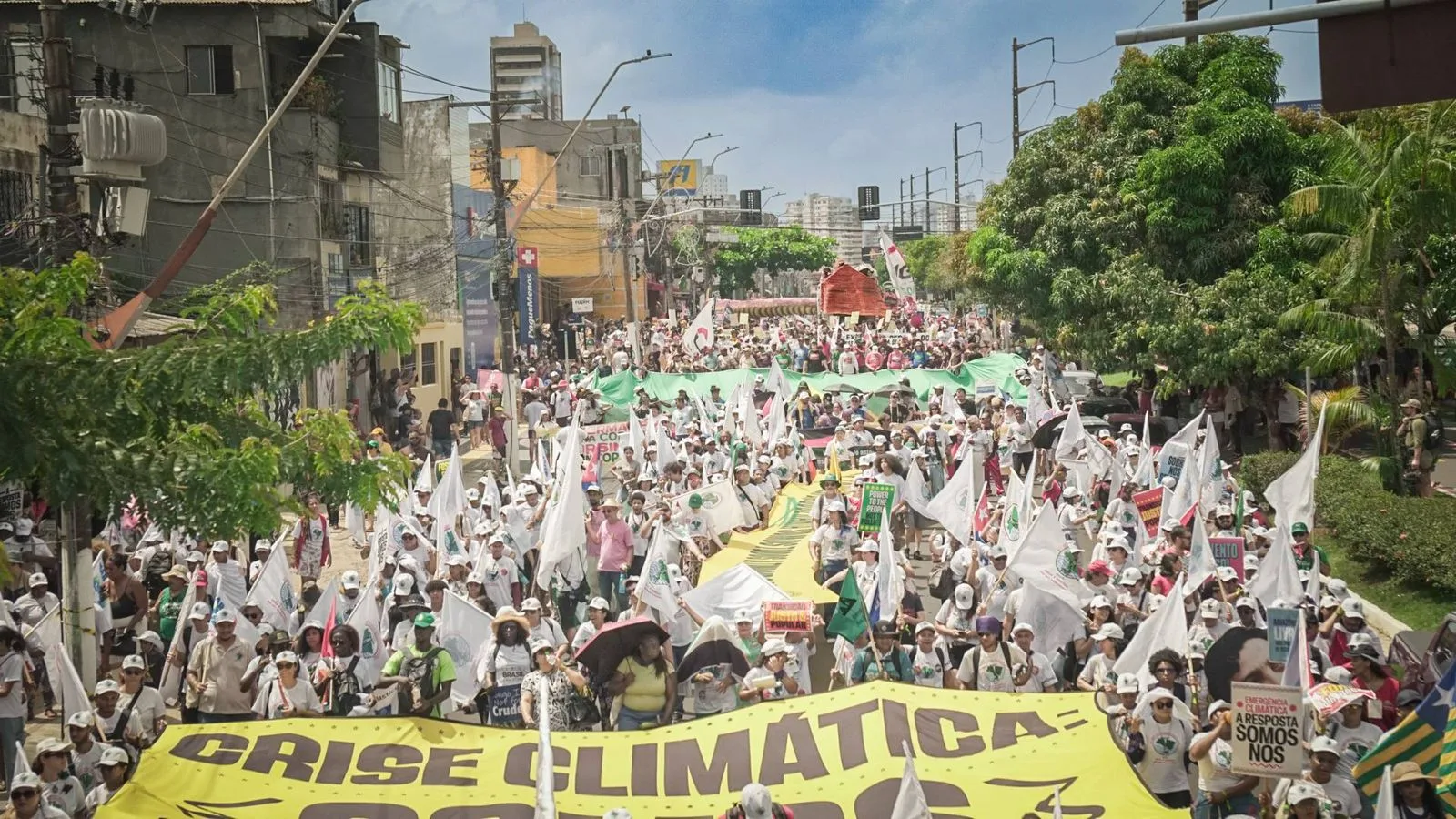
More than 70,000 people took to the streets of Belém, in northern Brazil, on Saturday morning (15) for the historic Global Climate March. In contrast to the official spaces of COP30, the demonstration brought together the full diversity of peoples and popular movements demanding climate justice.
Marching under the slogan “We are the response,” communities from forests, rivers, and rural areas carried signs such as “Agro is fire,” “No climate justice without popular agrarian reform,” and “Environmental collapse is capitalist.”
The march covered 4.5 km and ended at Aldeia Cabana, a symbolic site of struggle and resistance in the Amazon. The location pays tribute to the 19th-century Cabanagem Revolt and the date also coincides with Brazil’s Republic Day.
“Workers from all over the world are walking through the streets of Belém to say that the republic we believe in is the one that guarantees rights, protects nature for future generations, and defends our country’s sovereignty,” said Ayala Ferreira, from the national leadership of Brazil’s Landless Workers’ Movement (MST). “This is a protest about the environmental agenda, but also about other urgent issues.”
The march is part of the People’s Summit, an autonomous event running parallel to COP30 and organized by more than 1,100 civil society groups. The mobilization raised core grassroots demands, including land demarcation for traditional and Indigenous communities, expanding conservation areas, investment in renewable energy, strengthening family farming, restoring mangroves, and improving urban sanitation.
Dyneva Kayabi, from the Coordination of Indigenous Organizations of the Brazilian Amazon (COIAB), stressed that Indigenous land demarcation is essential for climate justice: “Without demarcation, there is no life, no education, no health. We are the response, because without us there is no clean air, no standing forest, no living rivers, and no fully preserved Mother Earth.”
Throughout the march, popular movements used creativity and performance art. One of the most notable acts was the Funeral for Fossil Fuels, calling attention to the urgency of ending the oil era and building a just, democratic energy transition.
Elane Barros, from the Movement of People Affected by Mining (MAM) in Maranhão state, called for a new mining model in Brazil, one rooted in popular sovereignty, social control, and sustainable management of natural resources: “People from all over the world are here to say that climate justice is only possible if the people are protagonists. We need sovereignty in mining, in food production, in every decision.”
During the gathering, ministers and members of Congress also addressed the crowd near Mercado São Brás, including Environment Minister Marina Silva, Indigenous Peoples Minister Sônia Guajajara, and left-wing lawmakers from the PSOL party: Chico Alencar, Sâmia Bonfim, Talíria Petrone, and Tarcísio Motta.
