

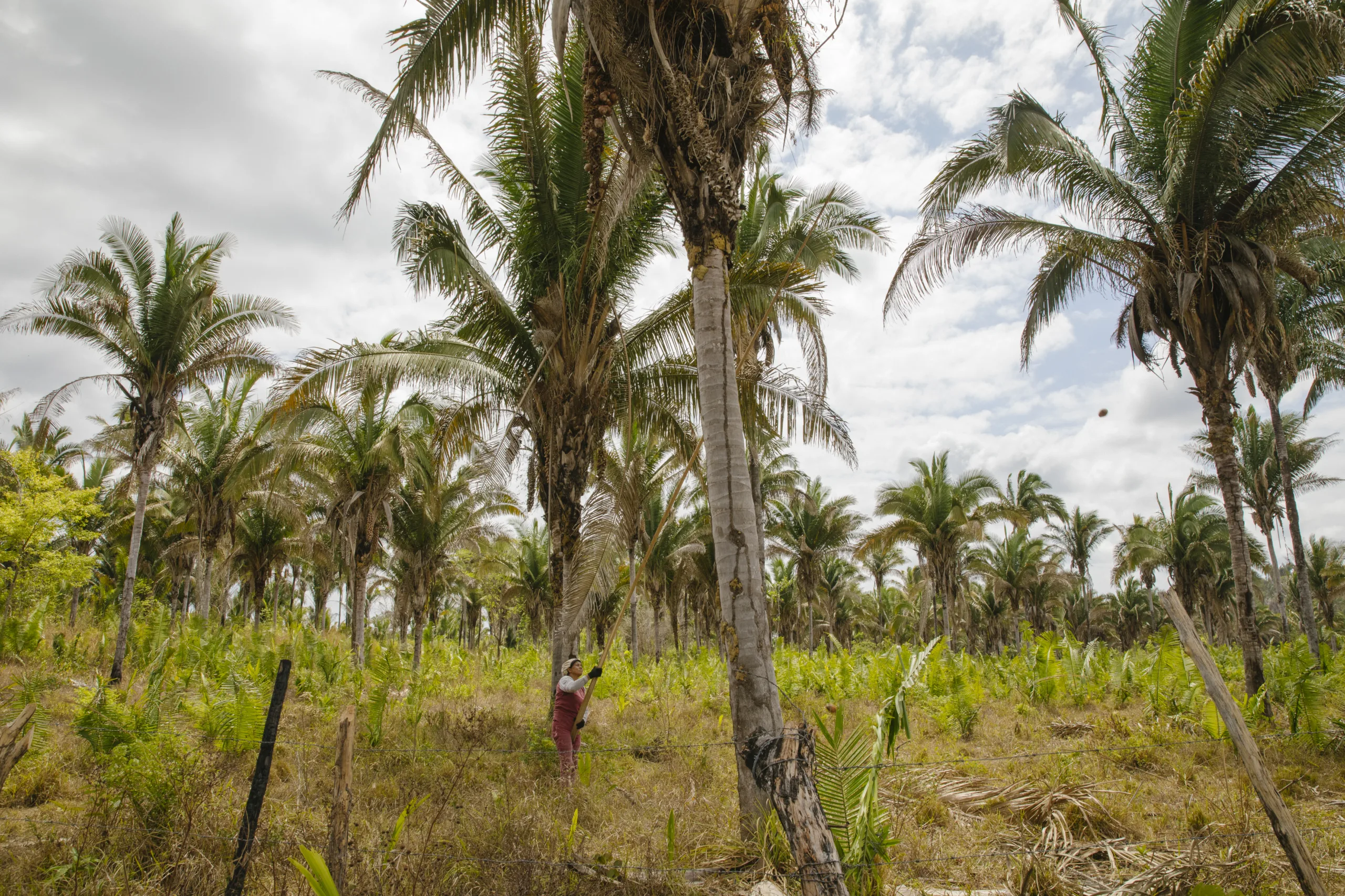
A source of pride for babassu coconut breakers in Maranhão, Brazil, the organic certification of the oil they produce is now at risk. The threat is coming from the air, through pesticide spraying carried out by small airplanes and drones, a method that has been expanding and affecting more and more rural communities across Brazil.
“It is polluting our babassu forests, and we run the risk of losing our organic seal,” says Franciene Frazão, a resident of a rural community in Lago do Junco, in the central region of the state, where pasture land already occupies more than half of the municipality’s total area.
The organic seal, issued after periodic testing of the production, certifies that the babassu oil is free of pesticides. “Every time the oil is produced, it is tested here in Brazil. And abroad, they test it again,” says Frazão.
Part of the organic babassu oil produced by the breakers in Brazil is exported to Europe, where many pesticides that are legal in Brazil are banned or allowed only in much smaller quantities.
This is the case of glyphosate, the most sold pesticide in the country, whose aerial application had previously been banned in Maranhão.
Considered “probably carcinogenic to humans” by the World Health Organization (WHO), the level of glyphosate residue allowed in Brazilian drinking water is 5,000 times higher than the limit permitted in the European Union.
In early 2025, after being in force for 11 years, a federal court injunction that banned the aerial spraying of glyphosate in Maranhão was overturned, once again allowing the poison to be spread through the state’s skies. In its ruling, the court dismissed the lawsuit filed by the Federal Public Prosecutor’s Office (MPF), which had prohibited aerial spraying of glyphosate since 2013.
Even before aerial glyphosate use was reinstated, in 2023, a shipment of babassu oil underwent strict evaluation due to contamination risk. “Our oil was held for two months because of suspicion, but after more in-depth testing it was released,” recalls Frazão.
Now, with more poison in the air, she sees the danger approaching and fears losing the key distinction that guarantees income for many communities. “And that distinction, our brand, is being organic,” says the coconut breaker, who learned to harvest babassu as a child.
Maranhão holds record for contamination
Data from the Pastoral Land Commission (CPT) indicate that Maranhão is the state most affected by aerial pesticide spraying. In 2024, the number of such incidents was the highest of the decade, totaling 276 cases across Brazil, affecting 17,027 families. The vast majority occurred in Maranhão, with 228 recorded cases — accounting for 82% of the national total.
In some parts of the state, the poison is applied to soybean and corn crops and eucalyptus plantations. In others, however, spraying over babassu groves aims to destroy native vegetation in order to open up new areas for cattle pasture.
“They spray the palm trees to kill the babassu forests so that grass grows for the cattle,” says Maria de Fátima da Silva, executive coordinator of the Interstate Movement of Babassu Coconut Breakers (MIQCB), which connects breakers in Maranhão, Pará, Piauí and Tocantins. She lives in Timbiras, in eastern Maranhão, where there is a record of pesticide spraying over the rural community of Manoel dos Santos, damaging crops and making people ill.
The case is documented in the 2024 Rural Land Conflicts Report by the Pastoral Land Commission, the most comprehensive annual document on rural violence in Brazil.
“The poison, in addition to falling on family crops, hit several people in the community, including children who were on their way to school,” the report states.
Silva also reports the case of the community of Alegrias, also in Timbiras, where “not only the babassu forest but even the people are bathed in poison, causing diseases.” “Today we have people there who are sick because of the poison,” she says.
“When you look at production in Alegrias, everything is dying. Coconut trees, orange trees, tangerine trees, garden vegetables, okra, cassava… nothing grows,” she laments.
‘The palm tree became my mother’
Babassu palm trees grow alongside other species in babassu forests, located in ecological transition zones between the Amazon, Cerrado and Caatinga biomes. Harvesting respects the natural cycle of the plants and fruits, without deforestation or aggression.
“We don’t want dead palm trees. Where there is forest, there are women. Where there is babassu, there are coconut breakers,” says Silva.
For many of these women, harvesting the coconuts, removing the kernels and producing the oil is more than a job.
“I have always been a coconut breaker. I think since my mother’s womb,” says Rosenilde dos Santos Costa, who lives in a rural area of Viana, in central Maranhão. The daughter and granddaughter of coconut breakers, she lost her mother early, when she was only 11 years old.
“The palm tree became my own mother,” she says. In the babassu forests, she has earned her living since childhood and built friendships that last to this day.
Babassu collection is collective work. The women enter the forest together and often open the coconuts and extract the kernels together. Organized into cooperatives, they send their production to domestic and international markets.
“The best part of my work is the unity among coconut breakers, our progress in our merchandise, and having managed to build a cooperative to add value to our products,” celebrates Frazão.
That same unity that guarantees quality products also helps the women confront the threats to their territories of work and life. Recently, a group of them occupied the City Council of Timbiras to pressure lawmakers to approve the Free Babassu Law.
The proposal, built collectively, was officially delivered to the City Council by representatives of MIQCB. Maria de Fátima da Silva was there.
“They thought that we, the rural workers’ union and the coconut breakers of that municipality, wouldn’t fill the chamber, so they didn’t put out chairs. And we pressured them, because either there were chairs for people to sit or we would sit on the floor,” Silva recalls.
The bill, which is still under debate, provides for the protection of babassu palm trees against deforestation and the prohibition of pesticide application over this vegetation.
“That entire plenary was filled with people. And we were talking about the poison, that they cannot put poison on the palm trees, because the palm trees are our livelihood,” she emphasizes.
Between November 12 and 16 of this year, about 50 babassu coconut breakers gathered at the People’s Summit, a parallel event to COP30, held in Belém, the capital of Pará. There, between talks, discussion circles and dances, they spoke to the BdF reporting team.
“We are asking for help for the babassu forest, for our standing babassu,” declared Silva, beside a stage where they watched a musical performance. Together, they danced on the lawn of the Federal University of Pará (UFPA), where the summit was held.
“When you start organizing in this movement and empowering yourself with knowledge and relationships, both in processing and political articulation, you become what we are today: a woman with one foot in militancy and struggle, and the other in the babassu forests,” Costa concludes.
