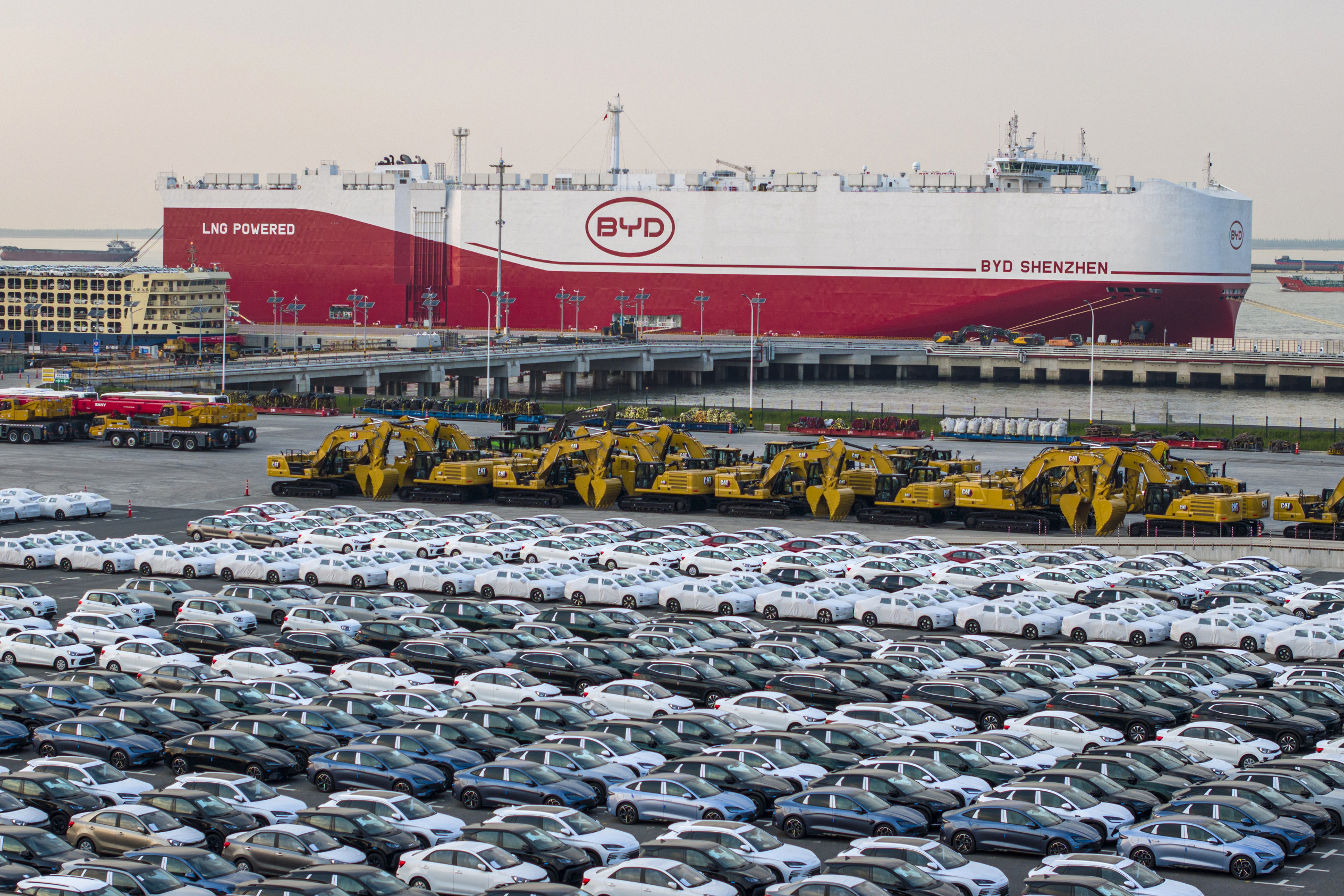
Before the end of the year, China has already reached a record trade surplus. The country registered a US$1 trillion surplus in international trade from January to November this year, despite U.S. tariffs that reached 145% at the beginning of the year, according to figures released Monday (8) by the General Administration of Customs (GAC).
The surplus represents more than 5% of China’s GDP, double the share recorded in 2019, and reflects the country’s strategy of market diversification in response to Washington’s tariff escalation. Last year, China came close to the same mark, posting a record surplus of 7 trillion yuan.
According to GAC data, Chinese exports totaled 24.46 trillion yuan in the period, a 6.2% increase compared to the same span in 2024, while imports reached 16.75 trillion yuan, up 0.2%.
Customs data indicates a major reorientation in trade flows: exports to the United States fell 29% in the first 11 months; exports to the European Union rose 14.8%; exports also rose to Australia by 35.8% and to Southeast Asia by 8.2%.
Trade with Belt and Road Initiative partner countries totaled 21.33 trillion yuan, an increase of 6%, and now represents 51.8% of China’s foreign trade. Electromechanical products generated 14.89 trillion yuan in exports, a rise of 8.8%, accounting for 60.9% of total exports.
Zero-tariff policy boosts imports from developing countries
Since December 2024, China has granted zero-tariff treatment to 100% of tariff lines from developing countries with which it has diplomatic relations, becoming the first major economy to apply such a policy.
“In the past 11 months, imports from least-developed countries have increased by more than 55 billion yuan, demonstrating concrete action to support shared development across the Global South,” said Lyu Daliang, director of GAC’s Department of Statistics and Analysis.
Data from Huangpu Customs in Guangzhou shows that from January to November, preferential imports totaled 1.3 billion yuan, resulting in 60 million yuan in tariff exemptions, according to Huang Chong, deputy director of the customs tariff department, speaking to CCTV.
African agricultural imports have been particularly boosted. “Since the beginning of this year, our company has imported sesame from Tanzania, Mozambique, Niger and Togo, which account for 90% of our total sesame imports. We estimate tariff reductions of around 7.7 million yuan,” said Chen Yue, an import company manager in Guangdong, also to CCTV.
Non-fossil energy products lead a new export phase
The province of Shandong exported nearly 200,000 tons of biomass energy products in the first 11 months, almost double the previous year, according to Ji Qiyong, chief inspector at Rizhao Customs.
“The biofuel we produce is made from residual vegetable oils and animal fats. It can be mixed with conventional jet fuel in any proportion and reduces carbon emissions by 80 to 85%,” explained Wang Beihai, deputy general manager of Shandong Sanju Bioenergy.
Lyu Daliang concluded that “the resilience of China’s export trade comes from a firm commitment to innovation and green development.”