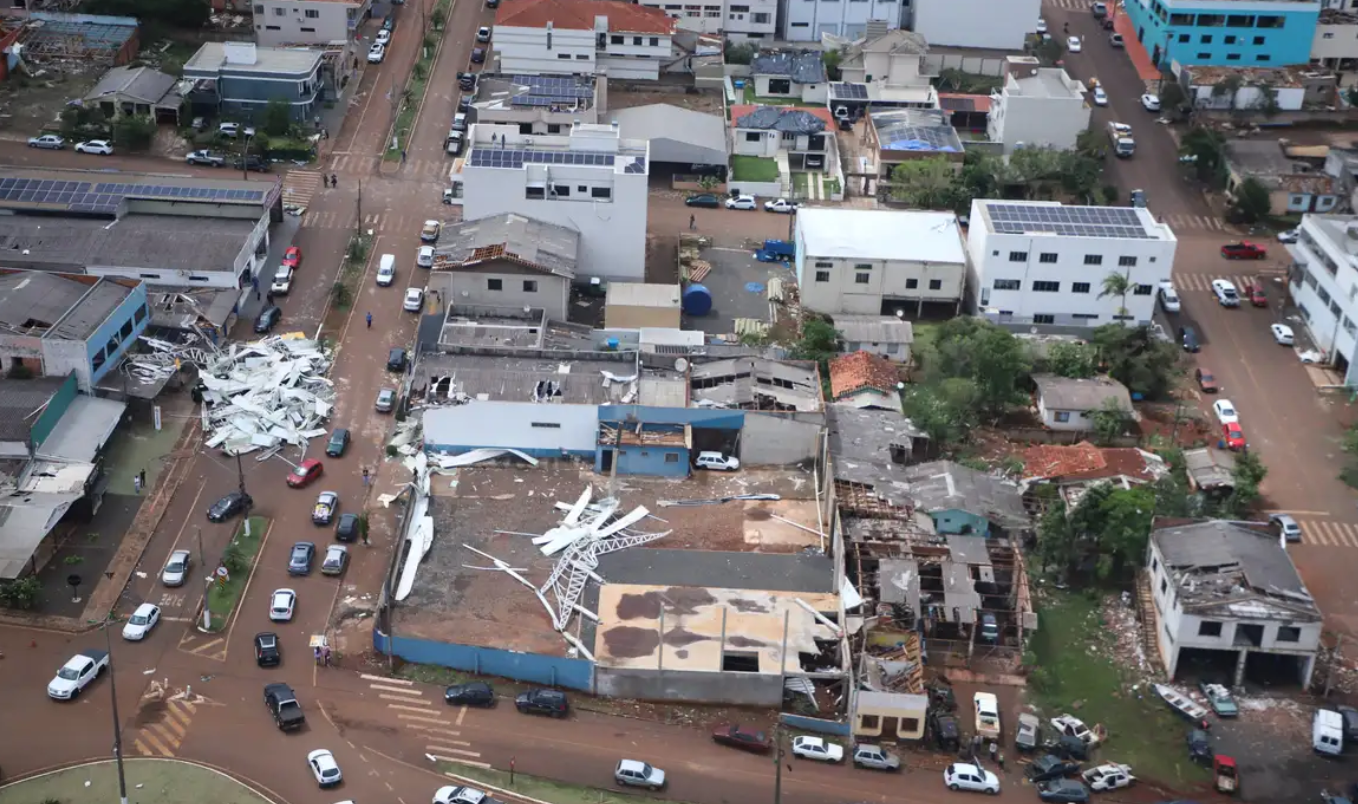
On November 7, 2025, a tornado nearly destroyed the city of Rio Bonito do Iguaçu, in southern Paraná, killing seven people. That same day, global leaders were meeting in Belém, in the state of Pará, at the Climate Summit, also known as the Leaders’ Summit, in preparatory meetings ahead of the 30th United Nations Climate Change Conference (COP30). Together, these two events illustrate the climate scenario of 2025.
While the world’s main climate conference ended with some achievements and many frustrations, extreme events in Brazil and across the globe leave no doubt that the climate crisis is already underway.
Climate does change, it is true. However, the phenomena we are experiencing now, intense and occurring within increasingly short time intervals, point to the severity of the moment. “Given that natural climate variability occurs over long intervals, when you see a high probability of extremely intense meteorological phenomena happening in a short period of time, that is what we call an extreme climate event,” explains Humberto Barbosa, founder of the Satellite Image Analysis and Processing Laboratory (Lapis) at the Federal University of Alagoas (Ufal).
For him and other experts who have studied climate variability for years, there is no doubt that the problem has intensified year after year. “Since the Paris Agreement in 2015, these events have become increasingly extreme due to rising temperatures and global warming,” Barbosa says.
At the Climate Summit, those already living with these changes issued urgent appeals, including presidents and ministers from island nations. “Rising sea levels, coastal erosion, flooding, destruction of basic infrastructure, and food insecurity are real, seriously affect our population, and undermine sustainable development and the future of current generations,” said Ilza Maria dos Santos Amado Vaz, Minister of Foreign Affairs, Cooperation and Communities of São Tomé and Príncipe, in Central Africa. “What is scientific theory for some is real life for us,” she added.
Some of these regions risk disappearing or losing parts of their territory due to rising sea levels. But one does not need to look far to feel the effects of the climate crisis. In Brazil, within a single year, the country faced multiple consequences of climate change.
The tornado that struck Paraná was just one more extreme climate event. Earlier, in July, 40 of the 62 municipalities in the state of Amazonas declared a state of emergency due to flooding that affected most of the state.
At the beginning of the year, storms between January and March flooded streets and a subway station in São Paulo. Strong winds damaged the power supply system, leaving thousands without electricity. At the end of the year, another windstorm once again plunged residents of Greater São Paulo into darkness.
These increasingly frequent events leave no doubt that rapid action is needed to limit global warming. However, the damage already done is irreversible: the planet is already warmer, Barbosa warns.
“We have already surpassed a 1.5°C anomaly in average global temperature since the pre-industrial era, which shows how much additional heat we are adding to the atmosphere. And that’s where extreme events come from,” the researcher explains.
To live with the climate crisis, it is essential for governments and society to develop adaptation measures to cope with an increasingly unstable climate. That is why COP debates focused on both climate adaptation targets and mitigation, in an attempt to prevent even more devastating consequences in the near future.
Acknowledging defeat
On that same November 7, the second day of the Climate Summit and the eve of COP30, President Luiz Inácio Lula da Silva acknowledged the global failure to curb planetary warming by stating that “the world is still far from achieving the goals of the Paris Agreement.”
In force since November 2016, the Paris Agreement is an international treaty adopted by 195 parties at the 21st United Nations Climate Change Conference (COP21) in Paris in 2015. The pact is based on the understanding that each country will do its best to prevent global temperatures from rising more than 1.5°C.
Despite the sobering message, COP30 in Belém ended without the desired results. Governments failed, for example, to reach a consensus on strategies to abandon fossil fuels.
“Currently, around 80% of global emissions come from the burning of fossil fuels. So we urgently need to move forward with this energy transition,” warns Anna Cárcamo, climate policy specialist at Greenpeace Brazil.
A few days before the conference ended, Lula expressed optimism about developing a document outlining a methodology for countries seeking a gradual transition from fossil fuels to cleaner, renewable energy sources, the so-called “roadmap.”
But at the final stage of the conference, when country representatives gather to make binding decisions, the proposal evaporated. Oil-dependent economies such as Saudi Arabia blocked the initiative, and the roadmap was excluded from the final text.
COP30 ended without strategies to end dependence on fossil fuels and fell short in proposals for adapting to the impacts of the climate crisis, such as flooding, extreme droughts, and windstorms.
At the beginning of the conference, a group of experts presented a list of 100 indicators for the Global Goal on Adaptation (GGA). By the end of the event, parties approved only 59 voluntary global indicators to measure countries’ progress.
“And many of them are not yet measurable. Over the next two years, methodologies and policies will be aligned so that we can actually track global progress on adaptation,” Cárcamo explains. These indicators cover areas such as food, health, ecosystems, infrastructure, and livelihoods.
According to Bárbara Loureiro, a national coordinator with Brazil’s Landless Workers’ Movement (MST), the conference concluded with a final document that was “fragile, lacking binding commitments, and incapable of addressing central issues such as fossil fuels.”
“So it is important to say that even ten years after the Paris Agreement, this COP positioned itself as a moment of celebration, but we asked: celebration of what? The world remains on a trajectory toward nearly three degrees of warming, while the measures needed to limit warming to 1.5°C remain blocked,” Loureiro warns.
The good news
Progress fell short of expectations, but some advances did appear in COP30’s final document. One was the mechanism to support countries in implementing just transitions. “That may have been the most significant positive outcome,” Cárcamo evaluates.
The final text does not specify how this mechanism will work but establishes a mandate for defining it. This would allow developing countries to receive financial, technical, and capacity-building support to implement low-carbon economic transitions. A timid but important step.
If proposals inside the Blue Zone fell short, outside of it popular movements and peoples of the land, forests, and waters came together to remind the world that their practices and knowledge point toward a healthier future.
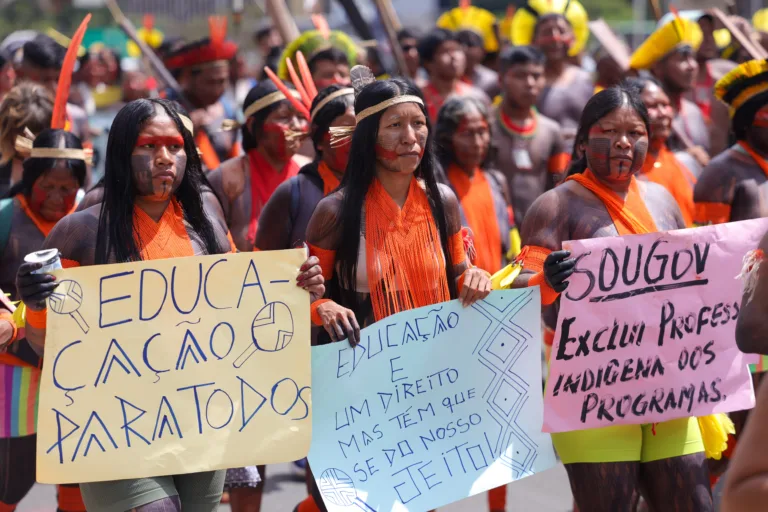
The first COP held in the Amazon became a landmark for popular participation. In the Blue Zone, where official negotiations take place, 400 Indigenous people from Brazil and 500 from other parts of the world were accredited to participate.
Including participation in other spaces such as the Green Zone, the People’s Summit, and the COP Village, more than 3,000 Indigenous people were present in Belém during the conference.
“For us, it was very important what we brought as the Indigenous movement of the Amazon Basin and the Brazilian Amazon, the idea that countries should view the demarcation and titling of Indigenous territories as climate policy,” celebrates Toya Manchineri, general coordinator of the Coordination of Indigenous Organizations of the Brazilian Amazon (Coiab).
During the conference, Minister of Indigenous Peoples Sônia Guajajara signed the ratification of four Indigenous lands and announced the demarcation of ten more territories. The land regulation package also included the titling of a total of four million hectares of quilombola territories.
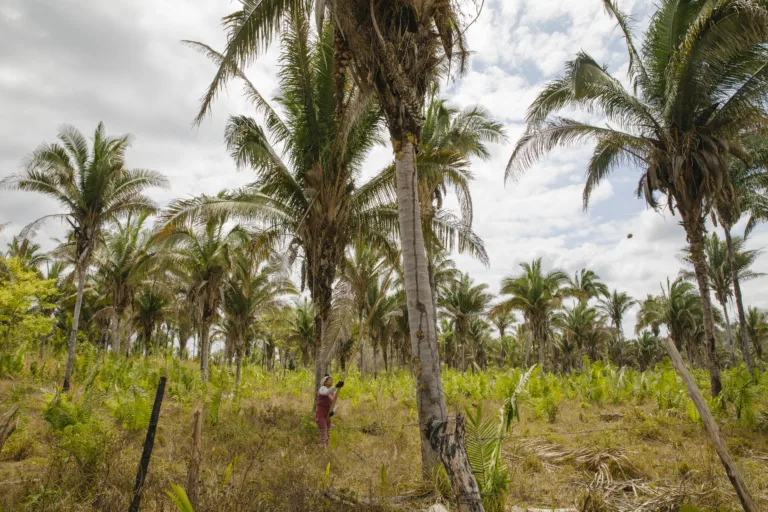
These are long-standing demands that gained urgency at the conference. Other traditional peoples, such as geraizeiros, river island communities, and babaçu coconut breakers, saw few concrete gains related to territorial protection but used the space to demand greater protagonism in climate debates.
“We’re not going to leave here with anything that will solve our lives,” said Samuel Caetano, a geraizeiro leader and president of the National Council of Traditional Peoples and Communities (CNPCT), in an interview with BdF during the conference. “But the fact that we came together, that we understand the processes being debated, that COP is a big business counter and that what’s being negotiated are our territories, I think that’s the greatest gain,” he concluded.