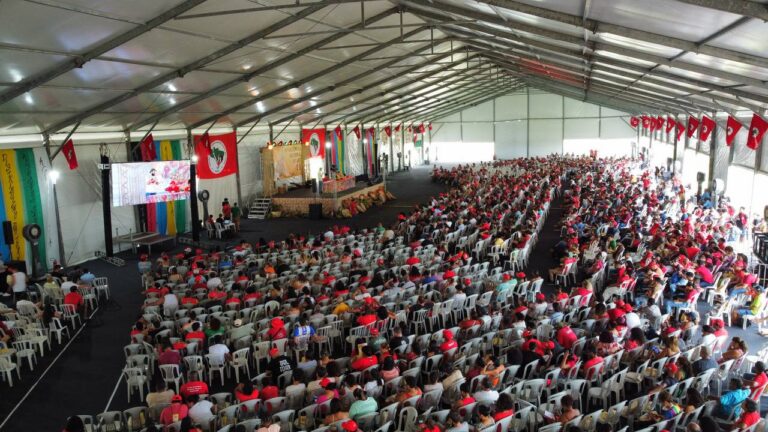
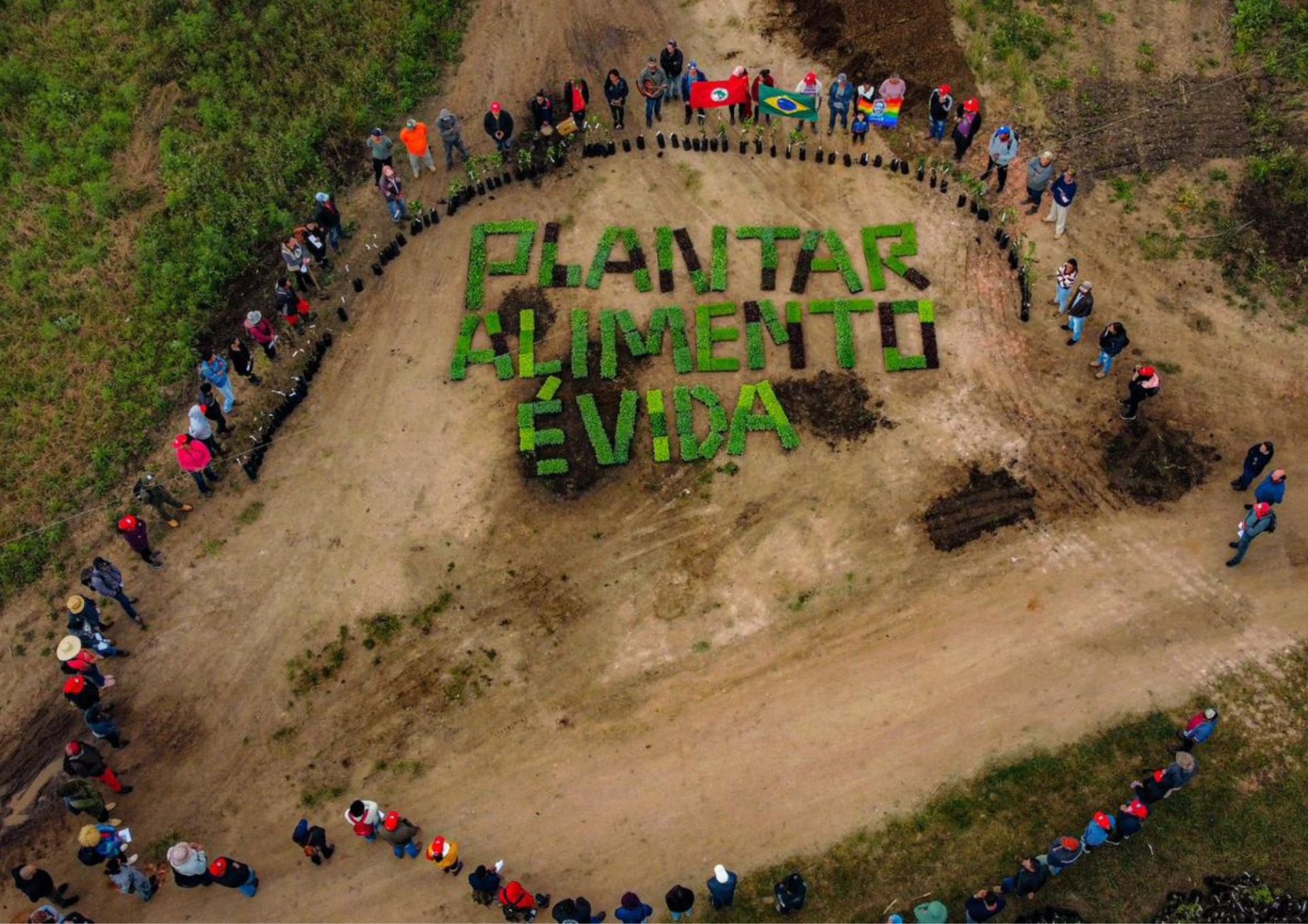
Since 2020, Brazil’s Landless Workers’ Movement (MST) has planted more than 45 million trees nationwide as part of its plan “Plant trees, produce healthy food.” The figures were presented during the movement’s 14th National Meeting, held between January 19 and 23 in Salvador, in northeastern Brazil.
One of the priority areas of the initiative is the Rio Doce basin, in the eastern part of the state of Minas Gerais, a region severely affected by the 2015 collapse of the Fundão tailings dam in Mariana, one of the largest mining disasters in the world. The dam failure released millions of cubic meters of toxic mining waste, contaminating rivers, destroying ecosystems, and undermining the livelihoods of hundreds of communities.
According to Fátima Vieira, a coordinator of the MST’s Popular Agroecology Program, the reforestation and agroecological work in the Rio Doce region aims to restore both the environment and the productive capacity of communities impacted by the disaster.
“Several agrarian reform settlements were directly affected. In the context of the reparation agreements signed after the crime committed by mining companies Vale, Samarco, and BHP, the movement stepped in to rebuild these territories through agroecology,” Vieira explained.
She notes that the initiative has transformed a production model previously centered on low-productivity cattle farming. Initially focused on subsistence through household gardens, settlements in the region have since developed orchards, diversified food production, and a fruit pulp processing agro-industry, generating income and food security for families.
The forest restoration project currently covers more than 2,000 hectares in the Rio Doce region and directly involves six agrarian reform settlements. Payments for environmental restoration services are carried out by the families themselves, linking ecological recovery with income generation.
“This is also a political struggle,” Vieira said. “The mining model continues to devastate territories. What we show here is that agrarian reform and agroecology are real alternatives.”
Beyond environmental recovery, the initiative has helped restore dignity and purpose to families affected by the Mariana disaster.
“People see water springs returning, birds coming back, life re-emerging. There is real joy in witnessing these changes in such a short time,” she added.
A long-term strategy
According to Camilo Santana, a national coordinator of the reforestation plan, the movement’s goal is to plant 100 million trees by 2030. But the initiative goes beyond reforestation.
“Our objective is to mobilize society around a popular environmental agenda — one that links ecological care with agrarian reform and food sovereignty. The solutions offered by corporations and financial institutions address economic crises while deepening environmental destruction,” he said.
Santana emphasized that the 45 million trees already planted respect native biomes and are spread across nearly all Brazilian states, contributing to the construction of a political culture centered on environmental care and healthy food production.
“There is no solution to the environmental crisis without confronting land concentration. Agrarian reform is central to protecting nature and ensuring social justice,” he concluded.