

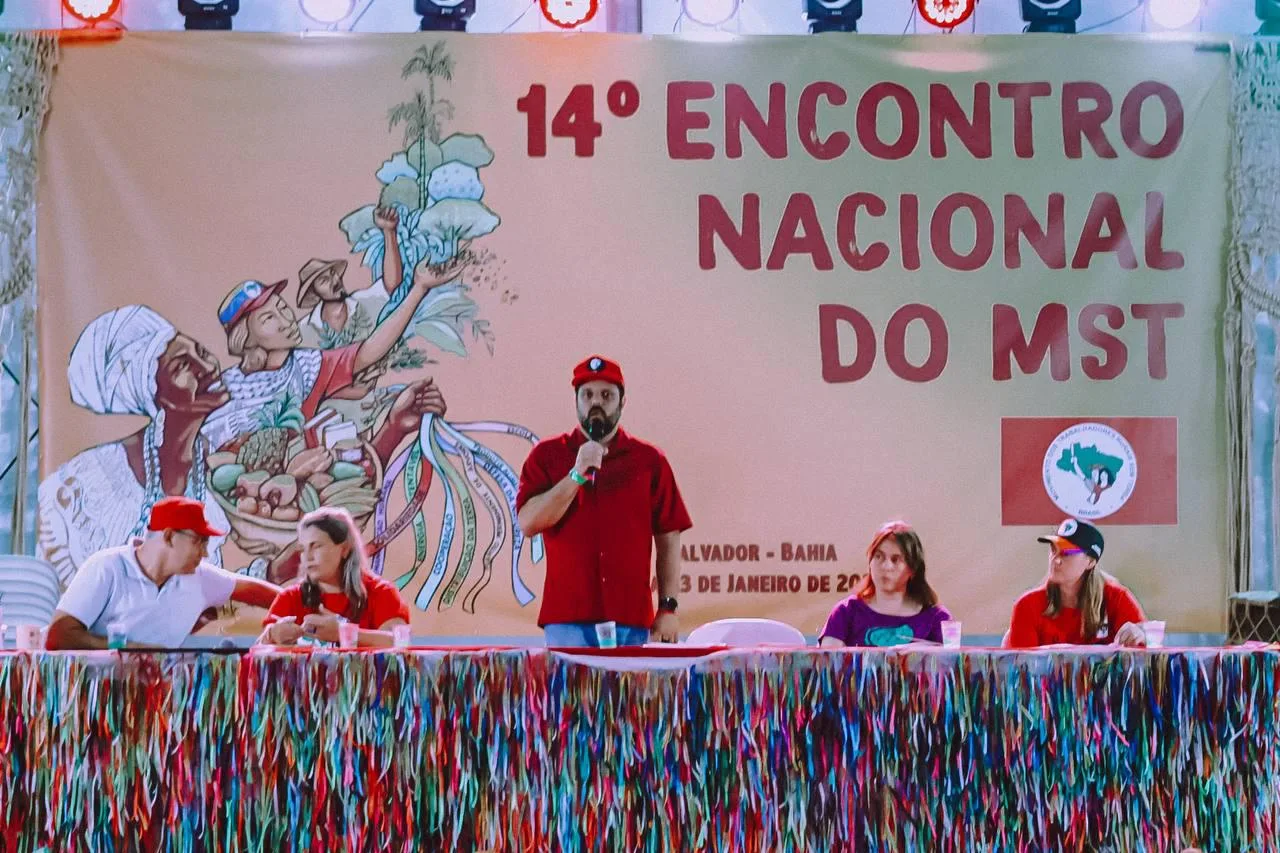
A new technological tool aims to transform agricultural production in Brazil by combining cutting-edge computing with the traditional knowledge of popular movements. The platform, called Iaraa, is an artificial intelligence system launched at the 14th National Meeting of the Landless Workers’ Movement (MST) in Salvador, Bahia.
The AI is being developed by the International Association for Popular Cooperation (Baobá) in partnership with the MST and the World March of Women (WMW).
According to Baobá’s Latin America coordinator, Luiz Zarref, Iaraa was created from the understanding that artificial intelligence is a development of humanity that should serve the working class and peasantry, not just the profits of U.S.-based big tech companies, which he says are closely linked to agribusiness.
Chinese technology with Brazilian DNA
Although Iaraa has what Zarref describes as a “drawing of Chinese technology,” its construction is essentially Brazilian. The partnership with China emerged from the possibility of exchange around what the Asian country calls a “new quality of productive forces,” seeking to apply this digital dynamism to the needs of agroecology in Brazil.
“Baobá’s role is to build international exchange, a technological internationalism among Global South countries. Because we have an office in China, we were able to connect with the effervescence of the digital world in Chinese society, based on the Chinese Communist Party’s definition that we are living in an era of a new quality of productive forces, one of which is artificial intelligence,” Zarref explained.
At its core, the AI is being trained on a robust knowledge base that includes books, manuals, and internal technical documents from popular movements, as well as materials produced by universities, NGOs, and research institutions. Future agreements are also expected to integrate data from public bodies such as Brazil’s Agricultural Research Corporation (Embrapa).
Features: from pest control to class consciousness
Iaraa goes beyond generic answers. It is being trained through prompt engineering to interact in specific ways with different audiences, such as settled families, technicians, and cooperative leaders. The tool will operate through three main entry points: direct field work (planting), collective work (mutirão), and technical assistance.
In practice, the AI can address everyday issues, such as controlling aphids or designing agroforestry systems, as well as produce in-depth studies on the role of agroecology in building class consciousness from a Marxist perspective.
The challenge of scaling up
The MST’s investment in this technology is part of its Popular Agrarian Reform strategy, which places agroecology at the center of producing healthy food for cities.
For Zarref, the main challenge today is scale. “Massification is scale. We have to move from pilot experiences to all productive chains and Brazilian biomes,” he said.
According to him, Iaraa is designed to help overcome “technological bottlenecks” by systematizing thousands of articles, experience reports, and theses produced by the MST at institutions such as the Technical Institute for Training and Research on Agrarian Reform (Iterra) and the Josué de Castro Educational Institute (IEJC), materials that would be impossible for a single person to read. The idea is for the AI to support technical assistance, not replace it.
Launch and next steps
Iaraa is currently in a testing and architectural design phase. The construction of its database will continue organically with the movements through May, when its official launch is scheduled to take place at the National Agrarian Reform Fair in São Paulo.
Initial access is expected to be free, via mobile phone or computer, though it may begin on a limited basis for cooperatives and associations due to technological infrastructure constraints. The ultimate goal is to consolidate the tool as a means of modernizing Brazil’s agroecological production strategy at scale.
