“We are not satisfied with the way agrarian reform is advancing, with the slowness, the delays, the lack of resources, and the pace at which new families are being settled.”
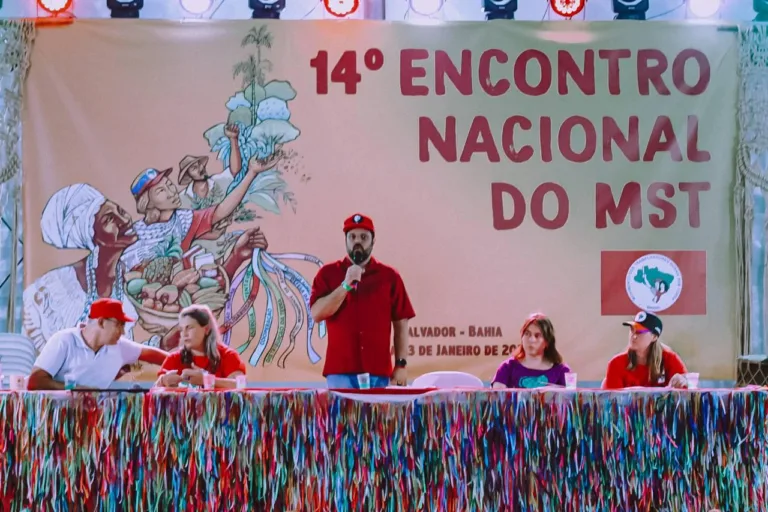
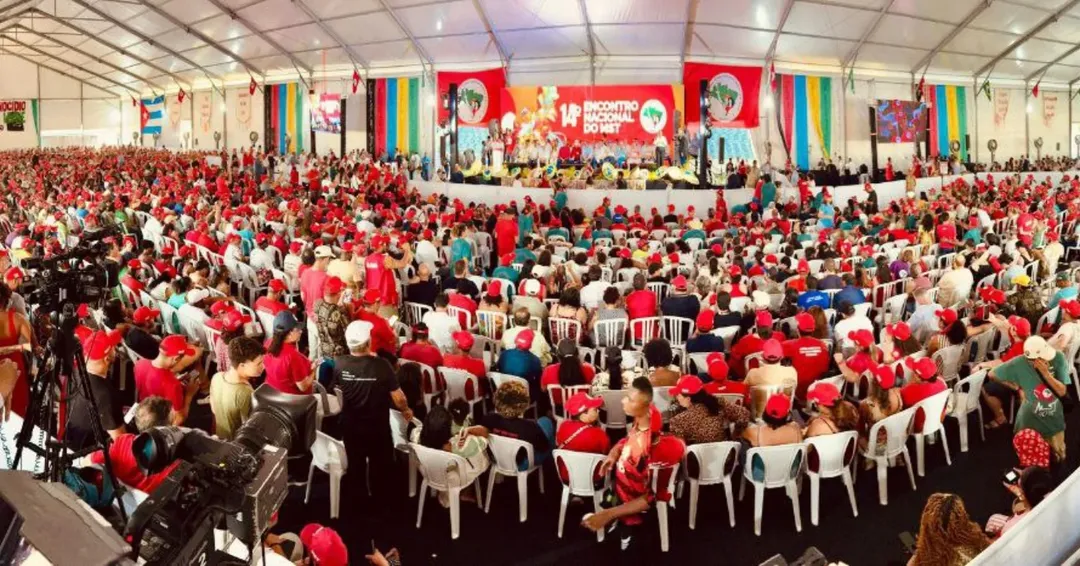
The assessment comes from Márcio Santos, a member of the national coordination of Brazil’s Landless Workers’ Movement (MST), and reflects the prevailing sentiment among grassroots activists and rural leaders gathered this week in Salvador, in the state of Bahia, for the movement’s 14th National Meeting.
The criticism emerges at the same moment the federal government is attempting to reposition its narrative on agrarian reform. Last Tuesday (20), Minister of Agrarian Development and Family Farming Paulo Teixeira stated that 2026 would concentrate the bulk of land expropriations during President Luiz Inácio Lula da Silva’s third term.
According to the minister, both budgetary and extra-budgetary resources have been secured, and 230,000 families have already been included in the agrarian reform program, with another 26,000 expected to be settled between February and March.
Despite these announcements, the figures remain far below the historical expectations surrounding Lula’s return to the presidency. In more than two years in office, only 385,000 hectares have been incorporated into the program, a performance well below that of Lula’s previous administrations, when roughly 47 million hectares were allocated to agrarian reform between 2003 and 2010.
In rural areas, the perception is that agrarian reform has returned to the institutional agenda, but without the political centrality required to confront Brazil’s deeply concentrated land ownership structure.
For Márcio Santos, the current scenario is shaped by an adverse national and international context marked by political polarization, the strength of the far right, and the government’s need to prioritize governability in a fragmented Congress hostile to working-class demands. Even so, he argues that the slow pace of settling landless families, many of whom have waited more than a decade for access to land, cannot be normalized.
The criticism is echoed by activists from different regions of the country. In southern Bahia, Douglas Rocha reports that there are ongoing processes to create new settlements, but at a pace deemed insufficient given the demand. “There are many disputes. Even with the state and federal governments on our side, the political context is not simple,” he says. According to Rocha, six areas in the region are in the process of being cleared, including the settlement where he lives, but progress depends on constant political negotiations and faces significant bureaucratic hurdles.
In northern Brazil, the assessment is even harsher. Jucilene Barbosa, an MST state leader in Pará, says the struggle for agrarian reform remains a structural dispute that transcends national borders. For her, confronting imperialism, land concentration, and historical forms of domination remains central to building popular sovereignty, especially in the Amazon. “We will continue fighting to carry out the agrarian reform we so deeply seek in all territories, to achieve a popular, just democracy and national sovereignty,” she says.
City councilor Marcela Menezes (Workers’ Party), from Ribeirão das Neves in the state of Minas Gerais, highlights the urban impacts of the absence of effective agrarian reform. According to her, the expulsion of rural workers from the countryside, without access to land or subsistence policies, fuels the disorderly growth of urban peripheries, deepening food insecurity, violence, and labor precarity. While acknowledging advances in policies to strengthen family farming, such as credit lines and institutional food procurement, she argues that land redistribution continues at a pace incompatible with the scale of the problem.
“There is a lot of idle land in Brazil, degraded by agribusiness. In the midst of the climate crisis, agrarian reform could help restore these degraded areas through agroforestry and agroecology, while distributing income and opportunities and preventing the violence our people face in urban environments,” she says.
However, any structural progress runs directly up against the balance of power in Brazil’s National Congress. Indigenous leader José Márcio, known as Jacarandá, from the Tupinambá people of Olivença in southern Bahia and a member of the Peoples’ Web (Teia dos Povos), argues that the strength of the agribusiness caucus and conservative sectors blocks the implementation of fundamental policies such as agrarian reform and the demarcation of Indigenous territories. According to him, even with a federal government aligned with popular demands, the lack of a parliamentary majority constrains key ministries and stalls essential decisions.
“It’s no use having Marina [Silva] as a minister if the agribusiness caucus won’t let her work. It’s no use having a Lula government if we don’t elect our own representatives [to Congress]. Many rural leaders have died in this struggle, so we need to rethink how we vote, because it is the agriculture of the people that puts food on the table in the cities,” he says.

Roseval Lino, an MST activist from the Araripe hinterlands in Pernambuco, agrees with this assessment. He recalls that the agribusiness caucus is one of the most influential blocs in Congress. For him, this helps explain why measures approved by the Executive Branch are frequently blocked or watered down in the Legislature, creating a permanent bottleneck for advancing agrarian reform.
“Today we’re not only fighting for the classic agrarian reform, the conquest of land itself, we also want to connect it to issues like education,” he argues, referring to the need to rebuild dismantled public policies such as the National Program for Education in Agrarian Reform (Pronera) and to strengthen family farming.
“Family farming is responsible for putting healthy food on Brazilian tables, yet it suffers from a lack of supportive public policies, while agribusiness delivers poison. Still, we must cultivate the utopia of a better world.”
In the state of Rondônia, Zonalia Neres says agrarian reform is practically at a standstill under Lula’s third administration. According to her, despite the resumption of some public policies, access to land has not advanced in concrete terms at the local level.
“Agrarian reform is stalled in my state, in my region, and across the country as a whole. The Lula government has strengthened some public policies, but when they reach us, they are often difficult to access,” she laments. Even so, Neres says Lula’s reelection in 2026 is seen as strategic given the risk of even greater setbacks, while stressing that real change will depend on intensified social struggle.
This combination of critical support and political pressure defines the MST’s current relationship with the federal government. Márcio Santos explains that the movement maintains political trust in the Executive Branch but rejects any logic of subordination or complacency. For him, agrarian reform must be understood as a joint task between the government and social movements.
Looking ahead, Márcio makes it clear that the next political cycle will require a different level of commitment. “We will not be satisfied if we do not advance on concrete demands of the Brazilian people, such as agrarian reform, reducing the workweek, ending the 6×1 work schedule, achieving real increases in the minimum wage, and other urgent issues,” he warns.
For the MST, Lula’s reelection is strategic for Brazil, Latin America, and the strengthening of multilateralism. Domestically, however, pressure will intensify, not only at negotiating tables, but also in the streets and through land occupations.
“We understand the constraints of the third term, but in a fourth term we will not accept them. Excuses will no longer be enough. We will demand much more forcefully from the next government that agrarian reform truly move forward in this country,” the national coordinator concludes.