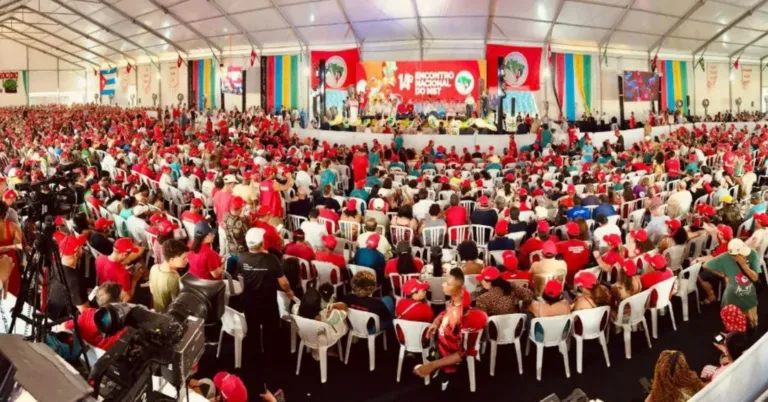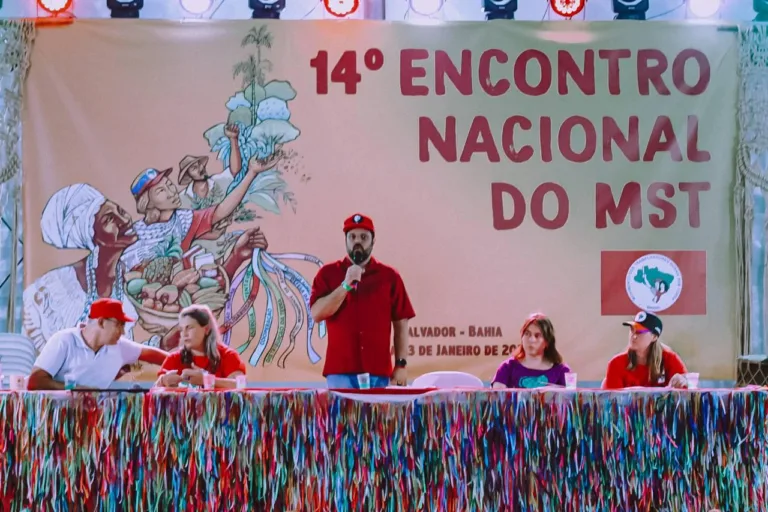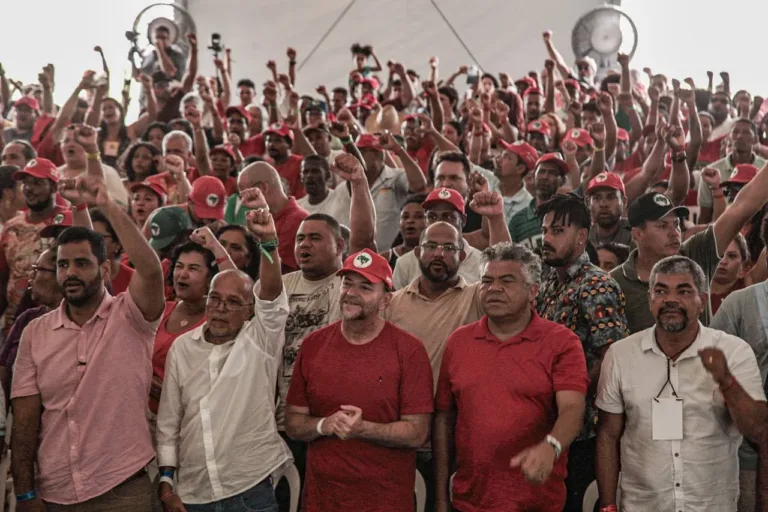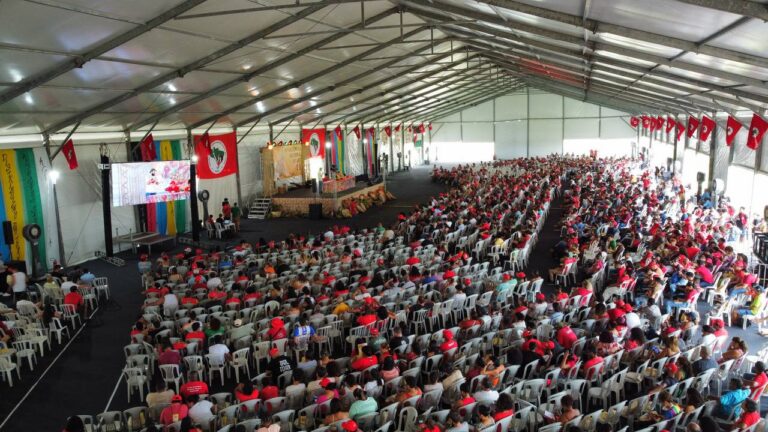
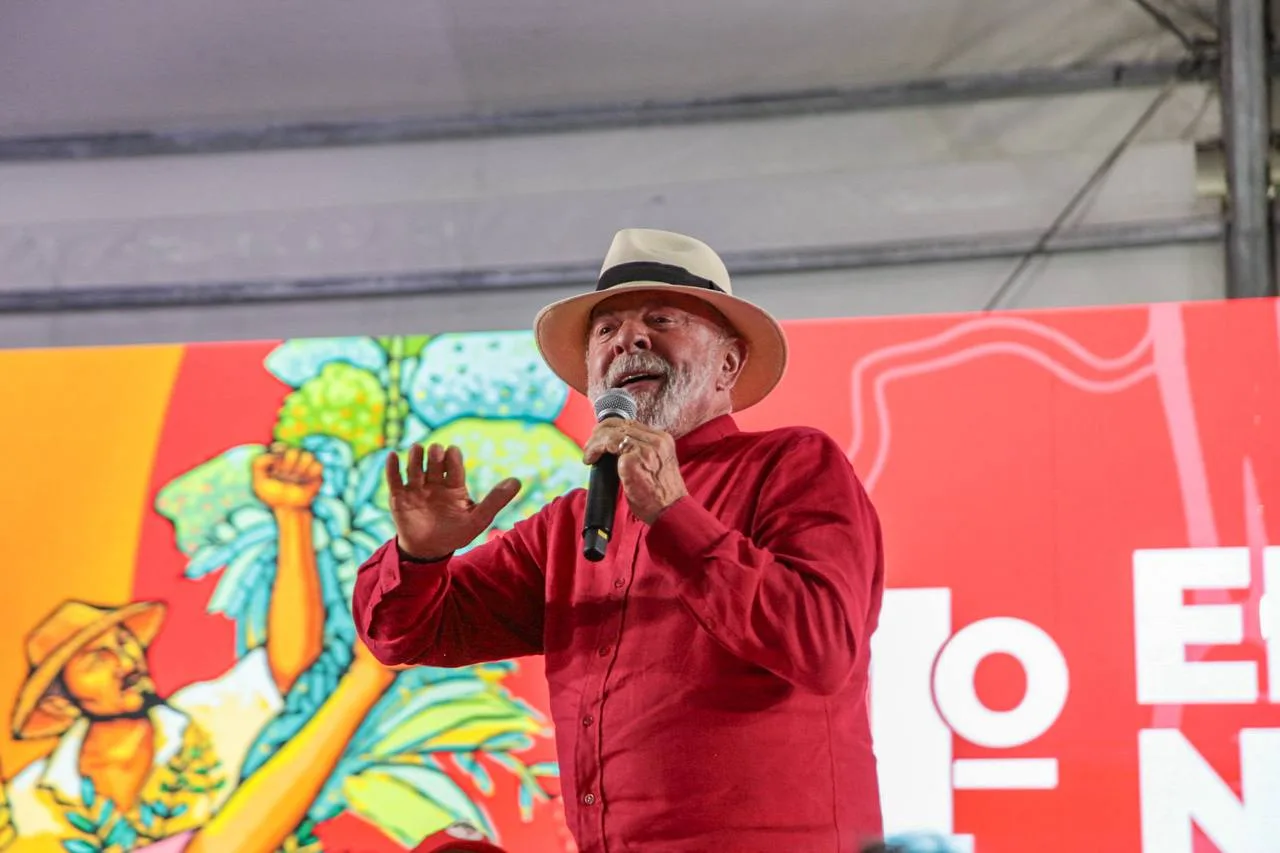
President Luiz Inácio Lula da Silva (Workers’ Party) took part last Friday (23) in the closing rally of the Landless Workers’ Movement’s (MST) 14th National Meeting, held in Salvador, in the northeastern state of Bahia.
In his speech, Lula condemned U.S. military aggression against Venezuela and denounced the kidnapping of President Nicolás Maduro and First Lady and National Assembly member Cilia Flores.
“I am outraged every night by what happened in Venezuela. I still can’t believe it. Maduro knew there were 15,000 U.S. soldiers in the Caribbean Sea. He knew there were threats every single day. And then they go into Venezuela at night, enter a fort, a military compound where Maduro lived, and take him away. And no one knew he was gone. How is it possible to show such disregard for a country’s territorial integrity? This does not exist in South America,” the president said.
Lula emphasized that South America has historically been a peaceful region. “We don’t have nuclear weapons, we don’t have atomic bombs. We have poor people who want to work, who want to live, who want to eat, have lunch and dinner, study. We don’t want war. What we have to show the world is our character and our dignity,” he stated.
“We may not have weapons, but we have character and dignity, and we will not bow our heads to anyone, whoever they may be,” Lula added, also referencing the rise of the far right in several Latin American countries.
“Are you following what’s happening in Latin America? What happened in Chile, in Argentina, in Venezuela, in Paraguay, in Ecuador? You are watching what’s happening in Costa Rica, Honduras, and what’s happening in the world with the election of President Trump in the United States. We are living through a very critical moment in global politics,” Lula warned.
Still addressing international geopolitics, Lula criticized plans by the U.S. government and the Israeli regime for the Gaza Strip following the destruction carried out by Israel.
“We don’t want another Cold War. We don’t want another Gaza. Have you seen the photo of what they plan to do in Gaza? A resort. They destroyed everything, killed more than 70,000 people, and now they say, ‘We’ll rebuild Gaza and turn it into luxury hotels.’ And where will the people who died and the poor people who survived live?” Lula asked. He also said that U.S. President Donald Trump proposes to “create a new UN” under his control.
“Multilateralism is being replaced by unilateralism, and the rule of the strongest is prevailing,” Lula said.
Long live the MST
The president thanked the MST for its 42 years of existence. “Landless comrades, thank you for existing. Without this movement, Brazil likely would not be where it is today. I am grateful to those who had the courage to fight. As my mother used to say, we must insist. Because no one gives us anything for free; either we conquer our rights, or we have nothing,” he said.
Lula echoed the MST’s criticism of agribusiness. “When we criticize agribusiness, 90% of the criticism is justified. But we must show that small and medium farmers are the ones who produce the food that reaches our tables and who fight against pesticides. Agribusiness produces for export; small farmers produce food for us to eat,” he said.
At the same time, the president welcomed the MST’s initiative to launch candidates for state and federal legislatures.
“I was very happy today when you introduced me to a group of comrades from the MST who will be candidates in the next elections. Thank God you decided to enter politics. Do you know the tragedy of those who dislike politics? They are governed by those who like it. And if those who like politics don’t like us, the changes we want will never happen,” Lula said.
The president concluded his speech with a call to combat gender-based violence. “During this campaign, and I will say this loud and clear, any man who raises his hand to strike a woman does not need to vote for me. That vote would be cursed if I accepted it,” he stated.
Lula was accompanied by ministers Guilherme Boulos (Secretary-General of the Presidency), Paulo Teixeira (Agrarian Development), Sidônio Palmeira (Social Communication), Gleisi Hoffmann (Institutional Relations), and Márcia Lopes (Women), as well as Bahia Governor Jerônimo Rodrigues (PT).
MST letter to the Brazilian people
Before authorities, Pernambuco state lawmaker Rosa Amorim (PT) and MST national leader Márcio Santos read a letter addressed to President Lula and the Brazilian people condemning U.S. military aggression against Venezuela and the kidnapping of President Nicolás Maduro and First Lady and National Assembly member Cilia Flores.
“We are living through a turning point in history, marked by wars and the advance of imperialism in our continent. The aggression against Venezuela, with the kidnapping of President Nicolás Maduro and lawmaker Cilia Flores, was an atrocious message to the peoples of the world, especially in Latin America,” the letter states.
According to the document, the interests behind such actions include the plundering of common natural goods such as oil, minerals, rare earths, water, and forests, as well as attempts to block the advance of multilateralism and popular sovereignty. The letter also references the Zionist offensive against the Palestinian people, coup attempts in Sahel countries, particularly Burkina Faso, and repeated efforts to destabilize countries such as Cuba, Haiti, Colombia, Mexico, and Iran.
The document also criticizes the agribusiness-based development model, described as “an arm of national and international capital in rural areas.” “As the hegemonic agricultural model, agribusiness is based on commodities for the market, the destruction and appropriation of common natural goods, and the intensive use of pesticides that contaminate soil, water, and air, putting the guarantee of a healthy life at risk,” the text says.
The movement then criticizes the “blockage” of agrarian reform in Brazil. “Agrarian reform, as a strategic national project, is blocked by the Brazilian bourgeoisie and by the advance of the agribusiness model in rural areas, which controls most of the National Congress, the media, and the judiciary. As a result, we have achieved few effective, large-scale public policies capable of confronting rural poverty and improving people’s lives. This is reflected in the fact that more than 100,000 families remain living in encampments across Brazil,” the letter states.
“This blockage runs counter to building a national project, since popular agrarian reform represents a challenge to the hegemonic agribusiness model and offers a path to overcoming the civilizational crisis and environmental collapse we are experiencing,” the document continues. It argues that agribusiness draws its strength from “a destructive project of death and violence,” subsidized by the Brazilian state through tax breaks, credit lines, debt forgiveness, and the weakening of environmental and land legislation by Congress, which the text describes as “an enemy of the people and of nature.”
“This hegemony makes it difficult to carry out a popular agrarian reform capable of confronting land concentration and ensuring the production of healthy food for Brazilian society as a whole,” the letter adds, while reaffirming the MST’s support for Lula’s candidacy and for state governments committed to the movement’s popular agrarian reform agenda.
Announcements: better late than never
After facing harsh criticism from the MST over the slow pace of agrarian reform in recent years, Minister Paulo Teixeira made a series of announcements during his speech at the closing rally.
“For President Lula, agrarian reform is land, but it is also development, food production, agroecology, cooperatives, mechanization, and support for getting family farming products to market. The more agrarian reform we have, the less hunger and inequality we will have in this country. That is President Lula’s goal,” the minister said.
The announcements include land purchases, the creation of new settlements, and the release of financial resources, totaling 113,700 hectares (around 281,000 acres) of land, expected to benefit 5,268 families in different states.
In Bahia, the Pombo Roxo Farm, in Alcobaça, will serve 173 families on 3,400 hectares, with an investment of R$ 39.3 million (approximately US$ 7.9 million). In Maranhão, the Salgador Farm, in Presidente Vargas, will benefit 655 families across 26,500 hectares, costing R$ 18.7 million (about US$ 3.7 million). In Sergipe, the Boas Novas 1 and 2 Farm, in Salgado, will serve 12 families on 120 hectares for R$ 3.2 million (around US$ 640,000).
Through a judicial agreement involving the Pinhal Ralo and Ninho das Cobras land parcels in Quedas do Iguaçu, Paraná, an investment of R$ 584 million (approximately US$ 117 million) was announced. The agreement with Araupel will settle 1,900 families on 32,300 hectares.
In Minas Gerais, the Nova Alegria Farm, in Felisburgo, includes 1,100 hectares for 37 families, with an investment of R$ 13.5 million (around US$ 2.7 million). In São Paulo state, the Três Irmãos Farm, in Palmeira d’Oeste, cost R$ 29 million (about US$ 5.8 million) for 47 families on 506 hectares. Also in São Paulo, the Santa Fé Farm, in Gália and Ubirajara, will benefit 17 families on 404 hectares for R$ 2.8 million (around US$ 560,000), while the Caximba Farm, in Apiaí, will serve 25 families on 76 hectares with an investment of R$ 4 million (approximately US$ 800,000).
In Mato Grosso, the Santa Cecília 1 and 2 Farms, in Nova Olímpia, will serve 123 families on 2,300 hectares for R$ 24.3 million (about US$ 4.9 million). In Rio Grande do Sul, the Vitória das Missões Cesa Nursery, in Vitória das Missões, will be allocated to seven families on 121 hectares for R$ 2.5 million (around US$ 500,000).
In Pará, ordinances were signed to create several settlements. The Dina Teixeira I settlement, on the Santa Marta Farm in Água Azul do Norte, includes 1,500 hectares for 63 families on public land under a technical cooperation agreement with Vale. The União settlement, in Ourilândia do Norte, also under the Vale agreement, will benefit 240 families on 8,800 hectares.
In Eldorado do Carajás, the Dalcídio Jurandir settlement was created on the Maria Bonita property through a purchase, with an investment of R$ 80 million (approximately US$ 16 million) for 232 families on 6,700 hectares. The Jair and Aguinaldo settlement, on the Gaúcha Farm in Bom Jesus do Tocantins, will accommodate 472 families on 14,800 hectares of public land. In Conceição do Araguaia, the Sertão Bonito settlement will serve 38 families on 1,400 hectares of public land.
Also in Pará, the Santa Lúcia Farm, in Pau d’Arco, became the Jane Júlia settlement, covering 5,600 hectares for 192 families. The area is marked by a history of conflict, having been the site of the last major massacre of rural workers, when ten people were killed by military police during an eviction operation in 2017. Additional settlements were confirmed: Céu e Mar, serving 42 families in Conceição do Araguaia, and Nova Canaã, benefiting 109 families in Rondon do Pará.
In other states, the Elizabeth Teixeira settlement, in Sobrado, Paraíba, received R$ 8.2 million (around US$ 1.6 million) for 25 families on 133 hectares. In Goiás, the Dom Tomás Balduino settlement, on the Crixás Farm in Formosa, will serve 330 families on 3,100 hectares. Finally, in Maruim, Sergipe, the Z-17 Fishing Territory was allocated to 529 families on 522 hectares.
The minister also highlighted investments in infrastructure and production support, including an agreement with Caixa Econômica Federal worth R$ 1 billion (approximately US$ 200 million) to build 10,000 homes in settlements, the release of R$ 717 million (around US$ 143 million) benefiting 60,000 families, and an agreement for the economic and agroecological recovery of settlements in the Rio Doce region, totaling nearly R$ 89 million (about US$ 18 million).
Beyond physical and financial assets, announcements were also made regarding the restructuring of public policies, such as hiring 700 new staff members, creating two new departments focused on land acquisition and quilombola communities, resuming and reformulating the National Program for Strengthening Family Farming (Pronaf), the Food Acquisition Program (PAA), the public food stock program, and correcting the National Program for Education in Agrarian Reform (Pronera) to enable the first medical degree course offered through the program.
The minister also indicated that additional deliveries and agreements are being negotiated for April.
National Meeting
Over five days of activities, the meeting sought to assess and refine the movement’s political guidelines, review and implement the Popular Agrarian Reform program defined at the MST’s last congress in 2014 in Brasília, evaluate organizational structures and strategic challenges, and discuss the defining elements of the current political situation. The gathering also outlined the organization’s actions for the coming period, including political engagement during this year’s elections.
During the meeting, the MST announced the pre-launch of 18 candidates for federal and state legislatures in the upcoming elections.