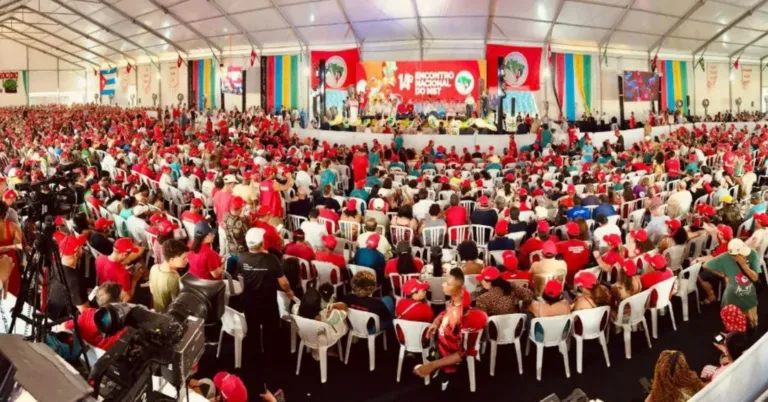

Brazil’s federal government has signed seven decrees authorizing the expropriation of unproductive farmland to advance agrarian reform, enforcing the constitutional principle that land must fulfill a social function. The areas had been occupied by the Landless Workers’ Movement (MST) as part of long-standing demands for land redistribution.
The measures were signed by President Luiz Inácio Lula da Silva shortly after the MST’s national meeting, where the movement urged the government to accelerate agrarian reform policies. During the event, Lula signaled that expropriations of idle land would move forward.
Under the decrees, the land will be allocated to settle hundreds of landless families through Brazil’s agrarian reform program. The federal government will compensate landowners, unless investigations find evidence of irregularities or crimes linked to the properties. Brazil’s National Institute for Colonization and Agrarian Reform (Incra) will be responsible for assessing the properties to determine whether irregularities or crimes occurred.
The decrees signed by Lula are part of a broader expropriation package relaunched in March last year, aimed at enforcing the Land Statute, a 1964 law that regulates land use, ownership and the social function of rural property. Under the statute, agrarian reform is defined as a “set of actions” intended to promote fairer land distribution through changes in land tenure and use, in line with principles of social justice and increased productivity.
Under the agrarian reform policy revived by the Workers’ Party (PT), the objective has been to assign a social function to unproductive lands occupied by movements advocating land reform and denouncing underuse.
Ceres Hadich, a member of the MST’s national leadership, said that even though the expropriated areas are relatively small, they carry strong symbolic weight as part of a historic struggle for agrarian reform.
“It is very symbolic because it represents a dignified form of expropriation and the creation of new settlements,” Hadich told BdF. “More than that, this package, even if limited, includes areas that are emblematic for the struggle. It strengthens our hope not only for the resumption of large-scale expropriations, but also for the strengthening of other mechanisms of agrarian reform, so that we can reduce the significant backlog of landless families living in encampments across the country.”
Popular movements have pressed the Lula government to advance agrarian reform policies, which is in Brazil’s Constitution for unproductive lands or properties linked to criminal activity.