

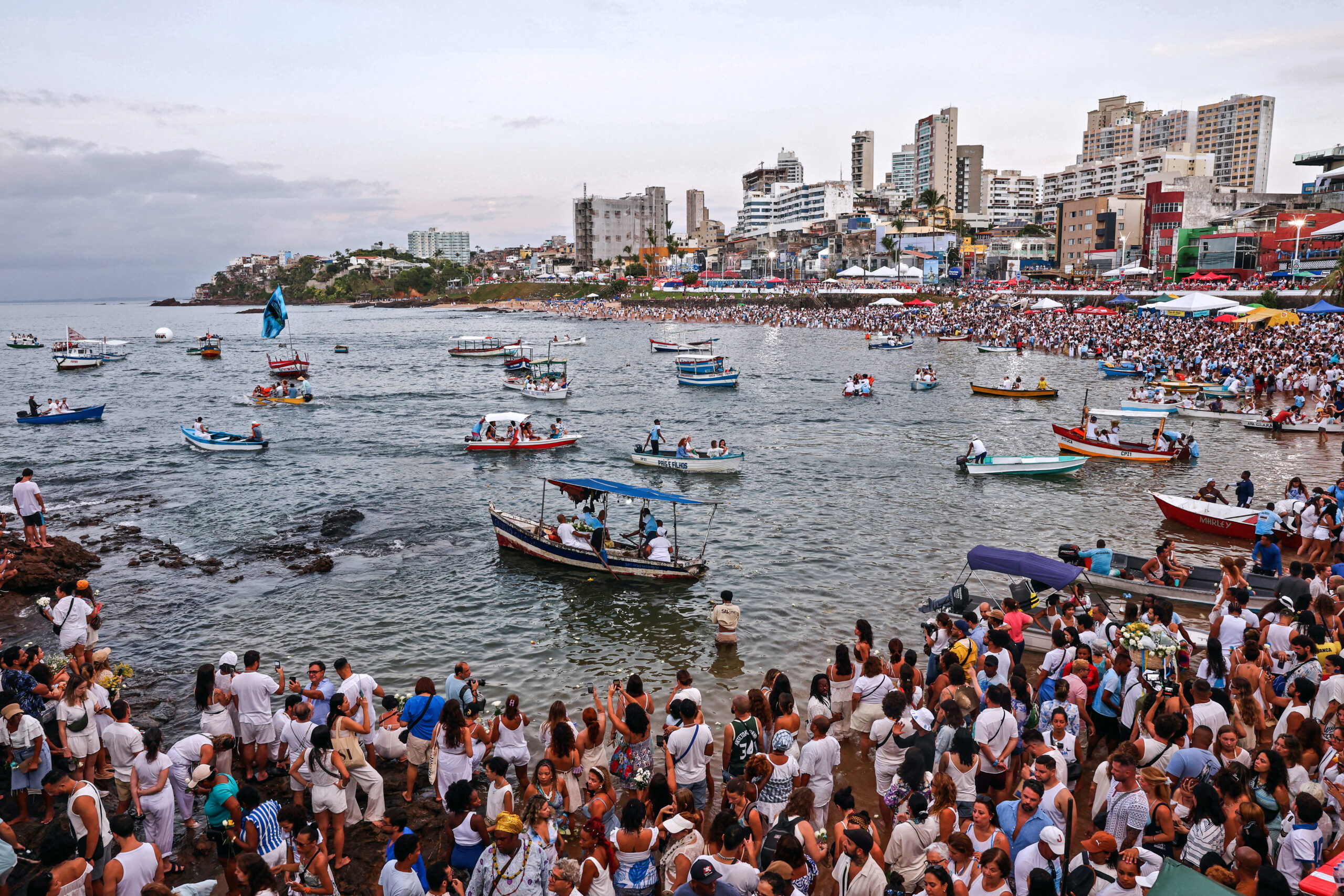
Celebrated across several Brazilian cities on Monday (2), Iemanjá Day marks acts of devotion to the orixá of the waters and the sea, as well as mobilizations against religious racism and in defense of the right to practice Afro-Brazilian religions.
In Salvador, the traditional Iemanjá festival was officially listed as Cultural Heritage in 2020 by the Gregório de Mattos Foundation (FGM). The celebration has taken place in the Rio Vermelho neighborhood since 1924. This year, the largest Iemanjá celebration in Brazil began last Sunday night (1), with the offering to Oxum, the orixá of fresh waters, at the Dique do Tororó lagoon.
Tradition holds that the mother of fresh waters must be honored before the mother of salted waters. “All fresh waters eventually flow into the sea. That’s why we say it is necessary to sweeten the heart before salting the feet,” explained Leonel Monteiro, president of the Brazilian Association for the Preservation of Afro-Amerindian Culture (Afa), in an interview with Correio 24 Horas. “First, we bring offerings to Oxum, and only then do we go to the sea to honor Iemanjá.”
The official tributes to Iemanjá began early Monday morning, with fishermen delivering the main offering to the sea. Around 5 a.m., the ceremonial gift arrived at the Fishermen’s Colony headquarters on Santana Beach. At 4 p.m., it was taken to the Loca de Iaiá, about three nautical miles offshore, with support from the Bahia Harbor Master’s Office. Throughout the day, worshippers and visitors were able to place additional offerings alongside the main tribute.
For the second consecutive year, the preparation of the offering was led by Mãe Nicinha de Nanã, from the Olufanjá terreiro (the sacred space, temple, or house where rituals for Afro-Brazilian religions are held). According to Elias Conceição, an ogan (ritual assistant) of the house, the process includes asking permission from Oxalá, the guiding orixá of the terreiro, as well as ritual baths and consultations with the orixás to ensure protection for those involved in the celebration.
The ritual is carried out in partnership with local fishermen, who accompany members of the terreiro to the moment the offering is delivered at sea. “There is harmony between the terreiros and the fishermen. We go out on the boats with them, we stay at the ceremonial space, because the offering must follow the ritual practices of the terreiro,” Conceição told the news agency g1.
Iemanjá, ‘the most Brazilian orixá’
In an interview with Radio BdF, journalist and religious studies specialist Claudia Alexandre described Iemanjá as a central figure in Afro-Brazilian religions. She explained that the deity was also associated with Catholic figures through religious syncretism like Our Lady, a process shaped by centuries of persecution against Afro-Brazilian faiths.
“Today, beyond honoring the great queen of the sea, many people, even those who do not attend Catholic churches or terreiros, feel a strong connection to this symbolism, which is deeply Brazilian,” Alexandre said. “Iemanjá is the most Brazilian orixá we have today.”
Alexandre recalled that devotion to Iemanjá in Rio Vermelho began after fish disappeared from an area once known for abundant fishing, leading local fishermen to seek spiritual protection.
“One of them made a promise and, when he went out to fish, found an image, not originally of Iemanjá, but of Our Lady, which became associated with her through syncretism,” she explained. “After that, fishing became abundant again. Coincidence does not exist; there was a spiritual dimension at work, blessing the fishermen. Since then, every February 2, they organize this celebration. The first boats to go out to sea that morning carry offerings to Iemanjá.”
Despite its cultural and religious significance and its nearly century-long history, Iemanjá Day is not a national public holiday in Brazil.
