

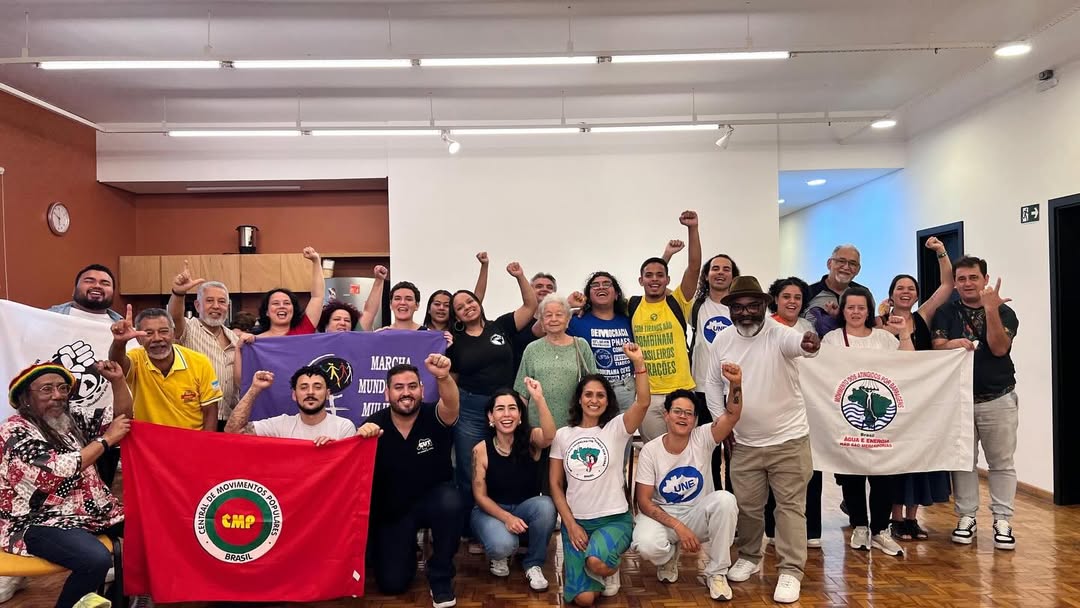
A national assembly bringing together major grassroots movements, trade unions and left-wing organizations met Wednesday (4) in São Paulo to define a joint calendar of mobilizations for 2026 and assess Brazil’s current political landscape. The event was organized by the national coordination of Frente Brasil Popular (Popular Brazil Front), a coalition of progressive movements.
Participants included representatives from labor federations, political organizations and social movements such as the Unified Workers’ Central (CUT), the Brazilian Workers’ Central (CTB), the Landless Rural Workers’ Movement (MST), the Movement of People Affected by Dams (MAB), the Socialist Youth Union (UJS) and the National Students’ Union (UNE), among others.
“We are discussing the end of the 6×1 work schedule and reducing working hours, defending national sovereignty, taxing the wealthy and implementing zero-fare public transportation. These are priority demands that must be raised through strong street mobilization this year,” said Juliana Donato, a representative of Frente Brasil Popular. She emphasized the need to build political organizing tools capable of engaging working-class communities in workplaces, educational institutions and neighborhoods.
The meeting highlighted a unified calendar focused on defending workers’ rights, combating violence and feminicide, and reinforcing democratic institutions in Brazil. Judite Santos, an MST leader, stressed the importance of strengthening mobilizations against gender-based violence and integrating the climate emergency into political organizing. “We need to deepen this debate and build broader mobilizations around the environmental crisis,” she said.
Activists also called for greater international solidarity with Cuba, criticizing the intensification of the U.S. economic blockade and urging the Brazilian government to adopt a clearer position. Participants raised concerns about what they described as genocide in Palestine and denounced U.S. actions in Venezuela, as well as threats of further escalation in the region.
Priority demands and political agenda
According to Frente Brasil Popular, 2026 presents major challenges for Brazil’s left as the country approaches elections later this year. The coalition sees itself as a key platform for organizing working-class struggles and building unity among popular and progressive forces.
In education, UNE representative Pedro Lucas Soares highlighted a proposed internship law aimed at strengthening labor protections, as well as demands to restore funding for public universities and confront rising tuition costs at private institutions. “Education must serve national development and address real social problems, rather than becoming merely a profit-driven sector,” he said.
Labor leaders also pointed to debates in Congress over regulating app-based delivery workers, while celebrating recent tax changes exempting workers earning up to 5,000 reais from income tax deductions. Housing activists from the Homeless Workers’ Movement (MTST) stressed the need to maintain social housing programs such as Minha Casa Minha Vida and combat real estate speculation.
Mobilization calendar for early 2026
The coalition’s mobilization calendar begins in February with actions focused on tax justice, followed by electoral assemblies in São Paulo and Minas Gerais. March will include international solidarity actions with Venezuela, nationwide demonstrations on International Women’s Day, and school strike mobilizations.
April’s agenda highlights memory actions marking the dictatorship period, World Health Day, and a large union and education march in Brasília, alongside MST’s “Red April” mobilizations. May centers on International Workers’ Day, while June emphasizes environmental actions such as tree-planting initiatives. July will mark Latin American and Caribbean Black Women’s Day, opening the path toward the official electoral calendar.
