
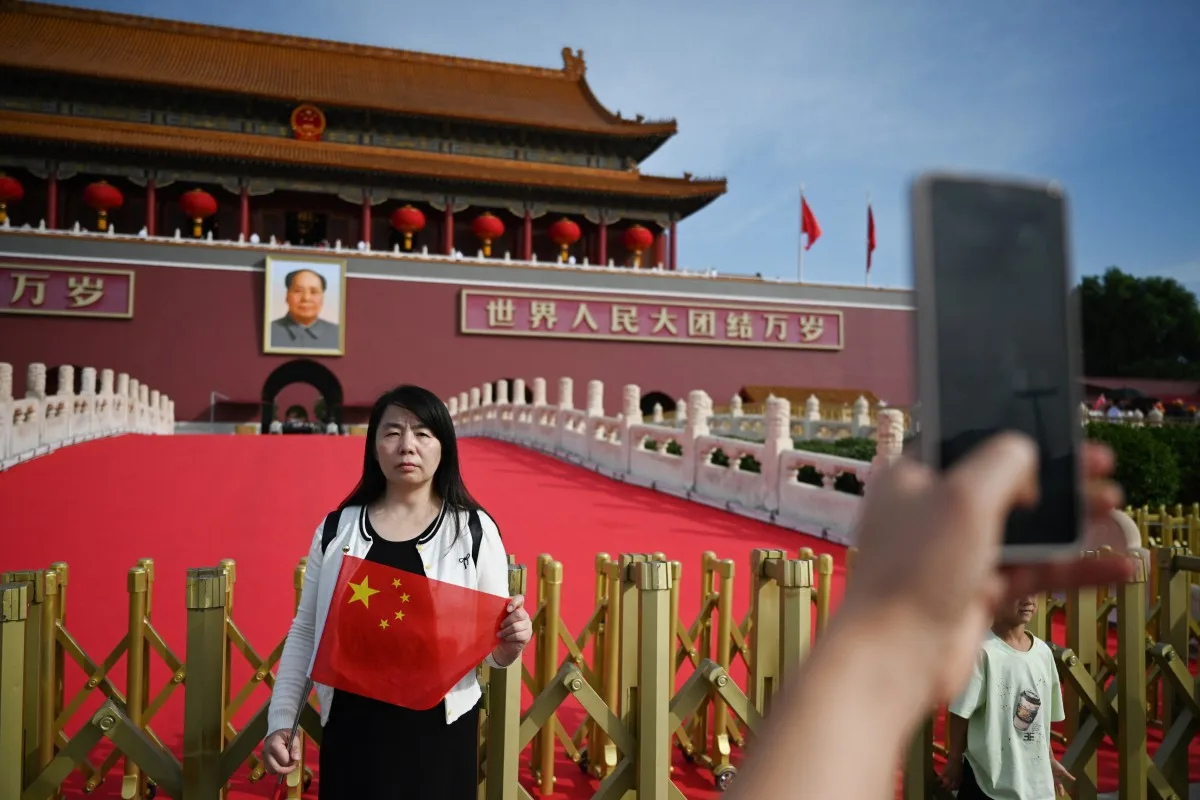
The People’s Republic of China marked its 76th anniversary on Wednesday (01), coinciding with the conclusion of its 14th Five-Year Plan, the first development cycle since achieving the “First Centenary Goal” in 2021. For decades, these plans have served as the Communist Party of China’s main tool to guide the country’s social and economic trajectory.
At an official reception in the Great Hall of the People, President Xi Jinping announced that the 20th CPC Central Committee will hold its fourth plenary session in November to draft the 15th Five-Year Plan (2026–2030). The new plan aims for “decisive progress” toward achieving basic socialist modernization by 2035, seen as a milestone on the way to the “Second Centenary Goal” in 2049. Xi highlighted advances since early 2025 in deepening reforms, promoting high-quality development, and improving people’s livelihoods.
The event brought together around 800 Chinese and foreign guests, including Premier Li Qiang, who chaired the reception, alongside senior leaders Zhao Leji, Wang Huning, Cai Qi, Ding Xuexiang, Li Xi, and Han Zheng. Xi reiterated Beijing’s commitment to the “One Country, Two Systems” framework in Hong Kong and Macao, and pledged to expand exchanges with Taiwan while opposing separatism and foreign interference.
The timeline of the “Two Centenary Goals”
First introduced at the CPC’s 18th National Congress in 2012, the concept of “Two Centenary Goals” sets long-term benchmarks. The first goal was reached in 2021 with the creation of a “moderately prosperous society,” which included the eradication of extreme poverty. The second, to be achieved by 2049, the centenary of the People’s Republic, aims to establish China as a modern, prosperous socialist country.
Key milestones include: modernization of the People’s Liberation Army by 2027, implementation of 300 reform measures by 2029, and the attainment of basic socialist modernization by 2035.
Quality over growth in the 14th Five-Year Plan
The outgoing 14th Five-Year Plan was unprecedented in that it dropped a numeric GDP growth target, instead prioritizing green transition, technological self-reliance, and “common prosperity.”
Official data show that more than 6.9 million people at risk of falling back into poverty were identified and assisted. Efforts focused on the “three guarantees”: compulsory education, basic medical care, and safe housing.
“From the Chinese perspective, when we look back, we see thousands of years of continuity. And when we look forward, we always think beyond today or tomorrow,” explained Gao Zhikai, vice-president of the Center for China and Globalization.
Rural revitalization as the foundation
Rural revitalization remains at the heart of China’s development model. Du Taisheng, vice-president of China Agricultural University, told BdF that “only when the problems of farmers are resolved can agricultural modernization and modernization of the entire country be achieved.”
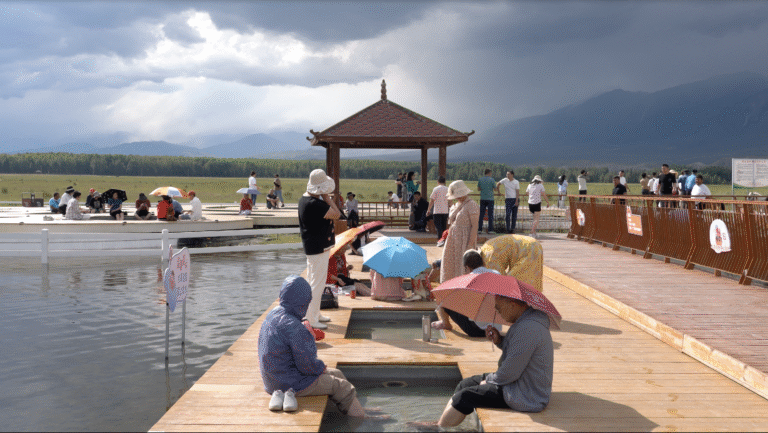
The strategy combines mechanization with digitalization, ecological practices, and smart technologies. It also encourages urban residents to engage in rural tourism and eco-agriculture as part of closing the rural-urban gap.
National defense and peaceful philosophy
On September 3, China held a military parade marking the 80th anniversary of victory in World War II. In his remarks, Xi underscored that historical experience should guide national construction.
“We always give priority to peace and want to stay away from war of all kinds. In Chinese philosophy, war is always the last resort, after exhausting all other options,” said Gao Zhikai, contrasting this with countries that “tend to use war as the first option.”
In foreign policy, Xi reaffirmed China’s commitment to multilateralism and to advancing the Global Development, Security, Civilization, and Governance Initiatives.