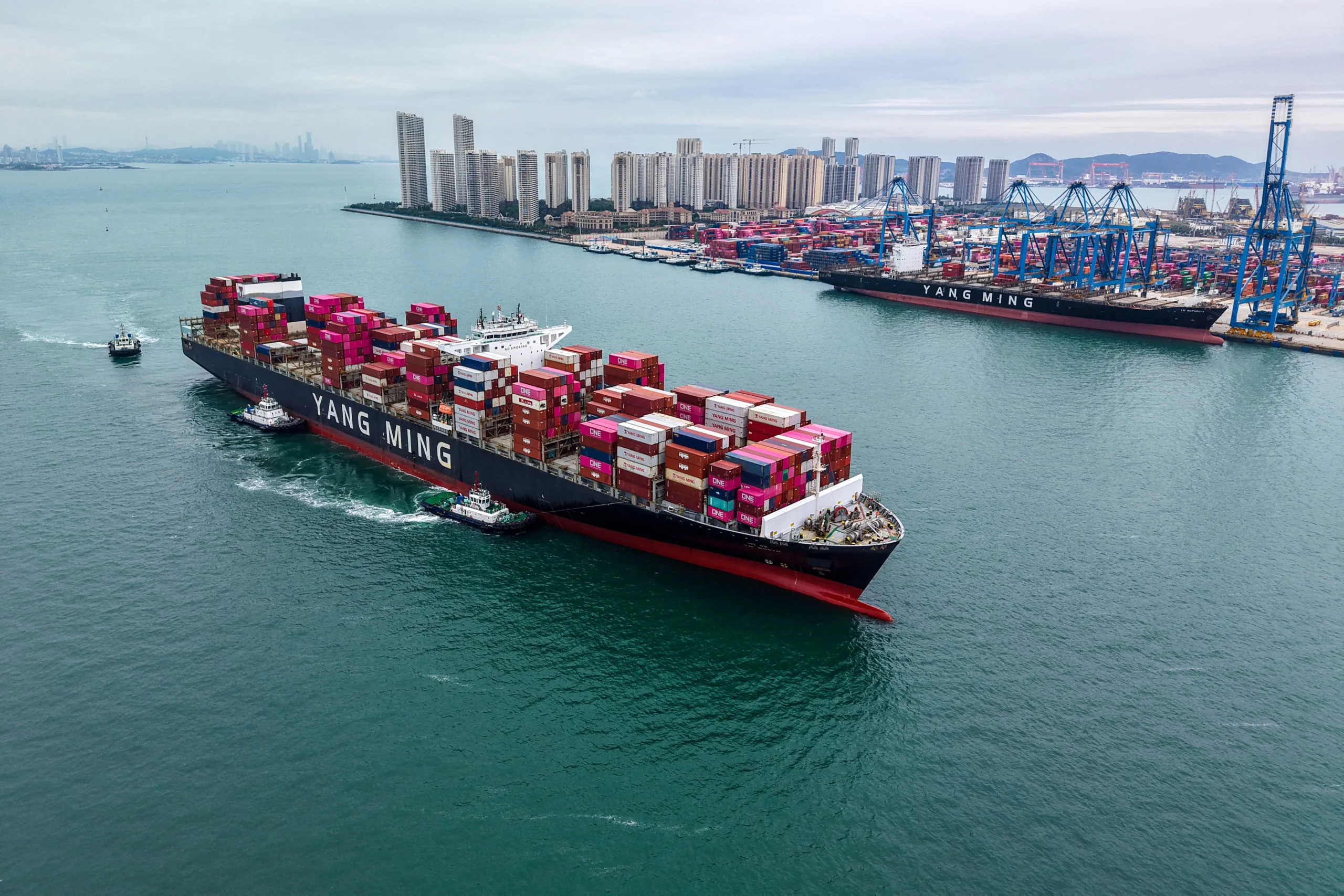
Reciprocal port tariffs between the United States and China came into effect this Tuesday (14), marking another chapter in the renewed trade tensions between the world’s two largest economies.
On the same day, China’s Ministry of Commerce announced additional countermeasures against five U.S. subsidiaries of Hanwha Ocean, a leading shipbuilding company from the Republic of Korea. The measures prohibit Chinese organizations and individuals from conducting transactions, cooperation, or any related activities with these entities.
The U.S. had decided to impose tariffs citing China’s “non-market” practices aimed at “establishing global dominance” in the maritime, logistics, and shipbuilding sectors. In response, Beijing applied similar port fees and restrictions on Hanwha Ocean’s U.S. subsidiaries as defensive countermeasures.
The origin of these tariffs lies in an investigation under Section 301 of the U.S. Trade Act (see details below), launched by the Office of the U.S. Trade Representative (USTR) on April 17, 2024, during Joe Biden’s administration, following a petition from five U.S. labor unions.
However, other measures under discussion in Washington reveal a broader U.S. strategy, one that seeks to curb China’s shipbuilding industry as a whole.
The tariffs, defined in April 2025 and modified in June, establish three categories of charges. Ships owned or operated by Chinese entities will pay US$50 per net ton, with an increase of US$30 per ton each year until 2028. Vessels built in China will be taxed at US$18 per net ton or US$120 per unloaded container, whichever is greater. Ships classified as vehicle carriers or roll-on/roll-off vessels will pay US$14 per net ton. Liquefied natural gas (LNG) tankers have been exempted from the fees.
China’s response
On Tuesday (14), the Chinese Ministry of Commerce announced the inclusion of five U.S. subsidiaries of Hanwha Ocean in its countermeasure list under the Anti-Foreign Sanctions Law. The South Korean company is one of the world’s three largest shipbuilders, alongside Hyundai and Samsung.
The targeted subsidiaries are: Hanwha Shipping LLC, Hanwha Philly Shipyard Inc., Hanwha Ocean USA International LLC, Hanwha Shipping Holdings LLC, and HS USA Holdings Corp.
Under the sanctions, Chinese organizations and individuals are prohibited from any form of transaction or cooperation with these five entities. According to the ministry, the subsidiaries were sanctioned for “assisting and supporting the U.S. government” in conducting Section 301 investigations against China’s shipbuilding sector.
Last Friday (10), China’s Ministry of Transport had already announced the implementation of special port fees on ships owned or operated by U.S. companies, organizations, and individuals, also effective from October 14.
The Chinese fee will be implemented gradually. Starting on October 14, 2025, it will be set at 400 yuan (about US$55) per net ton, increasing to 640 yuan (US$87) per ton on April 17, 2026, 880 yuan (US$120) on April 17, 2027, and 1,120 yuan (US$152) on April 17, 2028. Ships calling at multiple Chinese ports on the same voyage will pay the fee only at the first port, and no vessel will be charged more than five times a year.
According to the ministry’s statement, the countermeasures aim to “safeguard China’s sovereignty, security, and development interests.” A spokesperson urged the United States and the companies involved to “respect facts and multilateral trade rules, adhere to market economy principles and fair competition, correct their wrongful practices, and stop harming China’s interests.”
More than 80% of global trade is carried out by sea, according to the United Nations Conference on Trade and Development (UNCTAD). In a report published in April this year, the agency highlighted the growing participation of developing countries in global maritime transport, rising from 38% in 2000 to 54% in 2023. Much of that growth was driven by China, according to the report.
The Asian giant accounted for more than 53% of the global commercial shipbuilding industry in 2024, while the United States represented only 0.1%, according to data from the Center for Strategic and International Studies (CSIS), based in Washington. China is followed by the Republic of Korea with 28.2% and Japan with 14.9%, according to 2024 UNCTAD figures.
In January this year, the USTR concluded that China’s efforts to “dominate the maritime, logistics, and shipbuilding sectors” were “unjustified” and “burdened or restricted” U.S. trade.
However, a report by CSIS argued that if the United States wants to revitalize its shipbuilding sector, it must pass new legislation already under discussion, the Shipbuilding and Port Infrastructure for Prosperity and Security Act of 2025, also known as the SHIPS Act.
According to the think tank, the law would allow the U.S. government to impose higher tariffs on ships built in shipyards owned by the China State Shipbuilding Corporation (CSSC), the largest Chinese ship manufacturer. The strategy targets shipyards that produce both commercial and military vessels, enabling the U.S. to classify CSSC under the “dual-use” criterion, a category applied to technologies, software, and equipment with both civilian and military applications. This classification would justify stricter export controls.
Another CSIS report proposed that U.S. policymakers cut the flow of foreign capital and technology to Chinese shipyards, focus in the short and medium term on transferring market share from Chinese shipyards to South Korea and Japan, and strengthen domestic shipbuilding capacity. The report explicitly states that the goal of these measures is to disrupt Beijing’s military modernization efforts.
Section 301: also used against Brazil
Section 301 is part of the U.S. Trade Act of 1974 and grants the USTR authority to investigate foreign trade practices and impose unilateral trade sanctions against countries deemed to be in violation of agreements or to engage in “unjustifiable,” “unreasonable,” or “discriminatory” acts, according to U.S. criteria. The mechanism has been criticized for its unilateral nature.
This year, Brazil also became the target of a Section 301 investigation for “practices related to digital trade and electronic payment services, tariffs, ethanol market access, intellectual property protection, anti-corruption oversight, and deforestation,” with Brazil’s Pix payment system being one of the main focuses.
In a recent interview with BdF, presidential adviser Celso Amorim said that Brazil made “a certain concession” to the United States by responding to the inquiries under Section 301, since it is “a unilateral mechanism.”
Between 2017 and 2020, the USTR launched Section 301 investigations against China, the European Union, France, a group of ten trading partners, and Vietnam, imposing tariffs on China (2018) and the EU (2019). In 1979, the U.S. Congress amended the law to include shipbuilding subsidies within its scope.
On Friday (10), Lyu Daliang, spokesperson for China’s General Administration of Customs, stated that China hopes the United States will “recognize its mistakes and work with China to return to a path of dialogue and negotiation.”