

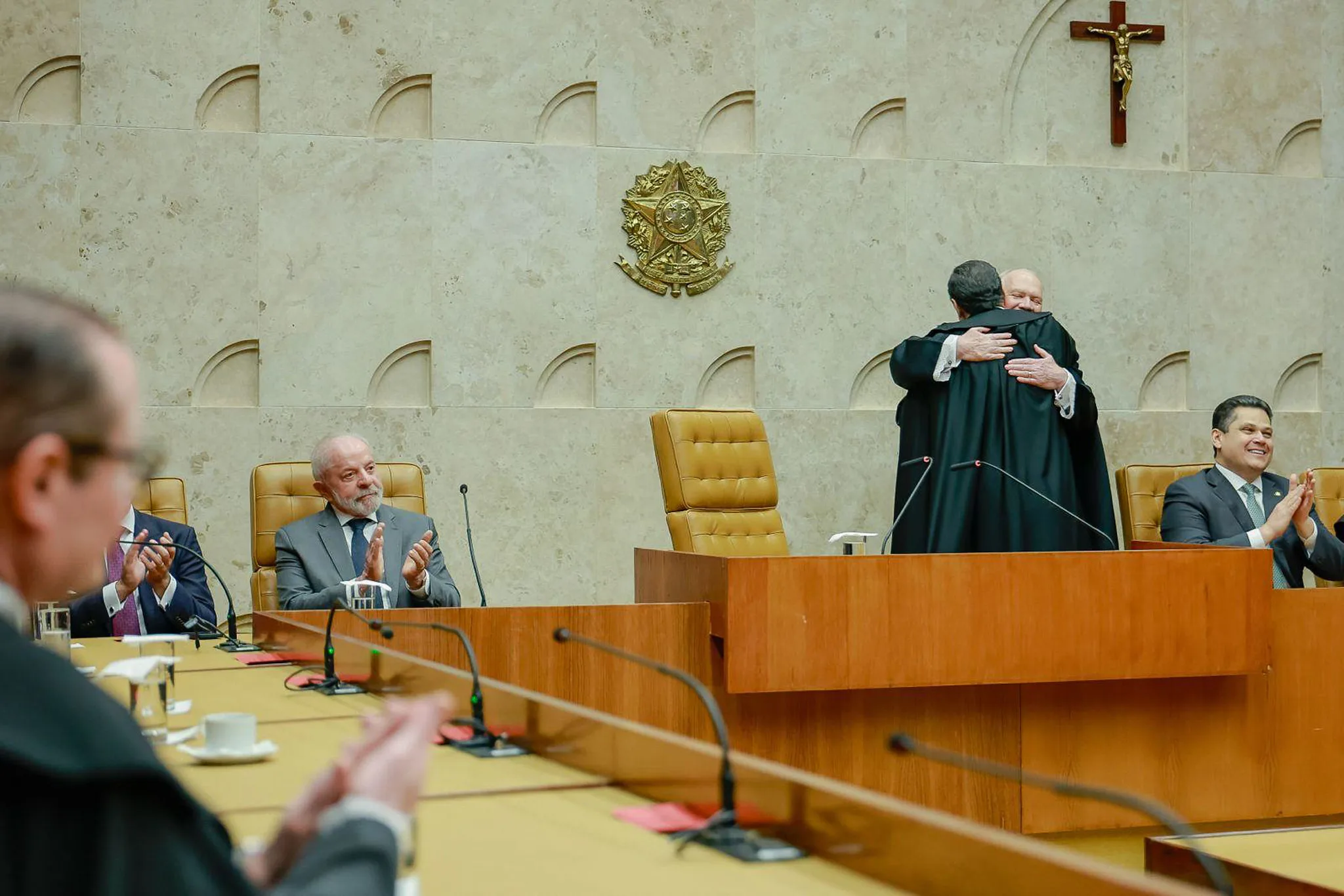
Supreme Court Justice Luís Roberto Barroso announced his early retirement on October 9, saying it was time to “follow other paths.” In a 16-minute farewell speech, he grew emotional as he reflected on his 12 years on Brazil’s Supreme Federal Court (STF), thanking former President Dilma Rousseff for his appointment “without ever asking or negotiating.” He said he now wishes to live “with more literature and poetry” and less of the public pressures of office.
Barroso, who oversaw key rulings during his tenure, including the accountability of those involved in the January 8 coup attempt and the suspension of evictions during the Covid-19 pandemic, warned against the dangers of political radicalization, calling it one of the Court’s biggest challenges. His departure opens a new seat on the STF, with Attorney General Jorge Messias emerging as the leading candidate to succeed him.
Choosing a new name
The early retirement of Justice Luís Roberto Barroso is stirring the legal world in Brasília. He is expected to step down this Saturday (18), and a long list of possible successors already circulates in the corridors of the Palácio do Planalto. According to former São Paulo state prosecutor Roberto Tardelli, “there must be names not yet exposed to the public. Certainly there are dozens of candidates.”
“Nobody who is truly a candidate will walk in and say, ‘I want to be a Supreme Court justice,’ because they risk rejection,” the jurist adds.
When asked about the matter, President Luiz Inácio Lula da Silva (Workers’Party), who has the constitutional prerogative to appoint STF justices, always offers the boilerplate response: “notable legal knowledge” and “unblemished reputation,” exactly what the Federal Constitution demands. To dispel any suspicion of favoritism, the president has repeatedly said he “doesn’t want any friends” on the Court.
“When he says he wants a minister, but not a friend, it suggests he intends to nominate someone with legal solidity, doctrinal strength, sound principles, and a robust sense of functional independence,” Tardelli assesses. “It’s a lifetime position, you only leave by age, by choice, as Barroso is doing, or death.”
A close advisor to Lula on legal matters, jurist Marco Aurélio de Carvalho says loyalty is one criterion the president will not waiver on, in addition to constitutional requirements. “The appointment is political, so loyalty is fundamental. Alongside ‘notable legal knowledge’ and ‘unblemished reputation’ ,” says the jurist, who belongs to Grupo Prerrogativas.
The frontrunner
The Attorney General of the Union, Jorge Messias, is emerging as the leading candidate. Within government circles, he is seen as the most qualified for the role. His key backer is Justice Minister Ricardo Lewandowski, who has publicly praised Messias’ “notable and renowned legal knowledge”.
Messias also has a religious dimension working in his favor: he is a Baptist, and evangelical sectors, often aligned with Brazil’s right-wing, see his nomination as politically dependable.
Female representation: “A national scandal”
In opposition to male candidates, a movement is gaining strength demanding Lula nominate a woman, ideally a Black woman, to replace Barroso. Currently, the STF has only one female justice, Carmen Lúcia, who will face mandatory retirement in April 2029 at age 75, as required by the Constitution.
“There’s a feminist push for the appointment of a jurist, a woman in this role, which seems absolutely reasonable to me, because Brazil may be the only major country whose Supreme Court has just one woman. That is indeed a scandal, one of the national scandals,” says Tardelli. “There are dozens of brilliant female jurists who could serve in the Court.”
Marco Aurélio Carvalho agrees there are many qualified women, but adds, “they often lack the proximity to the president necessary to gain his trust.”
Other possibilities
Senator Rodrigo Pacheco, former President of the Senate, is another name rising. He has close relations with justices Alexandre de Moraes and Gilmar Mendes and might represent a gesture toward the political center ahead of the 2026 elections. His selection could also solidify a bridge between the Congress and the STF in the ongoing institutional tensions.
Another contender is Bruno Dantas from the Federal Audit Court (TCU). His good relationship with the Senate works in his favor; he is seen as a moderate figure unlikely to generate controversy.
Trust must go beyond personality
Legal advocate Breno Cavalcante, of the Brazilian Association of Jurists for Democracy (ABJD), argues we need to “de-personalize” the discussion of trust in STF nominations.
“I believe we must shift the debate away from trusting personalities. People chosen must be evaluated for their career and commitment, not just adherence to the Workers’ Party. It’s about democratic-populist projects: building a sovereign nation with social justice, reducing inequalities by region, race, and gender. Where was that person during the 2016 congressional-judicial-media coup attempted to the President Dilma [Rousseff]? In 2018, when Lula was jailed and the Operation Car Wash was committing a series of crimes? What did they do or say?” he challenges.
“The STF must address root causes. Its members should defend democracy and include voices who live social, racial, and economic vulnerability, who understand structural racism and sexism,” he continues.
Changing times
“In another era, the Diário Oficial da União (Official Gazette) would already have published the appointment,” said a Planalto source to BdF, referring to Lula’s dilemma between a safe choice or answering social demands.
Tardelli notes that the STF has become far more prominent in recent years. “I think the president is mindful of a new situation: the Supreme Court’s expanded role in Brazilian political-institutional life. Fifteen or twenty years ago, this prominence was much less intense,” he remarks.
The STF’s elevated role is often traced to its exposure during the Mensalão scandal (a 2005 corruption scheme involving monthly bribes to Brazilian lawmakers in exchange for political support) and the live broadcast of its debates.
Lastly, the STF’s popularity could influence Lula’s choice. Once he names a nominee, that person must face confirmation by the Senate’s Constitution and Justice Committee (CCJ) and then be approved by the full Senate. To date, no presidential nominee to the STF has ever been rejected.
*With informations of Leonardo Fernandes
