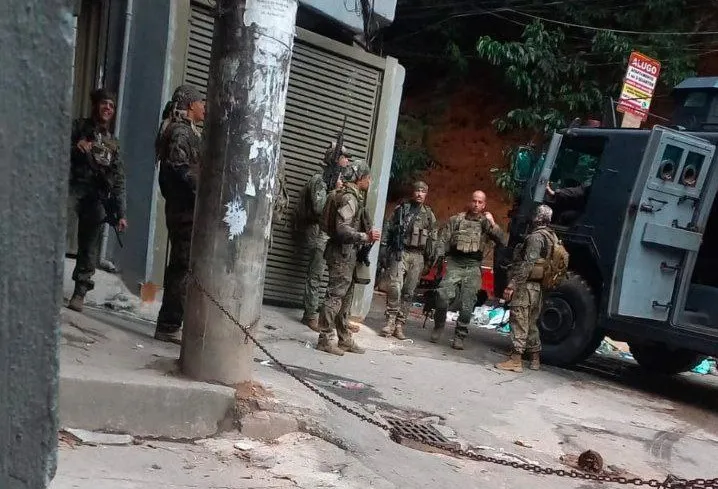

A large-scale police raid carried out on Tuesday (28) in the favelas of Complexo do Alemão and Complexo da Penha, in Rio de Janeiro’s North Zone, has become the deadliest operation in the state’s history. At least 64 people were killed, including four security officers. The operation, called Operação Contenção (“Operation Containment”), mobilized around 2,500 Civil and Military Police officers to execute more than 100 arrest warrants targeting drug traffickers linked to the Comando Vermelho, one of Brazil’s largest criminal organizations.
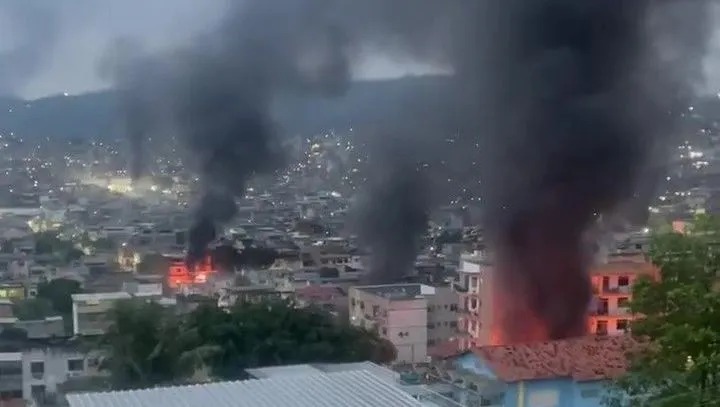
According to state authorities, suspects responded with gunfire, burning barricades, and drones used to drop explosives. Columns of smoke could be seen from several parts of the city, as shown in videos circulating online. The death toll has surpassed that of Rio’s previous deadliest raids: the May 2021 operation in Jacarezinho (28 killed) and the May 2022 raid in Vila Cruzeiro (24 killed).
So far, according to partial reports, 60 suspected members of criminal groups have been killed, including three from other states (Bahia and Espírito Santo), in addition to the four officers (two from the Civil Police and two from the Military Police). A Civil Police chief remains in critical condition. The NGO Voz das Comunidades reported that three civilians were injured by stray bullets: an unhoused man, a woman at a gym, and a scrap-yard worker.
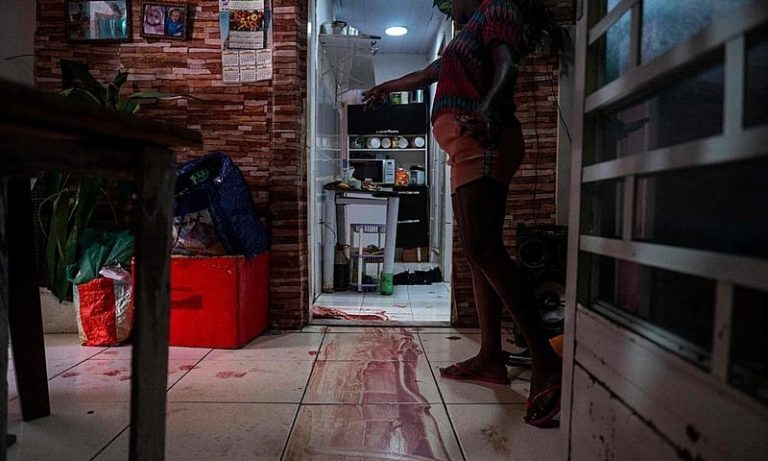
Residents of the two complexes shared images of destroyed homes across social media. In Complexo da Penha, classes were suspended in 17 public schools; in Complexo do Alemão, 28 schools were affected.
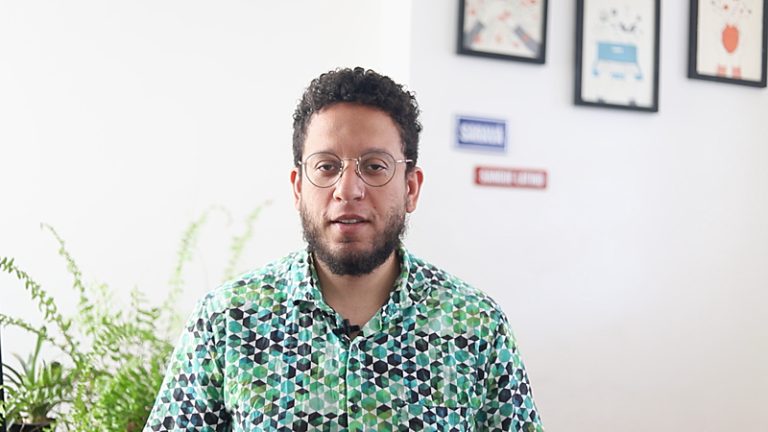
Local accounts also describe violent police actions. According to community media outlet Voz das Comunidades, ongoing rights violations have generated fear and outrage among residents.
Police have made 81 arrests, with five detainees injured and hospitalized under custody at Getúlio Vargas State Hospital, in Penha. Authorities also seized 31 rifles, two handguns, and nine motorcycles.
Governor targets Lula and Brazil’s Supreme Court
Rio de Janeiro far-right Governor Cláudio Castro used the operation to attack both Brazil’s federal government and the Supreme Federal Court (STF). He claimed that President Luiz Inácio Lula da Silva’s administration denied three previous requests for support from the Armed Forces in Rio’s security operations, including requests for armored vehicles for actions in favela areas.
“We have no support, no armored vehicles, no federal security or defense agents. Rio de Janeiro is completely alone in this operation, and we are conducting the largest operation in the state’s history,” Castro said.
Castro also sharply criticized the ADPF 635 ruling, known as the “ADPF das Favelas”, a Supreme Court decision that has restricted police operations in favelas since the pandemic, allowing them only in “exceptional circumstances.” According to the governor, this ruling has made it easier for drug traffickers from other states to relocate to Rio, taking advantage of the limits placed on police action.
Castro called the ruling a “cursed legacy” and accused the Court of fostering an environment favorable to organized crime. “What we are seeing now are the direct consequences of the ADPF. This is the reality created by the Supreme Court’s decision,” he said.
The governor argued that Operação Contenção was essential to target high-ranking traffickers and dismantle barricades after five years of what he described as operational constraints imposed by the Court. He also reproached the federal government for what he sees as a lack of cooperation from federal security forces and the Ministry of Defense, stating that Rio’s state forces continue operating “even without help.”
In a statement, Brazil’s Ministry of Justice and Public Security rejected Castro’s criticism, affirming that it “has promptly responded to all requests made by the State of Rio de Janeiro for the deployment of the National Public Security Force.”
Justice Minister Ricardo Lewandowski said in a press conference that the ministry had received no request for assistance related to Tuesday’s operation, and reiterated that the federal government is willing to support efforts to combat organized crime.
Rio de Janeiro Mayor Eduardo Paes said the city “will not be held hostage by criminal groups seeking to spread fear in the streets.” He stated that all municipal agencies were instructed to maintain normal operations and provide support to residents when necessary. Paes added that he is monitoring the situation from the city’s operations center and vowed that City Hall will continue acting “with authority, coordination, and firmness.”