

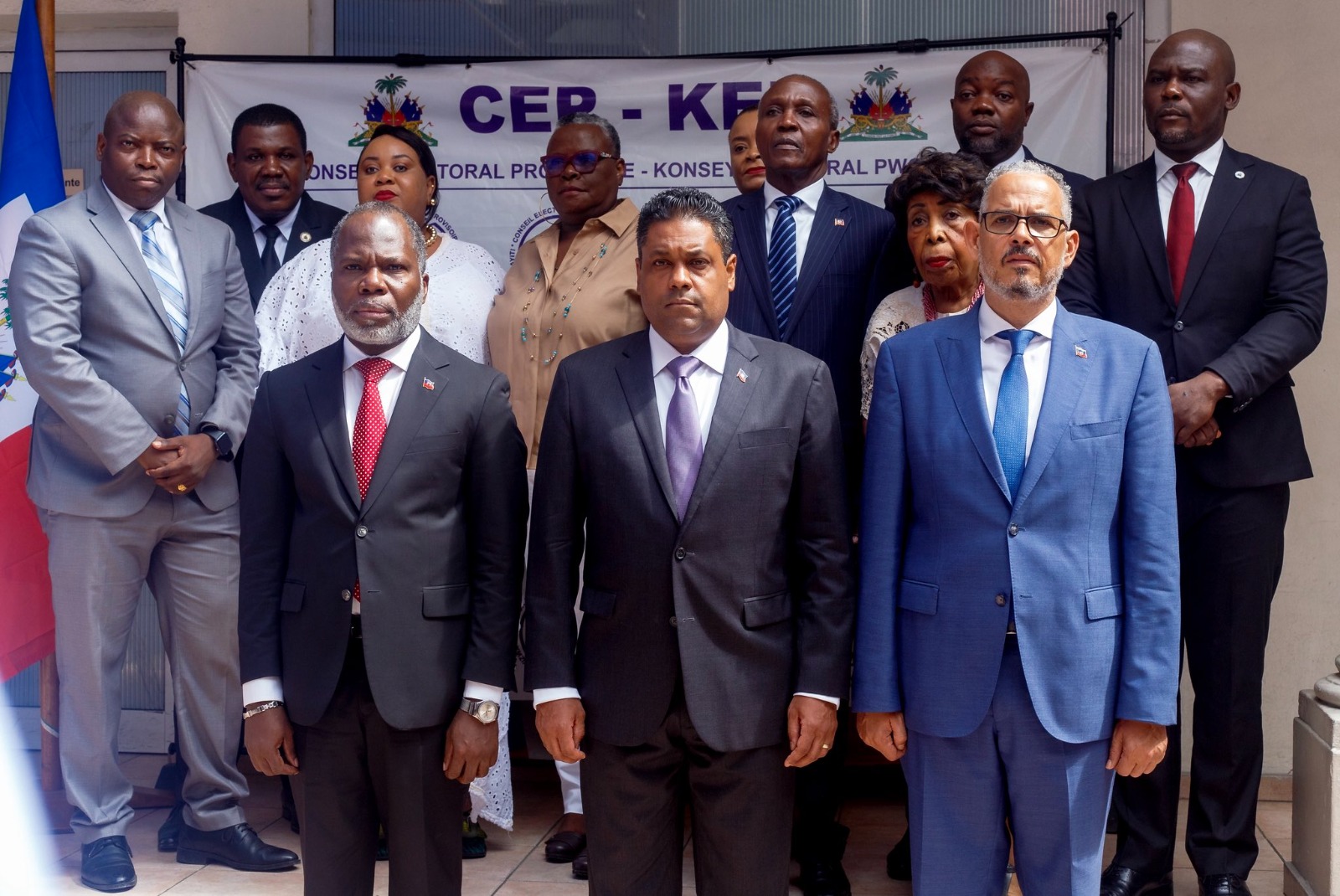
Following strong pressure from the United States, Haiti’s Transitional Presidential Council (CPT) has announced that national elections will take place in the coming months. The short-term plans have shocked and drawn criticism from movements and civil society organizations, which argue that the country lacks the basic conditions to hold democratic elections due to the widespread crisis ravaging Haiti. According to them, such a vote would merely legitimize a government committed to safeguarding foreign interests.
Hundreds of criminal armed groups operate freely across the country, blocking circulation throughout large regions, including the capital, Port-au-Prince. In addition, the near-total lack of electricity makes it difficult to prepare polling centers or register voters in a context where 1.5 million people are internally displaced.
These are among the arguments raised by Haitian movements, who also stress that there is no time to adequately carry out all stages of an electoral process, especially for a population that has been unable to vote, or even move freely around the country, for nearly 10 years.
Armed gangs control the main roads and spread terror in the most populated regions. Elysée Luckner Vil, a member of the coordination of the Popular Democratic Movement (Modep), shares the concerns of many Haitians. “The two departments with the most voters — the West and Artibonite — are the ones under the strongest gang pressure. The West is the political heart, where the capital is located. Imagine what kind of elections can be organized with bandits in control!”
To this day, traveling by land between the country’s two largest cities, Port-au-Prince and Cap-Haïtien, depends on paying armed men informally, when the journey isn’t simply impossible. Under such conditions, it is difficult to conceive of a political campaign with any credibility, or believe that residents of gang-controlled neighborhoods could enjoy freedom and safety on election day.
“As a popular organization, we are not against elections,” Vil explains. “They are a democratic achievement. The issue is the timing and the way it is being done, without respecting the principles and conditions needed for people to vote peacefully and choose the candidate they want.”
A U.S. Puppet?
Leaks from the Haitian press suggest that the electoral calendar will be announced within two weeks. Since taking office in August as president of the CPT, Laurent Saint-Cyr has repeatedly spoken of preparations for general elections. According to him, US$65 million has already been released, 85% of polling centers and 6.2 million voters have been identified by the Provisional Electoral Council, which now has a new president.
Behind the figures and announcements displayed by the government lies the need to reassure its international creditors, especially the U.S., which in April 2024 installed the CPT in power with a dual mandate: combat insecurity and restore democracy within 22 months. The problem is that, 18 months later, almost nothing has been accomplished on either front. With 100 days left before its mandate expires, the CPT is rushing to show results to its donors.
Speaking before the UN Security Council last week, the head of the United Nations Integrated Office in Haiti (Binuh) did not hide his skepticism. “Time is running out. I am concerned about the lack of a clear trajectory towards restoring democratic governance.”
Caricom, the main mediator among Haitian organizations currently forming or supporting the CPT, admitted it is “in contact with the leaders of the represented groups and sectors” in order to “collect proposals for the end of the mandate,” leaving open the possibility of extending or renewing an unelected transitional government.
The United States, meanwhile, insists that a nationwide vote be held by February. Washington, which pushed for the creation of the UN-authorized multinational “anti-gang” force, is now closely overseeing electoral arrangements, signaling that continued funding of that force will not come without political concessions.
“The time has come for the CPT and other Haitian government members to fulfill their role and present a concrete plan with an electoral calendar for the political transition,” declared U.S. Ambassador to Port-au-Prince Henry T. Wooster in early October, on the eve of Laurent Saint-Cyr’s trip to Washington.
Three days later, Haiti’s Council of Ministers announced a drastic measure: the abandonment of a draft for a new constitution, which the government had hoped to pass by referendum even before considering elections. The text, viewed by progressive sectors as a step backwards from the current Constitution, died under the justification of expediting the timeline. The US$5 million spent on its drafting will not be returned to the Haitian people, and the focus has now shifted to a supposedly democratic renewal of the executive branch.
Who benefits from an anti-democratic election?
Haiti has a long record of electoral irregularities dating back to the early 1990s, which have contributed to the gradual dismantling of the state and the erosion of public trust in democracy. In the most recent presidential election in November 2016, turnout did not exceed 21% of eligible voters.
This raises a key question: to what extent does it make sense to force a hollow electoral process simply to preserve the appearance of normality? The insistence of the United States and the United Nations on meeting the deadline, despite full awareness of the country’s situation and the lack of democratic guarantees, raises serious concerns. Most popular organizations opposing this externally imposed agenda argue that the elections would only serve to place a mask of legitimacy over a government aligned with foreign interests.
“Since the coup against Aristide [the president overthrown in 1991], we’ve had only sham elections in Haiti, in which countries like the United States and France manipulate the process to install submissive governments. Today it is the same: they are forcing the CPT to organize elections to continue this same project,” Elysée Luckner warns.
Whether or not one trusts the intentions of the Trump administration, the current high-tension atmosphere in the Caribbean, along with Haiti’s strategic geopolitical role, provide concrete reasons to fear yet another imperialist offensive on the island.
