

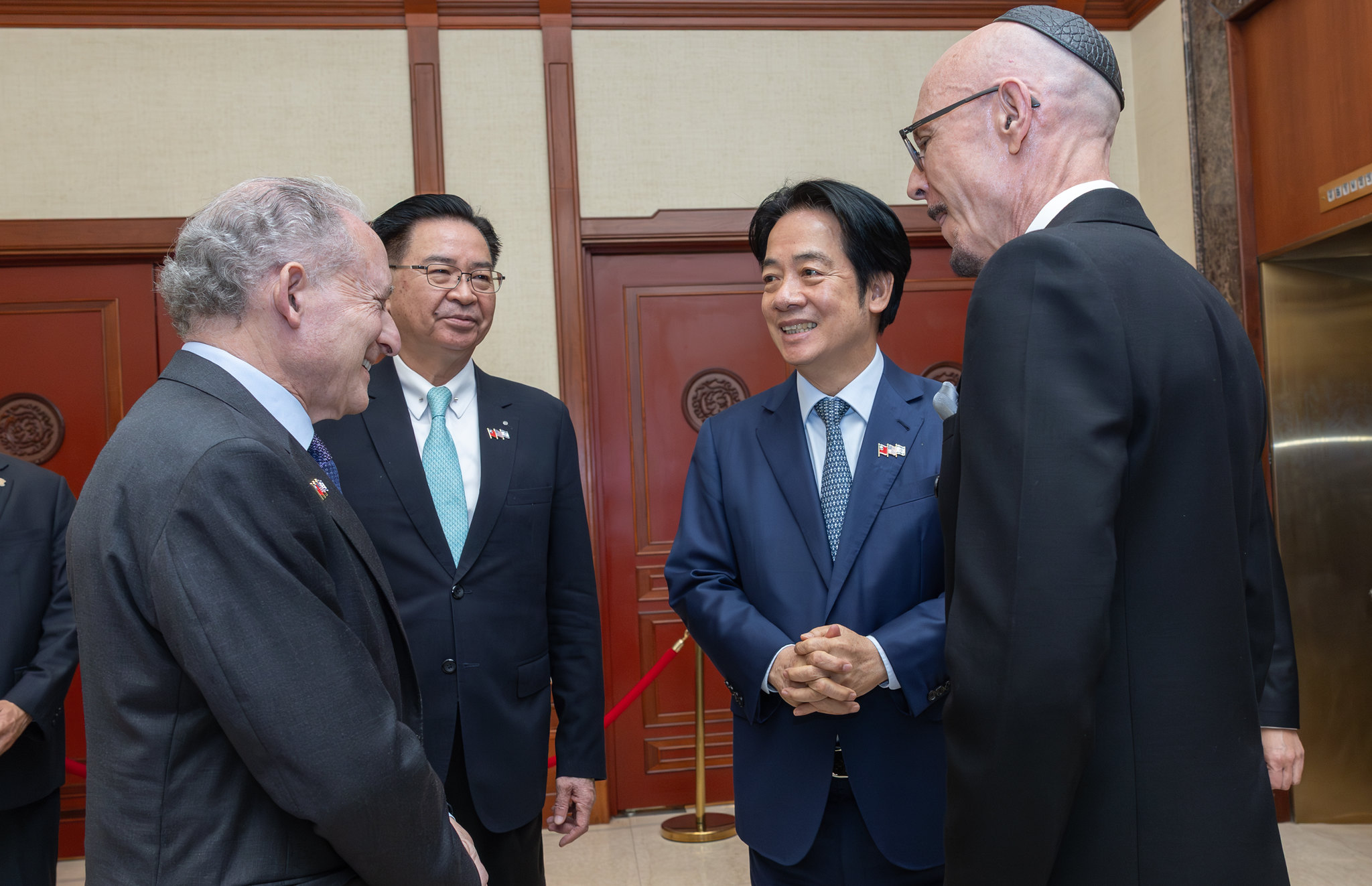
The meeting between the leader of the Taiwan region, Lai Ching-te, and a delegation of more than 200 representatives from the American Israel Public Affairs Committee (Aipac) exposes the island’s difficulties in establishing ties with the Trump administration and harms its international reputation, according to Shen Yi, professor at the School of International Relations and Public Affairs at Fudan University.
“This event should be seen as part of a series of moves by Lai Ching-te and other separatists who view the United States as their main supporter in their pursuit of ‘Taiwan independence’,” Shen Yi told BdF, referring to the dinner hosted by one of the main Zionist lobby groups on October 27 in Taipei.
The international relations expert argues that, under strong pressure from mainland China and unable to build meaningful ties with President Donald Trump, authorities on the island are seeking intermediaries. “They believe they can use the influence of the pro-Israel lobby group in Washington to build a connection with Trump,” he said.
But the strategy may backfire. “Judging by the reaction on social media, the meeting further damaged Lai’s reputation,” he noted. “Many online users commented [on the meeting] ‘One China’. Why? Because Israel’s international image is currently highly negative; it is being seen as a perpetrator of massacres, human rights violations, and war crimes,” Shen Yi stated.
“Paid visits” and accelerated reunification
Professor Shen Yi compared the Aipac visit to previous episodes, such as the 2022 trip to Taiwan by then-U.S. House Speaker Nancy Pelosi. “Public reports revealed that her visit was funded by Taiwan-based lobbying organizations that operate in the U.S.,” he said.
According to Shen Yi, such gestures bring little substantive benefit to the island’s authorities and serve mainly as “consolation for the pro-independence camp.”
“These provocations lead to only one outcome: mainland China will accelerate the process of reunification,” Shen concluded. “In two or three years, or at most within five, you will witness major actions and significant changes,” the scholar asserted.
The position of the People’s Republic of China is the defense of peaceful reunification, but it has reiterated that it does not renounce the use of force and reserves the right to take all necessary measures against separatist activities and external interference.
Announcements signal escalation
At the gala dinner, Lai Ching-te announced plans to increase the defense budget from the currently projected 3.32% for 2026 to 5% of GDP by 2030.
He also stated that, inspired by Israel’s Iron Dome and by the “Gold Dome” announced by Donald Trump this year, the Taiwan region would install an air defense system called “Dome-T.” “Israel’s determination and ability to defend its territory provides a valuable model for Taiwan,” Lai declared during the event.
About Aipac
On paper, Aipac is a nonprofit organization. Founded in 1954, it operates through four structures: Aipac itself, focused on lobbying the U.S. Congress; the Aipac PAC, its Political Action Committee that directly contributes to pro-Israel candidates; the United Democracy Project (UDP), a “Super PAC” allowing unlimited fundraising and spending in elections; and the American Israel Education Foundation (AIEF), its educational arm that organizes trips for lawmakers and staffers to Israel.
The current candidate for mayor of New York City, the largest city in the U.S., Zohran Mamdani, has been critical of mega-donation schemes like Super PACs. “They are spending more than I would charge them in taxes,” Mamdani recently said about the donors backing his opponent, also a Democrat, Andrew Cuomo.
As a 501(c)(4) organization (a tax-exempt social welfare group under U.S. tax law), Aipac is not legally required to disclose its campaign donors, as this category is for social welfare organizations exempt from taxation.
According to Aipac Tracker, an organization dedicated to monitoring and promoting transparency around Aipac’s activities, the committee functions as the “unofficial arm of Israel in Washington.” Aipac Tracker argues that the organization should fall under the scope of the Foreign Agents Registration Act (Fara), which requires anyone acting as an “agent of a foreign principal” to register with the Department of Justice.
The organization criticizes the fact that Aipac has maintained an office in Jerusalem since 1982, funds frequent trips by U.S. lawmakers to occupied Palestine, and consistently aligns U.S. policy with the Israeli agenda, including support for anti-BDS (Boycott, Divestment and Sanctions) legislation.
Lai Ching-te’s arrival has intensified tensions with mainland China
Although Beijing has not issued a statement specifically about the meeting with Aipac, the Taiwan Affairs Office of China’s State Council has maintained constant criticism of actions taken by the island’s authorities, who took office in May last year and belong to the Democratic Progressive Party (DPP).
In a recent press conference, the office’s new spokesperson, Peng Qing’en, stated that “the root cause of the current complex situation across the Strait is Lai’s refusal to recognize the 1992 Consensus, which embodies the one-China principle.”
Peng cited a report by the U.S. think tank RAND Corporation warning Washington not to allow Taiwan authorities to take provocative actions under the pretext of U.S. support. “More people in the international community are recognizing that Lai is a troublemaker and a saboteur of peace,” the spokesperson said.
