

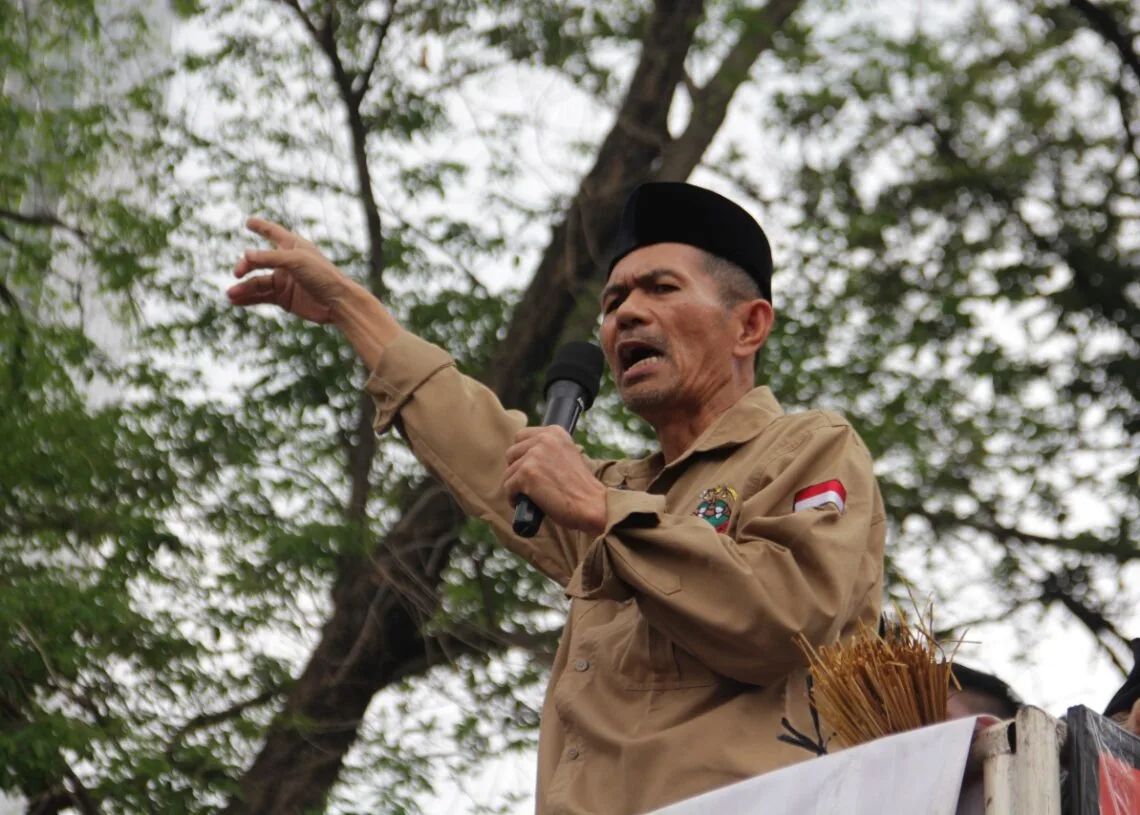
The Serikat Petani Indonesia (SPI), the largest peasant movement in Indonesia, has reclaimed 600,000 hectares of land since its founding in the late 1980s, during the Suharto dictatorship. With around 200,000 organized members and approximately one million people involved at different levels, the movement was born out of resistance to the violent expropriation of Indigenous and peasant lands to create industrial plantations.
Inspired by Paulo Freire and the principles of Pedagogy of the Oppressed, SPI joined La Via Campesina in 1996 and has pursued struggles similar to those of Brazil’s Landless Workers’ Movement (MST): against agribusiness and export-oriented agriculture, for agrarian reform, and for food sovereignty.
In an exclusive interview with BdF, Henry Saragih, one of SPI’s key leaders, offers a sharp evaluation of the administration of former President Joko Widodo (Jokowi), who governed the country for a decade, from 2014 to 2024. “In the first term, the agenda was progressive and came from social movements. They promised agrarian reform, a full shift in the economic model. But in the second term, they returned to another paradigm,” Saragih says, referring to the implementation of the omnibus law, which he argues represents “the entire neoliberal agenda: liberalization, privatization, flexibilization of labor laws, open markets.”
Of the 9 million hectares promised for agrarian reform in 2014, Jokowi delivered “very little,” relying largely on land titling mechanisms under pressure from the World Bank, which “does not actually allow agrarian reform to be possible,” according to Saragih.
Regarding Prabowo Subianto, the current president and son-in-law of Hadji Mohamed Suharto, Saragih recognizes the contradiction: while in the 2014 and 2019 campaigns Prabowo positioned himself “to the right” of Jokowi, he has now “strongly criticized neoliberal policies” and promotes what he calls “Indonesian socialism” based on Pancasila, a foundational national ideology rooted in the concept of gotong royong (working together). After this first mention, Saragih refers to it as a Pancasila-based economy.
At the St. Petersburg International Economic Forum, Prabowo proposed “a different economic regime, a mixture of the best of capitalism and the best of socialism.” But the implementation reveals structural limits: his mass meal-distribution program and his plan to create rural cooperatives, the latter originally proposed by SPI have been distorted through “bureaucratic, militaristic” execution that “benefits capital, opening space for large corporations” instead of strengthening popular organization.
SPI took part in founding the Labour Party which, in the 2024 elections, won one million votes and elected around 30 provincial and district-level representatives, although it did not reach the four million votes required for national parliamentary representation.
For Saragih, the hope for change depends on pressure from social movements: “we have to work hard for this,” he says, because Prabowo “does not come from social movements, he comes from a military tradition” and “the role of big corporations is still very strong within his government.”
BdF — First of all, could you briefly introduce SPI to readers in Brazil and other countries? When was the movement created, and what are its main demands and forms of struggle?
Henry Saragih — The embryo of our organization, the Indonesian Peasants’ Union (SPI), was created in the late 1980s during Suharto’s dictatorial regime. At that time, people were not allowed to form peasant, labor or media organizations, except for government-controlled ones.
During this period, under Suharto, Indigenous lands were seized to create industrial plantations and forestry companies. Coastal areas were taken to build large marine industries. Much of our land was lost. Farmers and Indigenous peoples were displaced.
Because of this, we peasants began fighting case by case to reclaim our land. In the early 1990s, we began building the peasant organization at the local level, because a national-level organization was not allowed. During that period, we mainly faced violence.
Was it more or less at the same time the MST emerged in Brazil?
More or less the same time, yes. In the 1990s, we started organizing, but only at the local and provincial levels, not nationally, because it was forbidden. But we resisted; it was not legal, and we kept building.
In 1996, we joined La Via Campesina. We expressed solidarity with the struggle in Eldorado dos Carajás, in Brazil, where the massacre took place. Since then, April 17 has been the International Day of Peasant Struggles.
At the beginning, our struggle focused on agrarian reform. After joining La Via Campesina, we started mobilizing around broader issues such as food sovereignty and biodiversity.
At the same time, from the beginning, we were also building our platform for peasants’ rights. Many of us had to deal with state violence. We asked peasants a very simple question: what are our rights? Workers have an international instrument through the International Labour Organization. Women have rights. But we peasants did not have rights. That is why La Via Campesina began building the platform on peasants’ rights.
In 2001, we organized a conference on “agrarian reform and peasants” here in Indonesia. Based on the outcomes, we brought the principles of peasants’ rights to La Via Campesina at the regional level, and then continued discussing them globally. This is our history: we built from the bottom up, case by case, gaining organization locally and later nationally.
Are there similarities between rural realities in Indonesia and Brazil?
In Brazil, agriculture became industrialized, with large-scale plantations for export. In Indonesia, it is the same. In terms of climate, we share a tropical context. Both of us have rainforest.
In Indonesia, we have palm oil plantations and industrial forestry expansion, palm and paper. In Brazil, you have soy. Brazil has not implemented agrarian reform; neither has Indonesia. This is the political-economic context that makes us similar.
The forms of struggle within La Via Campesina are also quite similar. For example, you say “occupy the land.” But in Indonesia, we do not say “occupy the land,” we say “reclaim the land.” Because if we say reclaim, it means the land was ours, it was taken, it was stolen, and we are demanding it back. If we say occupy, it is not ours.
Another important point: Paulo Freire is very well-known in Indonesia.
Paulo Freire? That is incredible. During the 1980s and 1990s?
Yes. Our movement incorporated the principles of Pedagogy of the Oppressed. In fact, all activists during the 1980s and 1990s read this book. It was our basic reference. Also Ivan Illich.
What are the main forms of struggle you use to reclaim land and rights?
For Indonesian people, our historical stages are clear: pre-colonial, colonial (Dutch and Japanese), Indonesian independence, then the dictatorship, and now the neoliberal era. For us, this is clear.
Our independence came with the 1945 revolution, but we were not truly independent. It was still a colonial axis. We nationalized the economy in 1956, ten years later. Then in 1960 came the agrarian reform law.
Our mandate at independence was to end colonization, which meant land serving only transnational corporations. This is our struggle: reclaiming our land, not only for Indigenous peoples but also for non-Indigenous peasants.
Through political education inspired by Paulo Freire, we liberate people, we do not domesticate them. We build consciousness. Because the plantation system is a form of colonization. We say that the Suharto regime was the continuation of colonization because it continued the plantation regime.
How many people are involved in SPI at different levels?
I would estimate around one million. But formal members are around 200,000. We have reclaimed around 600,000 hectares. Actually, our target for this year is one million hectares.
We demanded that the Jokowi government (2014–2024) implement agrarian reform. They promised to distribute 9 million hectares in 2014 for agrarian reform. But they delivered very little. What was done was through land titling, because the Indonesian government follows a lot of World Bank projects. And the World Bank does not actually allow real agrarian reform to happen.
You just mentioned Jokowi’s promise. How do you assess Jokowi’s policies for Indonesian peasants and for the working class in general?
The Jokowi of the first term was different from the Jokowi of the second term. In the first term, the agenda and national planning came from us, from social movements and the political platform. The goal was to implement an economic sovereignty agenda for Indonesia. They promised agrarian reform and a full shift in the economic model. It was a progressive agenda.
In the second term, they shifted to another paradigm. They implemented what we call the ‘omnibus law’. They said it was to create jobs, but in reality, it was about liberalization, privatization and flexibilization of labor laws. The entire neoliberal agenda: open markets.
In agriculture, a land bank policy. In the end, they promised agrarian reform, but it was not implemented. The workers’ agenda, the same. The entire progressive agenda, the same. We are trying to revoke this law, but they renewed it with a special mandate to reissue the omnibus law. They opened the market, imported food, gave big opportunities to corporations and canceled the agrarian reform program.
You said the first term was progressive and the second term shifted to neoliberalism. I have also heard criticism that Jokowi invested heavily in infrastructure, but not in education, healthcare or agrarian reform. Do you agree? How do you assess Jokowi’s ten years in office?
I think he is still doing what the World Bank wants. We want infrastructure, but not under World Bank criteria. Because what Jokowi really did was implement World Bank policy.
For example, airports: they are building big airports, like in Yogyakarta and West Java, but they are not functioning now. They are building toll roads, private. Recently, we saw the Chinese high-speed train, which we call Woosh. We want trains, but the ticket is very expensive because it is not built with our own resources.
Indonesia has the capacity to build trains, maybe not as sophisticated as the Chinese ones, but that level is not necessary, right?
And what about Prabowo? How do you evaluate his policies for peasants?
Prabowo ran twice against Jokowi. Jokowi was very progressive in his campaign. Prabowo was more to the right during the campaigns, in 2014 and 2019. In both campaigns, Jokowi spoke about agrarian reform. Prabowo did not.
His brother owns a forestry company and a plantation company for palm oil and pulp production. His brother runs the business. So Prabowo did not talk about agrarian reform, nor use the term “food sovereignty”. Prabowo talked about self-sufficiency, just increasing production.
Prabowo was more to the right than Jokowi in the campaigns. But once elected, Jokowi moved to the right. Meanwhile, Prabowo strongly criticized neoliberal policies. He said: “I support the Indonesian Pancasila economy as our basic principle,” meaning a form of Indonesian socialism, a Pancasila-based economy.
What do you think about his statement at the St. Petersburg Economic Forum proposing a different economic regime, a mix of the best of capitalism and the best of socialism?
I think part of what he said in his speech is being implemented. But he has his own way of implementing it. For example, the mass meal distribution program. He distributes through the military organization, with a military-style distribution model. But this is very expensive, bureaucratic and centralized.
He does not like to use popular organization. This creates problems, for example, 8,000 students suffered food poisoning. Because meals are produced in the cities and take hours to reach villages. They should cook near the schools. It should serve as a basis for organizing in the school.
But no: a big company in the city cooks 3,000 meals a day, maybe at night, and the next day, at noon, students will eat it. This is not good. It would be different if food was cooked at the school. And of course, the food does not come from farmers, it comes from industries. That is how Prabowo is implementing the program.
And how do you assess the policy of creating thousands of cooperatives in rural areas?
The idea came from us, from SPI. We presented it to the current Minister of Cooperatives, because he is a close friend of mine. The idea is to create cooperatives for rural producers. To implement agrarian reform, we need cooperatives, like in China and Vietnam.
But in the political process, they are changing the nature of cooperatives. They are creating cooperatives for each village, small, and this limits scale.
We want cooperatives for food production. But the cooperatives they are creating are only for distributing food produced by large private or state-owned companies. These are cooperatives for villages, not cooperatives for peasants. That was not the original idea: the idea was that we produce and then sell our products.
As you can see, in both cases, the meal program and the cooperatives, you could say the idea is good, but the way it is implemented is bureaucratic, militaristic and benefits capital, opening space for large corporations.
Do you think there is any chance the government will listen to SPI or to social movements, or even other civil society organizations, to improve implementation?
We do not know yet. Look at the workers’ case: for the first time since the Sukarno era, the president participated in a May Day event. He promised everything that day. But now, after four months, nothing has been implemented. Why? Because many of his ministers reject the policies he proposed. I think maybe only one has been implemented. Six or seven ministers met with Prabowo to say: “Do not fulfill your commitment to the workers.”
At the same time, Prabowo was the president of the peasants’ union created during the Suharto era, called HKTI. When Prabowo wanted to enter politics, before creating his party, he took over the peasants’ union and became its president in 2000. Later, in 2008, he created the Gerindra Party, meaning the Great Indonesia Movement. It is very nationalist.
But going back to Prabowo’s speech in St. Petersburg, is it just rhetoric? Does he believe it? It is surprising for Suharto’s son-in-law to say such things, isn’t it?
We are still trying to understand Prabowo. Two things are important. First, Prabowo’s father was one of the founders of the Socialist Party. Prabowo understands socialism, communism and democracy very well.
Second, in Indonesia, our ideology is Pancasila. Pancasila is Indonesian socialism, proclaimed in our Constitution after independence in 1945. It is a long debate. It is different from communist socialism and different from Islamic ideology. This is Pancasila. We call it gotong royong: working together. We do not refer to class structure, we use the concept of collective work. I think that is what he meant. He represents the Asia–Africa spirit of the Bandung Conference.
Do you think this discourse can have concrete application or influence his policies in the coming years? Do you believe in it?
We have to work hard for that. Two things make it difficult. First, he does not come from social movements. He does not come from the grassroots. He comes from a military tradition, with command-and-control style.
Second, the role of large corporations is still very strong within his government. That is why he raises a popular issue, but without popular implementation, as I mentioned before. The Rockefeller Foundation is also involved in the meal program. He became very excited when Rockefeller applauded him.
We had more dialogue with Jokowi in his first term, but now with Prabowo, there is less dialogue.
Did SPI help create a new party? When was it founded, and what is the current situation?
It is the Labour Party, founded after the fall of Suharto, in 1999. But it did not run in the 2014 or 2019 elections. We, peasant organizations and workers’ unions, joined together and began rebuilding the party.
In the 2024 elections, we ran candidates for the presidency and parliament. We were not successful at the national level. We received one million votes, and the minimum threshold to enter national parliament is four million. But we succeeded at the provincial and district levels, electing around 30 representatives.
