

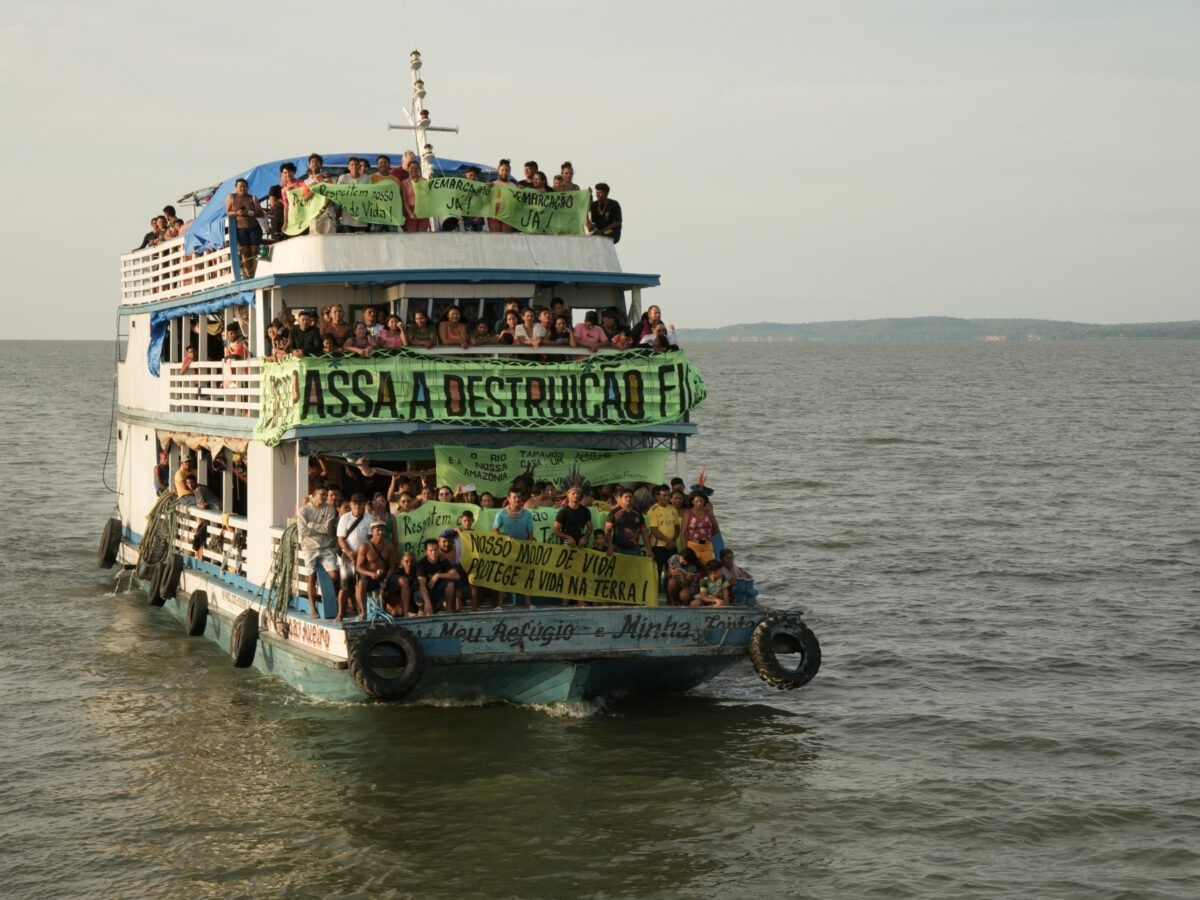
From the waters of the Guajará Bay, the largest parallel event to the 30th United Nations Climate Change Conference (COP30), happening in Belém, Brazil, began this Wednesday (12) with more than 200 boats, canoes and ships carrying about 5,000 people from popular movements across 62 countries, in a symbolic act marking the opening of the People’s Summit. The event runs until November 16, from 8 a.m. to 10 p.m., at the Federal University of Pará (UFPA) in Belém.
More than transport, income and a vital link between humans and nature, the Amazon’s boats have traditionally served as messengers along the rivers, carrying signatures and notes of affection. This time, they carry the voices of people from all over the world, proclaiming that the answer to a sustainable future lies with those who live from the waters, forests, fields and urban peripheries, communities that resist through collective, agroecological and ancestral practices.
Since last Thursday (6), the capital of Pará has been bustling with presidents, ministers and heads of state gathered for the COP30 and Climate Summit discussions. But as flotillas and caravans arrive this week, organisers of the official events are facing daily marches and protests denouncing projects such as the Ferrogrão railway and oil exploration at the mouth of the Amazon River. All groups will join together on Saturday (15) for the Unified March.
On Tuesday (11), a day before the opening of the People’s Summit, the Landless Workers’ Movement (MST) held a protest in the AgriZone, a pavilion created by the state-owned research company Embrapa within the COP30 programme, sponsored by major corporations such as Nestlé and Bayer.
That evening, another protest called for a tax on large fortunes inside the “Blue Zone,” the official COP30 area that hosts negotiation spaces. The demonstration, which began around 7:30 p.m., ended in turmoil. Still, the People’s Summit is guided not only by protest but also by dialogue and diversity.
Unlike COP30, focused on government negotiations, the People’s Summit is built through the work of more than 1,100 civil-society organisations. Over five days, it will offer open discussions in collective spaces, with plenaries, a children’s and youth area, a popular fair, solidarity kitchen, cultural activities and spaces for advocacy.
“We open the People’s Summit carrying all the symbols of the Amazon’s rivers while reaffirming our resistance to the false solutions presented by COP30, projects that destroy nature, pollute rivers, poison forests and threaten our ways of life,” said Ayala Ferreira, national leader of the MST.
November 15 will be marked by the Unified March, when Indigenous peoples, quilombola communities, youth, urban and rural workers, feminist groups, environmental collectives, trade unions and international networks will take to the streets of Belém to reaffirm that climate justice is inseparable from the defence of life and territories.
“It is impossible to discuss COP30 without placing climate justice at the centre. There will be no just transition without guaranteed rights for traditional peoples,” said Sara Pereira, from Fase Amazônia Program.
Historic mobilisation
Built over more than two years, the People’s Summit faces the challenge of bringing a plurality of voices into one space, the Federal University of Pará, which by Tuesday (11) was already filled with people from all over the world.
The summit’s programme is structured around six pillars: territories and food sovereignty; historical reparation and environmental racism; just transition; democracy and peoples’ internationalism; just cities and vibrant peripheries; and popular feminism and women’s resistance.
In a political statement, participating organisations emphasised that “decision-making countries have remained absent or presented absolutely inefficient solutions,’ while ‘investments that fuel climate change keep growing as territorial rights remain under threat.”
With an expected audience of more than 30,000 people, the gathering stands as a concrete response from grassroots movements to what they describe as the inertia and lack of commitment of the Conference of the Parties (COP). Despite reaching its 30th edition, with massive investments and billion-dollar mitigation funds, leaders say it has delivered little in terms of real results.
Full schedule
8 a.m.–10 p.m. – Popular Fair
8 a.m.–5 p.m. – Children’s Summit
9 a.m.–12 p.m. – Boat parade on the Guamá and Guajará rivers (route UFPA–Vila da Barca–UFPA); arrival of delegations
3 p.m.–5 p.m. – Reception of delegations at main stage
5 p.m.–7 p.m. – Opening of the People’s Summit at main stage
7 p.m.–9 p.m. – Opening show at main stage
CULTURAL ACTIVITIES:
Popular Fair
12 p.m. – Tamborimbó Collective
1 p.m. – Pandeiro Livre
Tapiri
8 a.m.–9 p.m. – House of Ancestral Wisdom (blessings, talk circles)
Riverbank
3 p.m. – Círio Procession
3:30 p.m. – Popular Mixture + Delegate Reception
5 p.m. – Political Act
7 p.m. – Suraras do Tapajós
8:30 p.m. – Célia Sampaio
Other spaces
1:30–4 p.m. – Energy transition and the intersectionality of gender, race, class and territory (People’s Summit / CUT & INESC space)
6 p.m. – Territories in Resistance: Circle of popular feminist and antiracist artivism – CASA FEMINISTA
