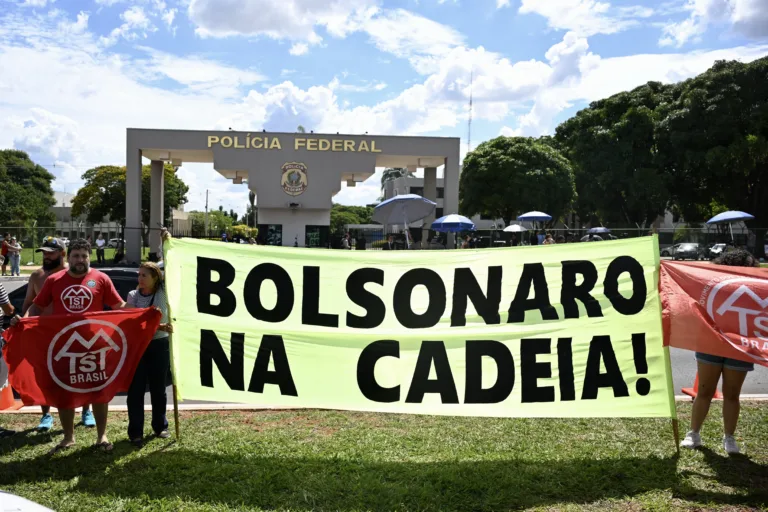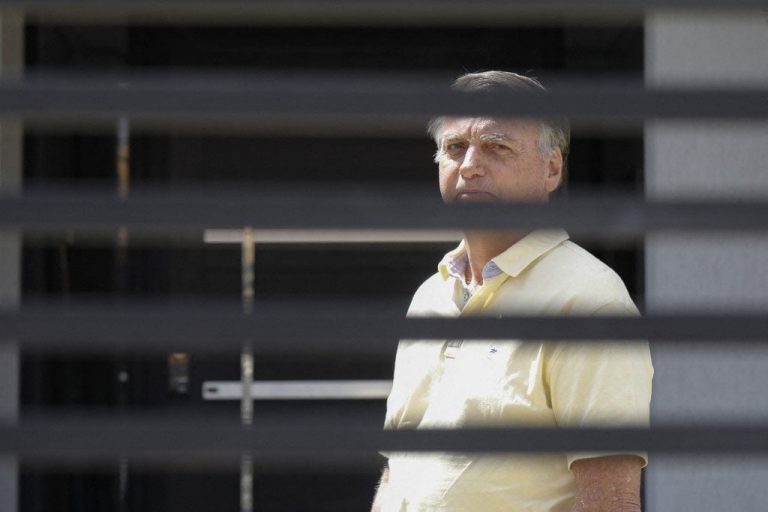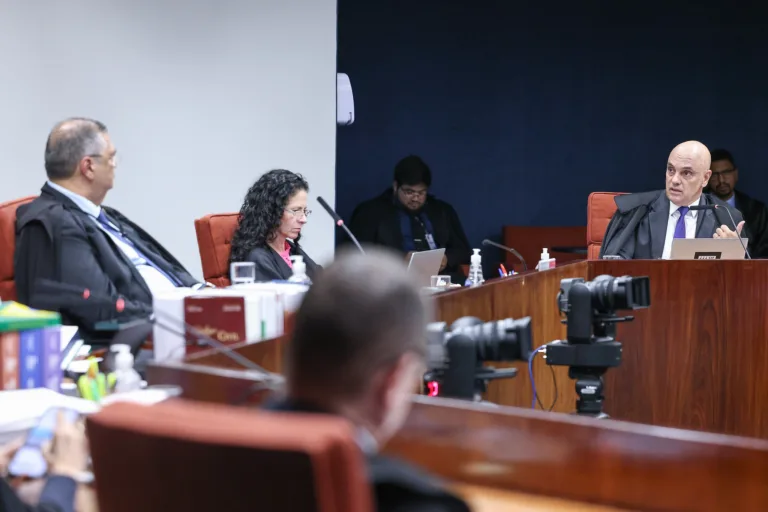
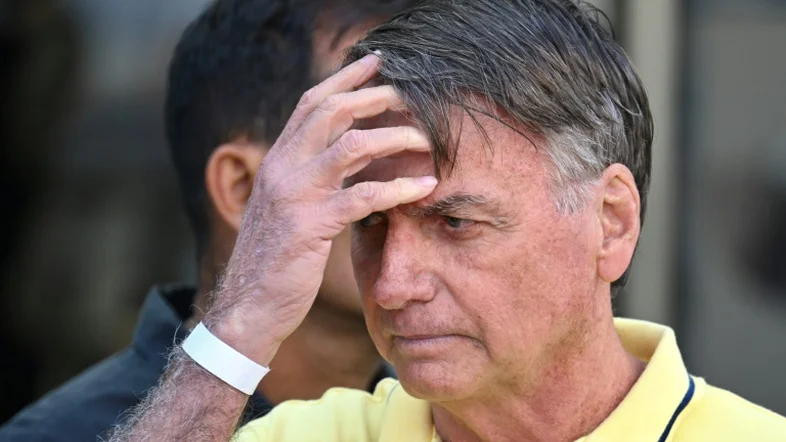
Justice Alexandre de Moraes of Brazil’s Supreme Federal Court (STF) has decreed the commencement of the prison sentence for former president Jair Bolsonaro, who was condemned to 27 years and three months in closed-regime prison for leading an attempted coup plot. He is currently detained at the federal police headquarters in Brasília, where he was transferred on Saturday (22).
The enforcement of his sentence follows the STF’s declaration that the criminal case has reached trânsito em julgado, meaning all appeals at the Court level have been exhausted and no further legal challenges remain.
Bolsonaro was convicted of armed criminal organisation, attempted violent abolition of the democratic rule of law, coup d’état, qualified damage by violence, serious threat against Union assets, and deterioration of protected heritage.
In addition to Bolsonaro, Moraes declared trânsito em julgado for former Justice Minister Anderson Torres and federal deputy Alexandre Ramagem (PL-RJ). “I certify that the rulings published on 18 November 2025 became final on 25 November 2025 for defendants Alexandre Ramagem Rodrigues, Anderson Gustavo Torres and Jair Messias Bolsonaro,” the certification signed by the Judiciary Secretariat reads.
Bolsonaro has been under preventive detention at the Federal Police headquarters in Brasília since Saturday morning (22). According to police officials, he attempted to disable his electronic ankle monitor. Moraes had imposed the monitor as part of the investigation into the obstruction of the coup case, which implicated his son, federal deputy Eduardo Bolsonaro (PL-SP), who is currently in the United States.
Apart from Bolsonaro, Moraes also ordered the enforcement of the sentences for Mauro Cid, Walter Braga Netto, Anderson Torres, Almir Garnier, Augusto Heleno, Paulo Sérgio Nogueira, and Alexandre Ramagem.
Sentences
Mauro Cid (plea-deal defendant), lieutenant-colonel and former aide-de-camp to Bolsonaro: 2 years in open regime; asset restitution and benefits extended to father, wife and adult daughter; Federal Police measures for protection of the collaborator and family.
Walter Braga Netto, retired general and former Minister of Civil House & Defence: 26 years in closed regime + 100 daily fines (each equivalent to one minimum wage at the time).
Anderson Torres, ex-Justice Minister and former Secretary of Public Security of the Federal District: 24 years in closed regime + 100 daily fines.
Almir Garnier, retired admiral and ex-Navy Commander: 24 years in closed regime + 100 daily fines.
Augusto Heleno, retired general and ex-Head of Institutional Security Office: 21 years in closed regime + 84 daily fines.
Paulo Sérgio Nogueira, retired general and ex-Defence Minister: 19 years in closed regime + 84 daily fines.
Alexandre Ramagem, federal deputy and former Director of Brazilian Intelligence Agency (ABIN): 16 years, 1 month and 15 days in closed regime + 50 daily fines.
Jair Bolsonaro, former President: 27 years and three months in closed regime + 124 daily fines (each equivalent to two minimum wages at the relevant time).
From president to prisoner
According to the Federal Prosecutor’s Office (PGR), March 8 2021, the date when then-former president Luiz Inácio Lula da Silva had his political rights restored, marked the start of a series of attacks by Bolsonaro on Brazil’s electronic voting system and electoral institutions. In mid-2021, he hosted a live broadcast from the presidential residence, publicly questioning the security of Brazil’s system of electronic voting. Prosecutors say this live stream flagged his broader campaign to undermine the Electoral Justice system.
In the same year, during September 7 celebrations, the president publicly stated he would not comply with decisions from the Supreme Court.
Attacks on Brazil’s electronic voting system
According to the indictment filed by the Office of the Prosecutor General (PGR), March 8, 2021 marked the beginning of a series of attacks by then-President Jair Bolsonaro on Brazil’s electronic voting machines and the country’s electoral system. That same day, former president Luiz Inácio Lula da Silva had his political rights restored after the Supreme Federal Court annulled the convictions from the Operation Car Wash cases.
The PGR highlighted that, in mid-2021, Bolsonaro held a live broadcast from the presidential residence in which he questioned the security of the electronic ballot system. Prosecutors said the livestream represented the start of a broader campaign to discredit the Electoral Court.
Later that year, during Brazil’s Independence Day celebrations on September 7, Bolsonaro publicly declared that he would no longer comply with rulings issued by the Supreme Court.
The ministerial meeting
On July 5, 2022, the government’s confrontation with democratic institutions took a new turn when Bolsonaro convened a ministerial meeting focused on the upcoming elections. A recording of the meeting was later retrieved from a close aide’s device.
During the meeting, Bolsonaro urged his ministers to act in the face of unfavorable polling numbers.
“Everyone here is above-average intelligent. Everyone here, like everyone out there, has something to lose. We can’t, folks, just let the elections happen as they’re painted… We’ll have to do something before,” he said, referring to the need for a “Plan B.”
“The picture on October 2 will be final, damn it! Could it be any clearer? We’re doing the right thing, but Plan B has to be implemented now,” Bolsonaro added.
At another point, General Augusto Heleno, then head of the Institutional Security Office (GSI), spoke explicitly of “turning the table”:
“There will be no review by the VAR [referee]. So, whatever has to be done, must be done before the election. If we have to slam the table, it’s before. If we have to turn the table, it’s before the election,” he said.
Shortly afterward, on July 18, Bolsonaro met with foreign ambassadors at the Alvorada Palace, once again casting doubt on the integrity of Brazil’s elections. The Prosecutor’s Office later described the meeting as an attempt to seek international legitimacy for a potential institutional rupture.
Electoral defeat
During the second round of the 2022 presidential elections, the Federal Highway Police (PRF) conducted road operations in areas where Lula had performed strongly in the first round. The Electoral Court (TSE) summoned then-director Silvinei Vasques and ordered the immediate suspension of the operations. Although no voters were ultimately prevented from casting ballots, the incidents drew widespread criticism and triggered investigations.
After his defeat, groups of Bolsonaro supporters set up camps outside Army barracks, calling for military intervention, while the former president remained secluded, refusing to publicly acknowledge Lula’s victory. On the eve of the inauguration of President Lula and Vice President Geraldo Alckmin, Bolsonaro left Brazil for the United States.
The “secret plan”
By late 2022, the Federal Police had identified a document known as “Green-and-Yellow Dagger”, attributed to General Mário Fernandes. The text outlined drastic measures such as annulling the election results, arresting political opponents, and even assassinating elected officials, including Supreme Electoral Court (TSE) president Justice Alexandre de Moraes.
The crisis reached its peak on January 8, 2023, when thousands of rioters invaded and ransacked the headquarters of Brazil’s three branches of government in Brasília. More than 1,500 people were arrested in the days that followed, charged with crimes such as destruction of public property and attempted abolition of the democratic state.
In September 2023, Bolsonaro’s former aide-de-camp, Lieutenant Colonel Mauro Cid, signed a plea-bargain agreement, providing authorities with detailed testimony about the crimes committed by Bolsonaro and other former officials.
Sanctions and the start of the criminal case
Bolsonaro’s first major judicial sanction came on June 30, 2023, when the Electoral Court (TSE) declared him ineligible for eight years for misuse of public communications during the meeting with foreign diplomats at the Alvorada Palace.
The criminal investigation advanced in November 2024, when the Federal Police formally charged Bolsonaro with attempting a coup d’état. In February 2025, the Prosecutor General’s Office (PGR) submitted the case to the Supreme Court, accusing him of leading an armed criminal organization that sought to undermine the constitutional order. In March 2025, the STF’s First Panel formally accepted the indictment, opening Criminal Case No. 2668.
Between May and August 2025, the case took on international dimensions after Bolsonaro’s son, federal deputy Eduardo Bolsonaro (PL-SP), traveled to the United States seeking sanctions against Brazilian authorities under the claim of “political persecution.”
In response, Justice Moraes imposed strict precautionary measures, including house arrest, communication restrictions, passport confiscation, and a ban on using digital platforms, which were later tightened after repeated violations.
Conviction
The final ruling took place in September 2025, when the STF’s First Panel convicted Jair Bolsonaro by four votes to one to 27 years and three months in prison, to be served under a closed regime. He was found guilty of armed criminal organization, attempted violent abolition of the democratic state, coup d’état, violent damage to federal property, and deterioration of protected heritage.
Seven other defendants, identified as part of the “Hard Core” of the coup plot, were also convicted, including federal deputy and former intelligence chief Alexandre Ramagem, former Navy commander Almir Garnier, former Justice Minister Anderson Torres, General Augusto Heleno, former Defence Minister Paulo Sérgio Nogueira, and General Walter Braga Netto, Bolsonaro’s 2022 vice-presidential running mate.
Their sentences range from 16 to 27 years, depending on their level of involvement.