

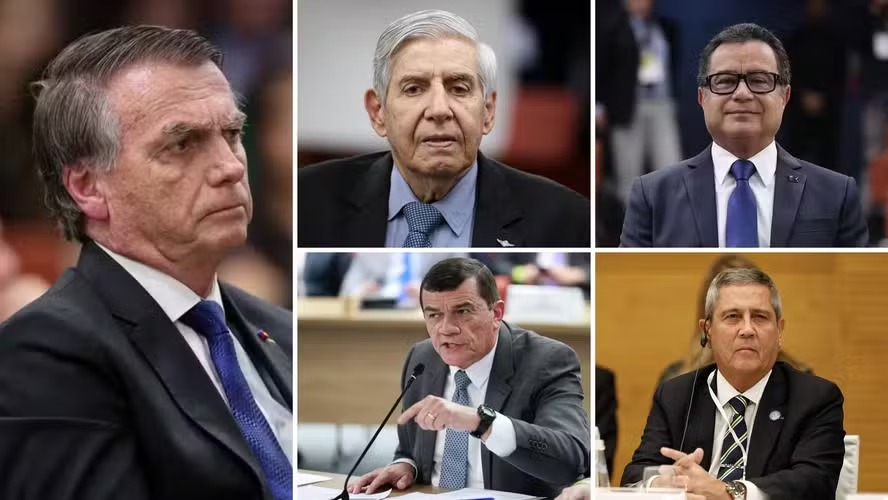
Never before in this country’s history had high-ranking military officers been convicted. In that sense, the year 2025 broke a tradition of more than two centuries of impunity. Wouldn’t this then be the perfect opportunity to take advantage of these historical winds and reform our Armed Forces, democratize them, and bring them closer to the population they are supposed to serve?
BdF put this question to political scientist and military analyst Ana Penido, a professor at the Federal University of Rio de Janeiro (UFRJ).
After all, besides the head of the criminal organization that tried to remain in power after losing at the ballot box, Jair Bolsonaro, a retired captain who received a sentence of 27 years and three months in prison, four-star Army generals Augusto Heleno, Paulo Sérgio Nogueira, and Walter Braga Netto were also convicted, as well as Admiral Almir Garnier Santos. They will serve sentences for five crimes, including coup d’état and criminal organization, ranging from 19 to 27 years in prison.
Lieutenant Colonel Mauro Cid, however, did not have his case referred to Military Justice, since as a result of a plea bargain his sentence did not exceed two years and will be served under an open regime. “Within the Armed Forces, it was considered more serious to betray colleagues than to attempt a coup d’état,” explains Penido. Read below the interview, in which the analyst explains how the trials were seen within the barracks and the challenges of improving our Armed Forces:
BdF: Is it possible to take advantage of this historic year, in which we put four-star generals behind bars, to reform the Armed Forces and make them more democratic?
Ana Penido: There is a lot of debate about this and yes, it is possible to have armed forces committed to the values of democracy in general, but even so they remain an institution governed by hierarchy and discipline.
The dynamics of internal democracy within a military institution are not democratic by nature. One person commands and the other obeys, and at most you build grievance mechanisms.
Even so, is it possible to bring them closer to the population, respecting and guaranteeing democracy instead of staging coups?
The armed forces, particularly the Army, in a way express what the population is like, and the problems we have in the structure of the country. For example, we see an all-white High Command and, in compulsory recruitment, those boys who stay for only one year, a predominantly Black, low-income youth from the outskirts.
On the other hand, we have a problem related to ideological diversity within the armed forces, involving democratic values, views on the market, and social values in general. It is not just about democracy, but also about behavioral issues, such as relations with women, LGBTQ people, etc.
This is indeed a problem, because all studies identify that they are politically right-leaning. We do not have many methodologically structured studies on the ideological behavior of the Armed Forces, only a few on the Army.
There is more research on the police, which indicates this logic, positions more linked to the right, not necessarily the far right, which today displays an inherently anti-democratic stance, but rather this kind of “gelatinous” right.
This is a democratic problem, because what is best for a country is to have forces that reflect the diversity of its people, not only in their problems, such as the structural racism that permeates Brazil and also the forces themselves.
Do you see the possibility of change?
Not in the short term. I see no forceful initiative from either the Executive or the Legislative in this direction. None at all. In fact, I think we are missing a huge historical opportunity.
It is not about punishing X or Y, because that is the task of the judiciary and I think it is doing its job well — after all, we saw four-star generals who historically were not punished by Military Justice being punished by civilian courts. But these initiatives have not been accompanied by the Executive or the Legislative.
We do have an opportunity for changes that are not reactive or punitive because of the Bolsonaro government. They are necessary changes in light of what the last 25 years since the end of the military dictatorship have been like, and in response to the demands that international geopolitics has placed on us, an explosion of conflict around every corner, such as the issue of Venezuela.
What did the convictions of these generals cause within the Armed Forces?
I believe what generated the most indignation within the Armed Forces were cases of military officers who encouraged internal divisions, such as when comments by Braga Netto were leaked telling people to attack a brigadier’s family. Or when memes circulated calling four-star generals “watermelons” (green on the outside, but red, that is, communist, on the inside). These things caused a stir.
Because one thing is to betray democracy or attempt a coup; another is to betray your institution. When one soldier turns in another, this resonates very badly internally.
In this sense, the punishments are seen as a penalty not necessarily for political intervention, but for the method used. Betraying a colleague is considered worse than betraying democracy.
Was attempting a coup not considered so serious?
Exactly, it is less serious than turning in a colleague or telling people to attack a colleague’s family, which is even worse. And we saw this in the testimonies, right? That is why there are different perceptions.
For example, General Heleno has always been very well regarded within the ranks. He truly has a very distinguished career and is the pure expression of career success in the eyes of the military.
Cid is the same. He was ridiculed for keeping jewelry at home, but being appointed to work with the president is a position of enormous prestige. He was being rewarded for being considered the best available officer for the task. This shows the scale of our problem and our difficulty in dealing with this world and intervening in it.
Is there a lack of political will?
Partly, but I think political will is actually easier. What calculation does Lula make? Even before the Bolsonaro government, the Armed Forces were considered one of the institutions most trusted by the population.
People like the Armed Forces, but this declined during the Bolsonaro government and reached its lowest levels right after the attempted coup. This happened for two reasons: they lost prestige on the right, which thought they would stage the coup but they did not go far enough; and with the left, which already did not expect much from the military.
Ordinary people also began to learn about a set of privileges that the military already had before the Bolsonaro government, but which became visible when they went into government. They did not start drinking whisky or buying Viagra under Bolsonaro, this was already happening before, but nobody knew about it.
This affects public opinion, and political will is closely related to public opinion. If people thought the Armed Forces were working well, they would hardly accept the political cost of making changes. The most important thing to do is to change public opinion. And this also involves defining the role of the military, not using them for everything.
The military must be professional, focused on defense policy. Surveys show that people like them not for being soldiers, but for building infrastructure projects, which is a problem, because that is the function of the state.
Or for good sports performance. Why is the Armed Forces in Sports program in the Ministry of Defense and not in the Ministry of Sports?
There are structural problems that go far beyond what happened on January 8, 2023, and that Brazil has historically failed to face. I think the changes that need to be made must take into account the domestic and international scenarios and renegotiate our understanding of what the Armed Forces are for and how they can relate to society.
Do you defend that military personnel should publicly express their opinions?
I defend that the military should reflect the diversity of Brazilian society. It is natural for these people to have opinions. Those who are on the right express this freely. They feed a certain militarism in society that thinks it is chic, that goes out and buys camouflage clothing and so on. On the other hand, more left-leaning opinions are persecuted.
My point of view is that public manifestations must be prohibited for those on active duty. For reservists, that is fine.
