The recent U.S. military assault on Venezuela and the kidnapping of the country’s president, Nicolás Maduro, along with First Lady and National Assembly deputy Cilia Flores, has sparked intense debate over the fragility of global norms and international law.
Coming amid the third anniversary of Brazil’s January 8, 2023 coup attempt and on the eve of the country’s next presidential election, analysts warn that Washington’s renewed national security doctrine poses risks to Brazilian sovereignty. Under this doctrine, Latin America is treated as an exclusive sphere of influence, one in which virtually anything is permitted.
If bombing a sovereign country is now tolerated, the question follows: what would prevent interference in electoral processes? Political scientist Jorge Folena argues that U.S. President Donald Trump, whom he describes as a leader of the global far right, will seek to interfere in Brazil’s elections to favor a candidate aligned with a “surrender of sovereignty” agenda “similar to Brazil’s 2019-2022 government.”
“The electoral process will demand even greater mobilization from democratic, popular, and progressive forces to explain to public opinion that defending national sovereignty is essential,” Folena warns. “The fascists, the far right, and neoliberal forces are committed to handing over Brazil’s wealth and even turning the country into a U.S. protectorate, erasing our sovereignty and independence.”
Political scientist Mayra Goulart, in turn, distinguishes the geopolitical realities of Venezuela and Brazil. She notes Venezuela’s political isolation and contrasts it with Brazil’s diplomacy based on soft power, which leads her to rule out the possibility of a direct military intervention in Brazil. Still, she foresees a highly contentious electoral scenario marked by radicalization and heavy use of digital disinformation, backed by powerful tech entrepreneurs aligned with the global far right.
“If the Workers’ Party (PT) pulls far ahead in the polls, this could trigger further radicalization by the far right, either by encouraging coup attempts or by launching an even more aggressive campaign, flooded with fake news, using every possible tool, with the blessing of platforms closely associated with global far-right leaders and Donald Trump,” Goulart assesses.
“For that reason, I believe this will be a very difficult election, and Donald Trump’s return to power in the U.S. is indeed a factor that could generate some degree of interference in Brazil’s elections,” she adds.
Trump and January 8
“Donald Trump openly expresses his fascist worldview. And January 8 in Brazil was a fascist act, it was carried out by fascists,” Folena says, drawing a direct line between the 2023 coup attempt and U.S. foreign policy, which he argues is not new but has become more explicit under a far-right government.
“This doctrine Trump presents for Latin America is one the United States has applied for 200 years, now intensified and carried out by a declared fascist, a supremacist who disregards due process, the right to defense, and the rule of law altogether,” Folena says.
“The Brazilian fascists, led by the former president, behave in exactly the same way,” he continues. “That’s why they are emboldened right now, encouraged to call for a Trump-style action in Brazil similar to what happened in Venezuela. It is a typically fascist action.”
Mayra Goulart adds that beyond direct interference, U.S. interventionism may inspire new coup-minded movements inside Brazil.
“This new security doctrine and Trump’s leadership act as symbols that certainly encourage coup plotting in Brazil, especially because our Armed Forces are heavily influenced by the United States,” she explains. “This signaling, of the Monroe Doctrine, of national interest overriding law, of force above legality, can create fertile ground for these coup energies that still persist within the military.”
“Even with the investigations into January 8, these coup cells were not dismantled and continue to reproduce this ideology,” Goulart notes, adding that impunity fuels further anti-democratic discourse.
“I’m particularly concerned about the Dosimetry Bill, because it signals that if there is a coup attempt, nothing will happen in the end, there will be forgiveness, there will be amnesty. That is extremely dangerous and encourages coup plotting,” she warns.
The United States as a global threat
For Folena, the military aggression against Venezuela exposed the vulnerability of national sovereignty in the face of an authoritarian U.S. government under Trump. “This action weakened not only Venezuela’s sovereignty, but that of all countries. What Trump imposed was the law of the strongest, and that is disastrous for the world’s peoples,” he says.
He argues that Brazil is particularly vulnerable due to its lack of robust military deterrence. If the will of a foreign leader overrides international law, Brazil, and the Amazon, could become targets of undue external pressure.
“Under this worldview, Trump could take action against Brazil just as he could against any country, especially those without deterrence. Brazil has no real deterrence,” Folena says. “If the law of the jungle prevails, if international law and respect for sovereignty are discarded, those without military power are exposed to anything.”
“If he dislikes President Lula, or Brazil’s policies, or decides he wants to seize the Amazon, he could try to put that into practice,” he adds.
Folena characterizes Trump’s belligerent actions as “typically fascist,” recalling historical precedents from Europe’s authoritarian past. “Mussolini’s Italy invading Ethiopia, Nazi Germany invading neighboring countries, this is the same supremacist, colonial logic of looting another nation’s wealth.”
Mayra Goulart invokes Karl Marx’s The Eighteenth Brumaire of Louis Bonaparte to note that history never repeats itself exactly, “except as farce or tragedy.” Still, she says, patterns are visible.
“There is a clear pattern of disregard for international regulations, contempt for multilateral institutions, and the primacy of national interest governing relations within a declared sphere of influence,” she explains.
Lula: confidence, naivety, or restraint?
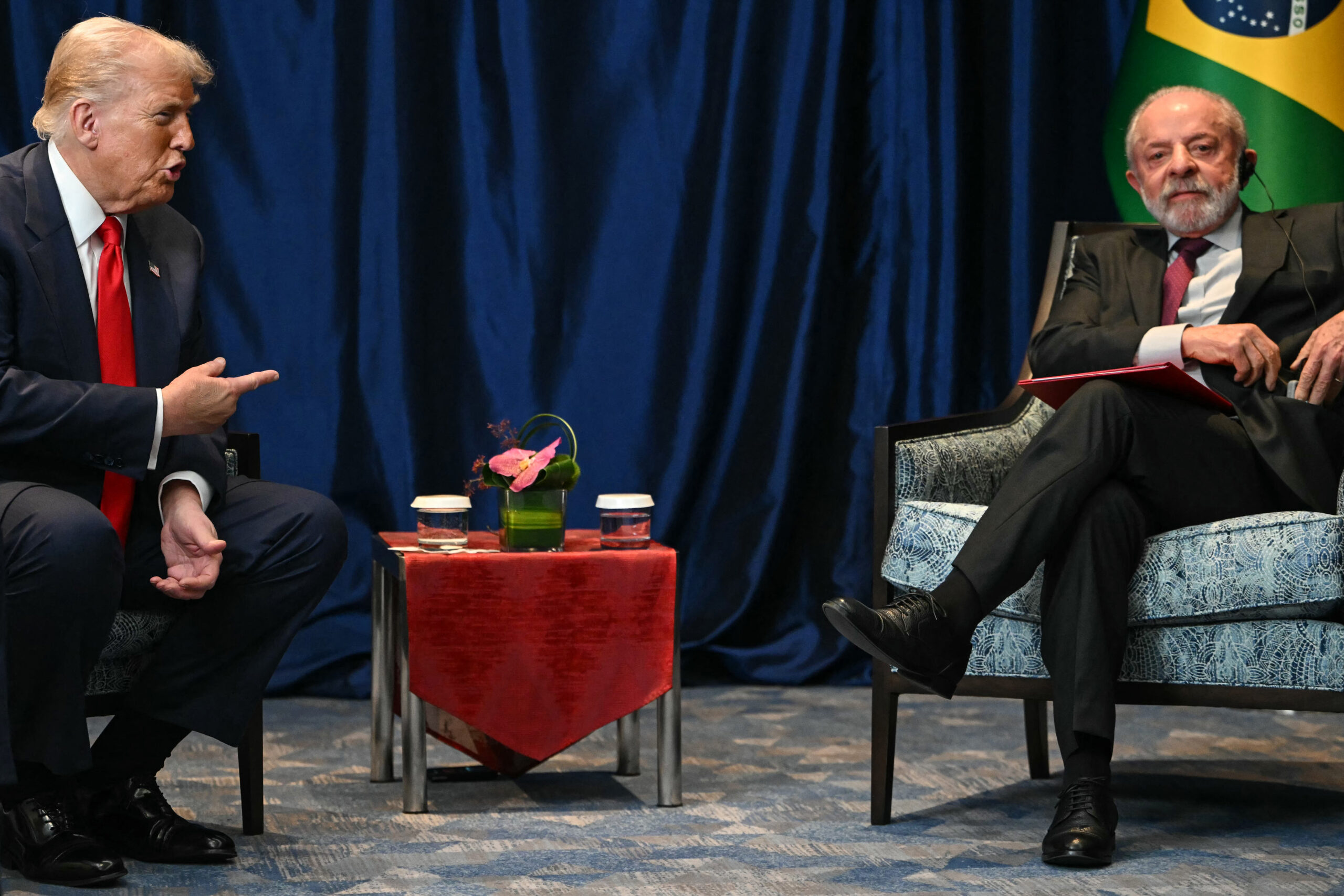
In December 2025, shortly before the end of the year, BdF asked President Luiz Inácio Lula da Silva whether he feared interference by Donald Trump’s government in Brazil’s upcoming elections. Lula avoided a direct answer, saying he would win based on his government’s achievements.
“I am very confident in our foreign relations, our economy, our social inclusion policies, our climate and energy transition agenda,” Lula said. “There is no issue I am not comfortable debating with anyone. I believe the far right will not govern Brazil again.”
At the time, Lula had already expressed concern about a possible U.S. military action against Venezuela and said he intended to speak with Trump before Christmas to avoid war.
“Before Christmas, I may need to speak with President Trump again to see what Brazil can contribute so that we reach a diplomatic agreement instead of a fratricidal war,” Lula said, days before the U.S. attack and the kidnapping of Nicolás Maduro and Cilia Flores.
After the assault, both Brazilian diplomacy and President Lula formally condemned the attacks for violating international law. The Brazilian government recognized Delcy Rodríguez as Venezuela’s interim president.