

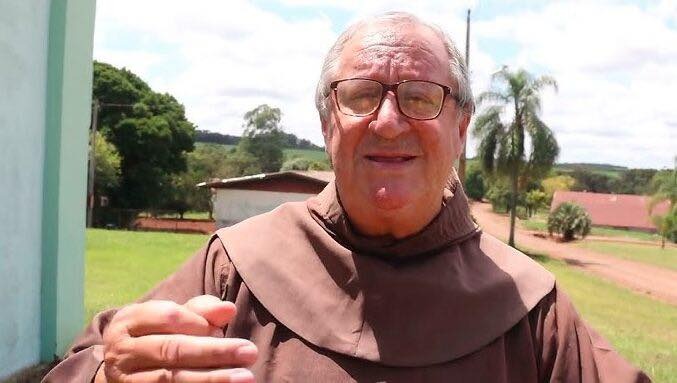
Friar Sérgio Görgen, a Franciscan friar and one of the most influential figures in Brazil’s peasant and land rights movements, died this Tuesday (3) at the age of 70, following a heart attack. He passed away at his home in the Conquista da Fronteira settlement, in the rural municipality of Hulha Negra, in southern Brazil.
Görgen was a national leader of the Small Farmers’ Movement (MPA), a grassroots organization that represents family farmers and advocates for food sovereignty, agroecology and public policies for rural communities. He was also one of the founders of the Landless Workers’ Movement (MST), one of the largest social movements in Latin America, known internationally for its role in land reform struggles.
In addition to his activism, Frei Sérgio served as a state legislator for the Workers’ Party (PT) between 2002 and 2006, combining institutional politics with long-term grassroots organizing. For decades, he was widely recognized in Brazil as a religious leader who linked Christian faith with social justice and political commitment to the rural poor.
In a statement, the MPA described him as “more than a leader, but a shepherd who chose the ‘smell of the sheep’ and the mud of struggle.” According to the movement, his legacy lives on “in every native seed planted in Brazilian soil, in the fight for food sovereignty and peasant dignity.”
Frei Sérgio belonged to a tradition of liberation theology, a current within Latin American Christianity that understands faith as inseparable from the struggle against poverty, inequality and oppression. His activism consistently challenged the idea that religion should be confined to church walls.
“Religion does not begin when we enter a church, but when we leave it,” he said in an interview with BdF in 2024. “The mission we receive from Jesus of Nazareth is lived in the world, not inside four walls.”
Throughout his life, Frei Sérgio took part in high-risk political actions, including hunger strikes in the 1990s demanding agricultural credit for small farmers, protests against Brazil’s pension reform in 2017, and mobilizations in 2018 calling for the release of then–former president Luiz Inácio Lula da Silva.
He was also a survivor of the Santa Elmira Farm massacre in 1989, a violent eviction of rural workers by state forces in southern Brazil. The episode left dozens injured and became a landmark case in Brazil’s history of land conflicts. Görgen later documented the massacre in books and testimonies, helping preserve its memory as part of the country’s unresolved agrarian question.
Beyond organizing and politics, Frei Sérgio played a key role in strengthening popular communication. In 2018, he helped found BdF Rio Grande do Sul, the southern Brazil branch of the media outlet, providing institutional and political support through the Padre Josimo Cultural Institute.
According to journalists who worked with him, Görgen believed that communication was a central terrain of struggle and insisted on journalism rooted in dialogue with working-class and rural communities.

João Pedro Stedile, a national leader of the MST, described him as a “comrade of 40 years of struggle” and emphasized that “even when battles were lost, victory came through organized people.”
For many movements across Brazil, Frei Sérgio Görgen represented a rare figure who bridged faith, political action and peasant resistance, at a time when land concentration, environmental destruction and food insecurity remain structural challenges in the country.
His death marks the loss of a key reference in Brazil’s popular struggles, but, as movements emphasize, not the end of the political seeds he helped plant.
