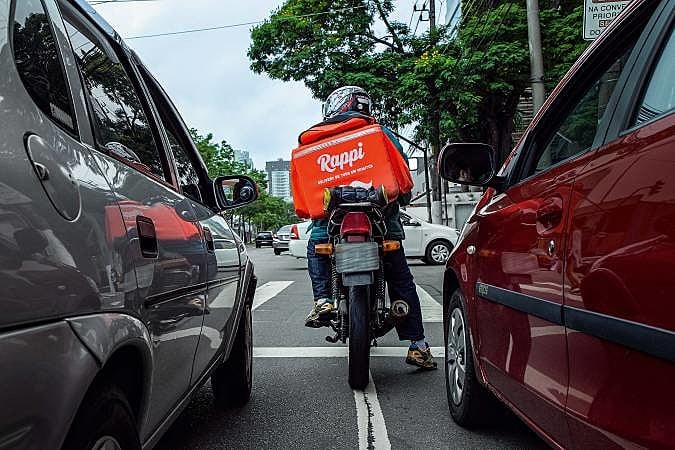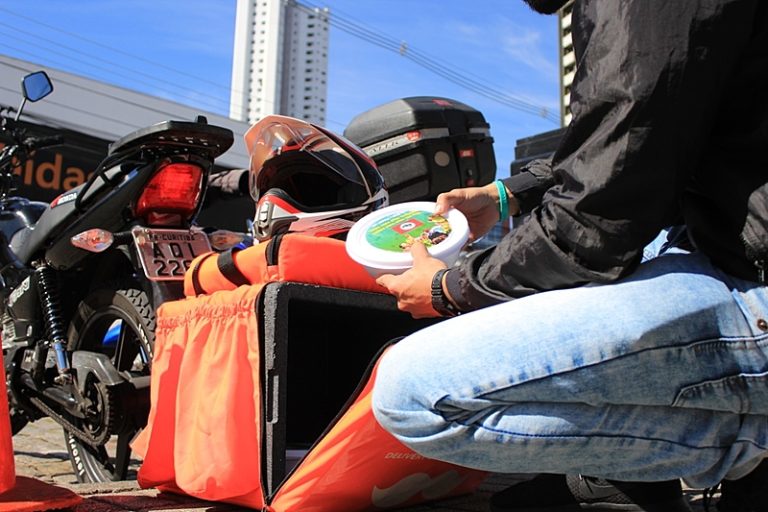
Regulation of app-based delivery work has advanced in Brazil’s National Congress, but the proposal currently under discussion has drawn significant criticism from workers and social movements. Couriers say the draft legislation fails to address key demands such as fair minimum rates, expanded insurance coverage, algorithmic transparency, and labor protections. The proposal has also sparked controversy for including a requirement that workers present a criminal background certificate.
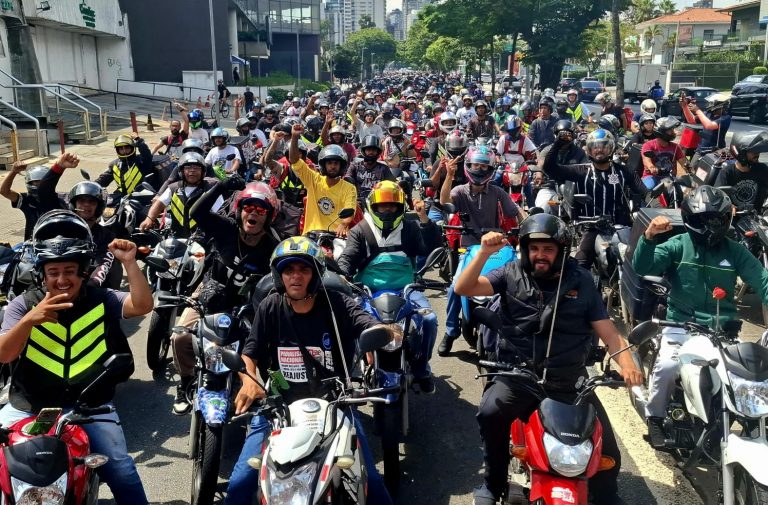
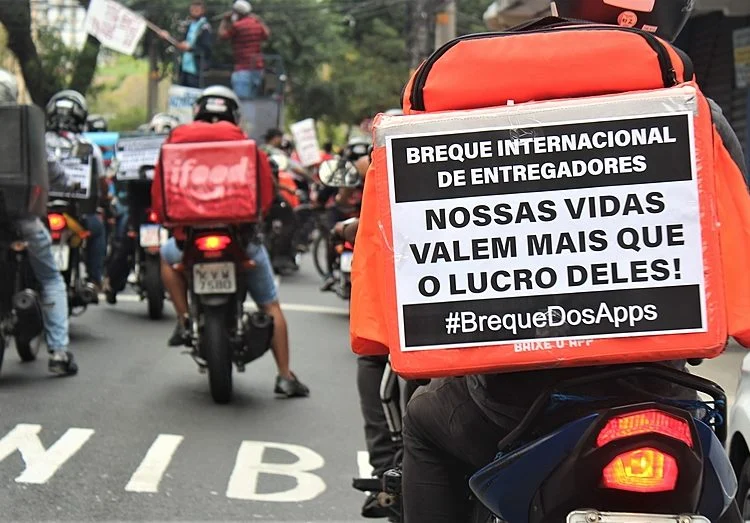
The debate centers on Complementary Bill (PLP) 152, currently under analysis in the Chamber of Deputies. App-based motorcycle couriers have called for a protest this Saturday (7) against the draft presented by federal deputy Luiz Gastão. While the bill proposes new rules governing platform obligations and worker rights, critics argue it does not reflect the basic demands raised by the category.
A revised report by deputy Augusto Coutinho introduced additional changes that further divided workers. One of the main points of contention is the requirement for a certificate proving the absence of criminal convictions. Social organizations warn that this requirement could effectively exclude formerly incarcerated individuals from registering on platforms.
Anderson Luis de Lima, a member of the Motocas do ABC collective, part of a broader mobilization front defending delivery workers, said the issue is non-negotiable.
“The worst part is preventing young people with a history in the prison system from working. Other points can be discussed, but banning former prisoners from working is inhumane. This sector has always welcomed them. The government has an obligation to reintegrate these people into work,” he told BdF.
Brazil’s Constitution and its Penal Execution Law recognize access to work as part of social reintegration for formerly incarcerated individuals. Workers argue that if approved in its current form, the bill could face legal challenges and potentially be overturned by the Supreme Federal Court (STF).
Organized groups also criticize the proposed minimum payment rates. The bill establishes a base fee of R$ 8.50 per delivery (approximately US$ 1.70) for trips covering up to 4 kilometers between pickup and drop-off locations. Couriers say the minimum should be R$ 10 (around US$ 2.00) and that compensation must also account for travel time to reach the restaurant or pickup point.
Workers’ organizations are also demanding mandatory additional payments of R$ 2.50 (about US$ 0.50) per extra kilometer beyond the limit and R$ 0.60 (around US$ 0.12) per minute of waiting time after a 10-minute delay. Another demand is an annual adjustment of the minimum fare according to inflation, which is currently absent from the draft legislation.
A further controversy involves grouped deliveries. Under PLP 152, when multiple orders are delivered during a single trip, workers would receive the full minimum rate only for the first delivery. The second would pay 50% of the minimum rate and the third just 25%. Couriers argue they should receive 100% of the minimum fee for each delivery, regardless of route overlap.
Algorithmic transparency and unfair account suspensions
Workers are also demanding algorithmic transparency. Currently, platforms do not disclose how pay is calculated, how delivery assignments are distributed, or how dynamic pricing operates. Movements are calling on companies to explain these criteria and provide clearer information about how earnings are determined.
A related issue is account deactivation. Couriers report being removed from platforms after user complaints without clear explanations or due process.
Jr. Freitas, coordinator of the Movement of Workers Without Rights (MTSD) — which participates in a federal government working group on regulation — said unjustified suspensions are one of the sector’s most pressing problems.
“Workers are often disrespected by customers but still end up punished. Some couriers have no idea why they were blocked because platforms do not even indicate which delivery triggered the issue. Sometimes mistakes by restaurants fall on the courier. Platforms must guarantee the right to defense and compensation when workers are unjustly removed,” he said.
Disputes with platforms and social security contributions
Companies operating delivery platforms have resisted increasing minimum rates or committing to annual adjustments. They have also opposed expanding life insurance coverage. Currently, insurance applies only during active deliveries; workers want coverage extended to travel to the first delivery and return trips home.
The bill also addresses social security contributions to Brazil’s public system (INSS). The proposal would require contributions equivalent to 10% of 20% of workers’ earnings, but couriers argue companies should bear a larger share of this cost, a position platforms reject.
Renato Assad, from the National Organization of Two-Wheel Workers (ONTDR), described the current proposal as one of the “biggest attacks and setbacks” against workers in recent decades, warning that it could deepen precarious labor conditions across digital platform sectors.
“Ending the six-day work schedule has been promoted as an electoral promise, while at the same time the government negotiates a regulation that normalizes 12-hour workdays. That is a major contradiction,” he said.
Dispute over the bill’s origins
Assad’s criticism refers to an earlier draft developed after the 2025 National App Strike, when delivery workers across Brazil organized coordinated stoppages demanding better working conditions. Those demands were incorporated into Bill 2.497, introduced by former federal deputy Guilherme Boulos.
Shortly afterward, however, the president of the Chamber of Deputies created a special committee to accelerate discussions, merging the proposal into Complementary Bill 152. Many couriers consider this move a political maneuver that altered the original project’s direction.
While some workers demand a return to the original proposal, the federal government argues that negotiations must now proceed within PLP 152.
Delivery worker groups plan to hold a protest this Saturday (7) in Diadema, São Paulo state, against the bill.