

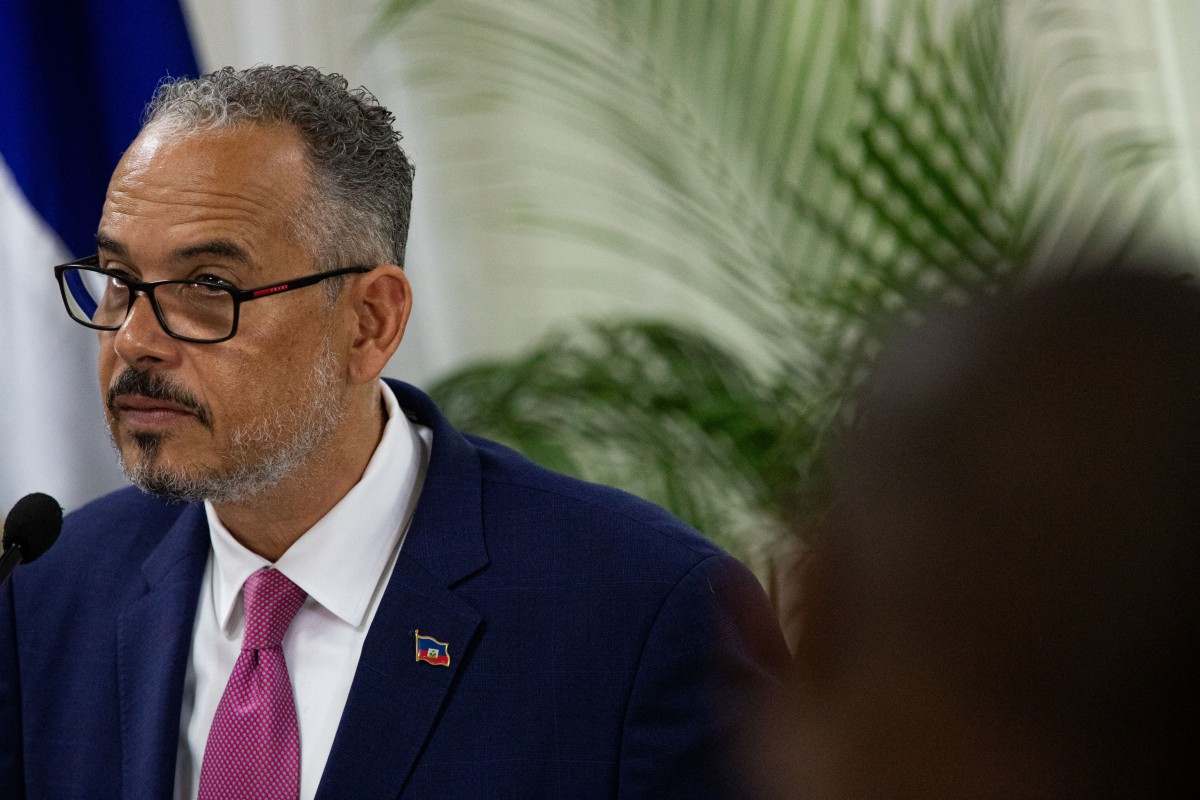
Following direct pressure from the United States, Alix Didier Fils-Aimé assumed control of Haiti’s executive branch last Saturday (7). Progressive sectors within the country, however, argue that Aimé, who currently serves as prime minister, is aligned with foreign interests and the Haitian elite, and shows little willingness to address his limited legitimacy among the population.
“Let us remember that Alix Didier Fils-Aimé diverts US$35,000 per month from Haitian public funds to pay lobbyists at the U.S. State Department. In addition, he signed a 10-year contract worth hundreds of millions of dollars with the private security company owned by Eric Prince,” stated grassroots broadcaster Radyo Rezistans on social media.
“The company will be responsible for modernizing customs operations and controlling Haiti’s borders with other countries. In doing so, Alix Didier Fils-Aimé is effectively handing over control of customs and national borders to foreign mercenaries.”
“The contract documents have been submitted to the Superior Court of Accounts for review. It is urgent that civil society pressure the Court to prevent this project from being approved.”
BdF’s correspondent in Haiti, Cha Dafol, notes that “the vast majority of the population does not recognize the prime minister as their legitimate ruler.”
“He has never been elected to any office. After being appointed prime minister, he delivered his first speech following the fall of the transitional government, and spoke the first half in French, despite knowing that most Haitians would not understand him,” she said.
Dafol highlighted that few Haitians speak French, the language associated with former colonial rule. Haitian Creole, the language spoken by the majority, was only used during the second half of Aimé’s address. “That shows he was speaking primarily to elites and foreign audiences,” she added.
Alix Didier Fils-Aimé is a businessman in the communications sector and a graduate of Boston University in the United States. He previously served as president of the Haitian Chamber of Commerce and Industry (CCIH) and unsuccessfully ran for Senate in 2016.
Threat of U.S. intervention
Aimé’s rise to power comes amid mounting pressure from Washington. In January, when it became clear that Haiti’s Presidential Transitional Council (CPT) would conclude its two-year mandate without fulfilling its main objective, creating conditions for new elections, the body began considering alternatives to avoid a power vacuum.
Options discussed included forming a smaller transitional council or requesting assistance from the Caribbean Community (Caricom). However, the solution that ultimately prevailed was appointing Aimé as the sole head of the executive, a move reportedly demanded by the U.S. embassy.
Washington’s representation in Port-au-Prince warned that any attempt by the CPT to alter the government’s composition would be seen as a threat to regional stability and that it would “take appropriate measures accordingly.” The United States also deployed three warships off Haiti’s coast, a move widely interpreted as pressure to secure the prime minister’s position.
“Haitians noticed several U.S. warships stationed in the waters near Port-au-Prince on Sunday, February 1. The Haitian government did not issue any official explanation for their presence,” Radyo Rezistans reported.
“According to a statement from the U.S. embassy, the presence of these ships demonstrates Washington’s commitment to protecting Haiti from insecurity and ensuring peace in the country.”
However, the collective of grassroots communicators argues that “in order to keep Prime Minister Alix Didier Fils-Aimé in power and remove members of the CPT – who had previously dismissed a CPT-appointed prime minister – the United States has effectively declared war on Haiti. This represents a truly deplorable level of criminal behavior by the U.S. government.”
Haitian journalist Reyneld Sanon told Brasil de Fato that “overall, the population is angry about the pressure exerted by the U.S. and Canada to maintain Alix Didier Fils-Aimé in power. However, there have been no demonstrations in front of embassies because people fear that U.S. warships and troops could intervene at any moment.”
“Aimé is not here to govern the country, he is a servant installed by the United States to carry out its imperialist agenda. For example, he has allowed several U.S. companies to secure contracts worth hundreds of millions of dollars. Both he and State Secretary Mario Andresol and Police Director Vladimir Paraison maintain good relations with criminal gangs and enjoy the backing of imperialist embassies.”
Sanon believes that even if elections are eventually held, the dominant bourgeoisie will remain in power. “Since U.S. troops left the country in 1934, the only truly free and democratic elections took place in 1990. Imperialism has consistently controlled elections in Haiti, it is imperialism that ultimately determines the outcome.”
With no elections held since 2016, the Presidential Transitional Council took office in April 2024 to guide a transition following the resignation of Prime Minister Ariel Henry, who had governed since the assassination of President Jovenel Moïse in July 2021.
