

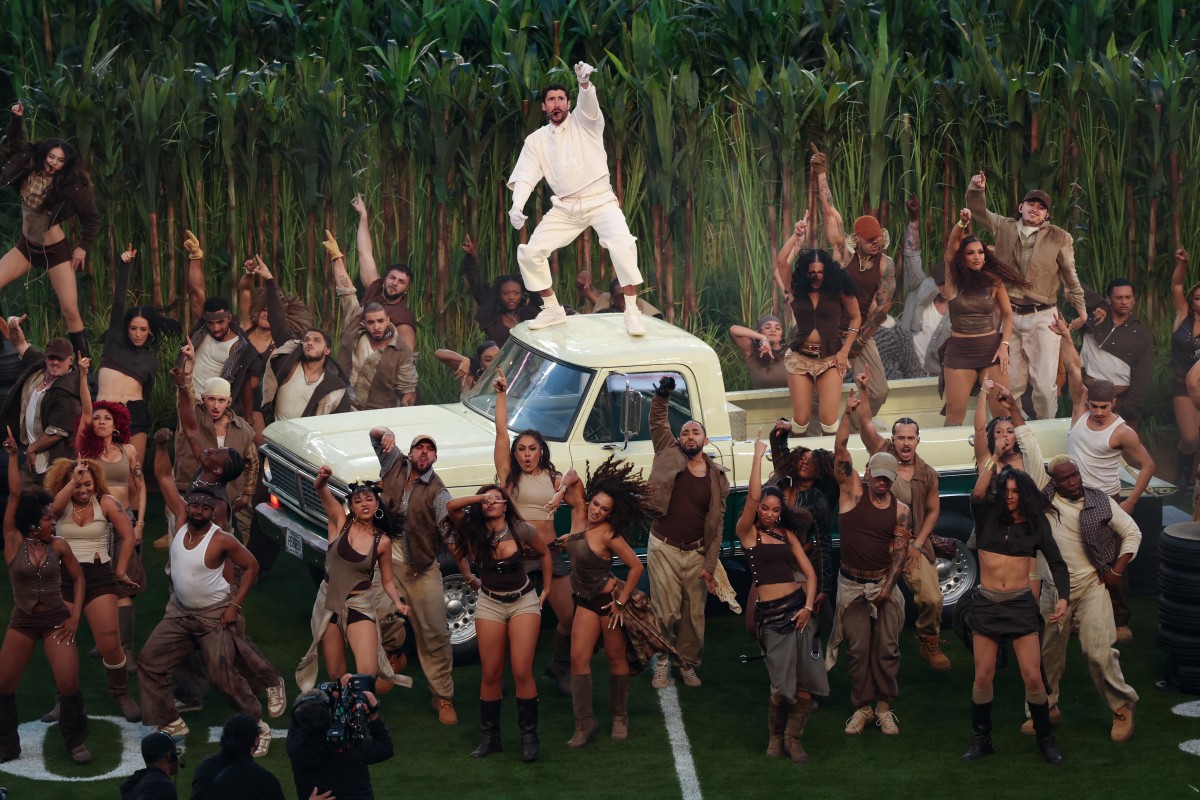
Bad Bunny’s 13-minute halftime performance at the Super Bowl this Sunday (8) was far more than an entertainment spectacle. According to scholars, it was a symbolic political act that celebrated Latin American identity while highlighting its historical wounds. To unpack the significance of the moment, BdF spoke with Alexandre Barbosa, a professor at the Center for Latin American Studies on Culture and Communication (Celacc-USP).
“That unforgettable dance [‘Baile Inolvidable‘, Bad Bunny’s third song of his latest album] was a perfect summary of what Bad Bunny does best: blending celebration and joy with protest and political denunciation,” Barbosa told Radio BdF.
The scholar pointed to the closing moment of the performance, when the artist displayed the flags of Latin American countries. “For those of us who study decolonial thought, it felt like seeing our theoretical discussions come to life,” he said.
Barbosa emphasized that Latin America cannot be reduced to countries that share Romance languages. “It is a set of nations shaped by colonialism and still marked by its legacy,” he explained. This broader definition includes Spanish-speaking countries and Brazil, as well as French-, Dutch-, and English-speaking Caribbean nations, and territories such as Puerto Rico, a U.S. “associated state” in what he described as an “anomalous political situation.”
The professor drew parallels between reggaeton – a genre that emerged in working-class communities in Panama and Puerto Rico – and Brazilian cultural expressions such as samba and funk. “Latin American popular culture is born from the people. Samba grew in urban peripheries, funk tells the stories of marginalized neighborhoods. Reggaeton did the same, combining reggae rhythms with the Latin American DNA of percussion,” he said.
Like samba and funk, reggaeton has also faced stigma and criminalization. In Barbosa’s view, former U.S. president Donald Trump’s criticism of Bad Bunny’s performance, calling it “a disgrace to America”, reflects the same long-standing hostility toward popular culture from marginalized communities. “For Bad Bunny, that should be taken as a compliment,” he joked.
Unlike some Latin artists who have adopted English-language repertoires to reach global audiences, Bad Bunny has maintained his artistic identity. “Not a single song in the show was in English. He was speaking directly to a massive Latin audience inside and beyond the United States,” Barbosa noted.
He also sees the U.S. cultural industry increasingly trying to engage with this expanding audience. “They know they cannot ignore this public. Fortunately, when artists like Bad Bunny enter the mainstream industry, they often manage to preserve much of their cultural roots.”
According to Barbosa, the current global visibility of Latin American culture is not unprecedented. He recalled similar waves in the 1960s with Chile’s Nueva Canción movement led by Violeta Parra, and again during the democratization processes of the 1980s. “Culture tends to flourish in moments when Latin America is politically and geopolitically ‘on the move,’ trying to chart its own path,” he said.
A regional context marked by alternating progressive and far-right governments, yet no longer entirely defined by the shadow of the Washington Consensus, has created fertile ground for this cultural momentum. “There are several ‘beacons’ being lit across Latin America, not only Cuba. Culture responds to these shifts, and people identify with them,” he added.
Repression and xenophobic rhetoric, such as Trump’s attacks against Latin American migrants, may also produce unintended consequences. “Every form of repression creates cracks. A young person from São Paulo’s periphery can identify with the struggles of a persecuted migrant. When they see an artist expressing those experiences, it builds a powerful connection,” he said.
From this perspective, Bad Bunny’s Super Bowl performance and the growing presence of Latin narratives in mainstream culture are part of a broader movement. “This is not about nationalist triumphalism, it’s about sovereignty. It’s about recognizing that we can move forward on our own terms, with our challenges but also with our richness. Despite everything, this has been a very good week to be Latin American.”
