
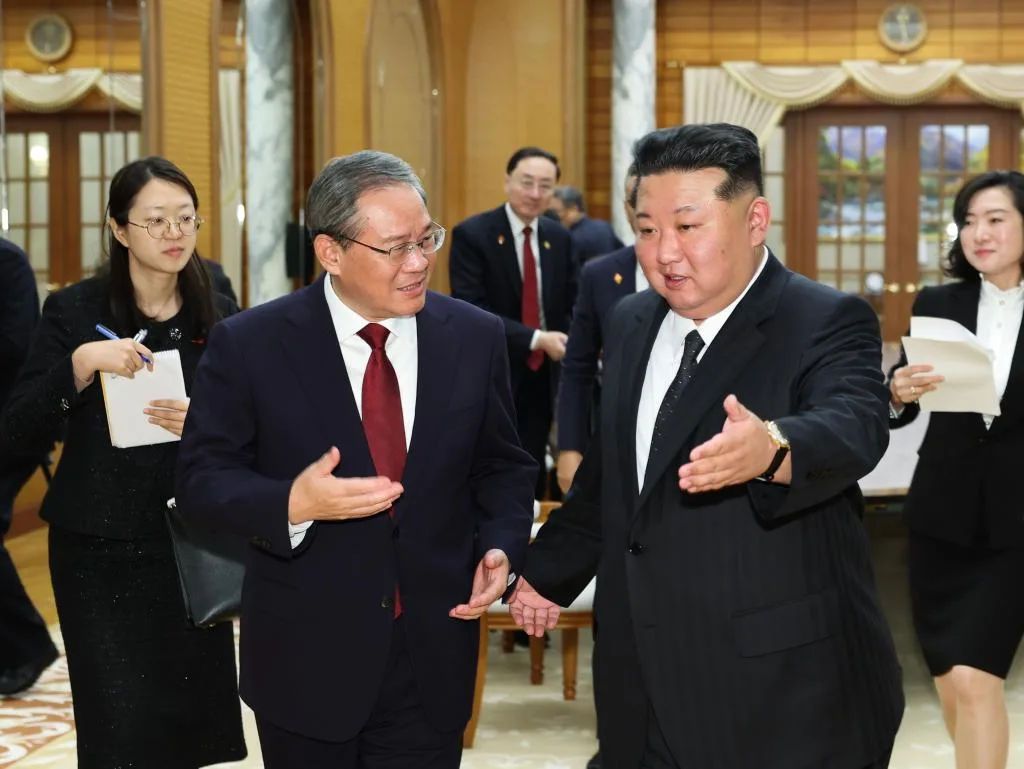
Chinese Premier Li Qiang’s visit to Pyongyang last week, the first by a senior Chinese official to the Democratic People’s Republic of Korea (DPRK) since the pandemic, signals a new stage in the alliance between the two countries and highlights Beijing’s strategy to strengthen regional partnerships amid rising tensions with Western powers.
Between October 9 and 11, Li took part in celebrations marking the 80th anniversary of the founding of the Workers’ Party of Korea (WPK), coinciding with the 75th anniversary of China’s participation in the Korean War. The diplomatic gesture – which included a floral tribute at the monument honoring the more than 180,000 Chinese soldiers who died in the conflict – reaffirms a bond that extends beyond rhetoric and is rooted in decades of strategic cooperation.
A War-Forged Alliance
The Sino–North Korean relationship dates back to the Korean War (1950–1953), when China sent the People’s Volunteer Army to support the North against U.S. and South Korean forces. The war, which claimed approximately 3 million Korean civilian lives according to UN estimates, consolidated Beijing’s position as one of Pyongyang’s key allies.
Since then, China has played a central role in supporting North Korea’s economy – from post-war reconstruction to modern infrastructure and technology investments. This cooperation spans the fields of security, trade, and modernization of key economic sectors in the DPRK.
Messages of Continuity
Chinese President Xi Jinping sent a message to North Korean leader Kim Jong-un, affirming that “the friendship between our two parties and countries will remain firm, no matter how the international situation changes,” according to a statement by the Korean Central News Agency (KCNA) reproduced by Xinhua. The message underscores the strategic depth of the partnership amid an evolving regional geopolitical landscape.
In a statement to Chinese media, Li Qiang described China and North Korea as “close neighbors, comrades, and partners in a shared destiny,” adding that “the transformations in the international landscape make it even more necessary to strengthen unity among Asia’s socialist countries.”
Regional Context
The visit took place amid growing militarization on the Korean Peninsula, with U.S. military bases operating in South Korea and Japan. Beijing’s official statement emphasized that the Chinese government “supports regional stability and dialogue among all parties” and “rejects any form of unilateral pressure or sanctions.”
Current Sino–North Korean cooperation includes joint infrastructure projects and Chinese financial and technical support for North Korea’s economic modernization, making it a partnership that extends beyond political alignment and materializes in concrete investment and development efforts.
Shared Memory of Anti-Fascist Resistance
During the ceremony in Pyongyang, Kim Jong-un emphasized that “the common struggle waged by Koreans and Chinese against world fascism remains an example of the solidarity that continues to guide the relations between our peoples today.” His remarks linked the shared memory of resistance against imperial Japan and U.S. intervention on the peninsula with the countries’ current strategic alignment.
Founded in 1949, the Workers’ Party of Korea, guided by the Juche ideology formulated by Kim Il-sung, led land reforms, industrialization plans, and literacy campaigns that transformed North Korea’s social structure in the post-war period.
*With information from Xinhua and the Korean Central News Agency (KCNA).