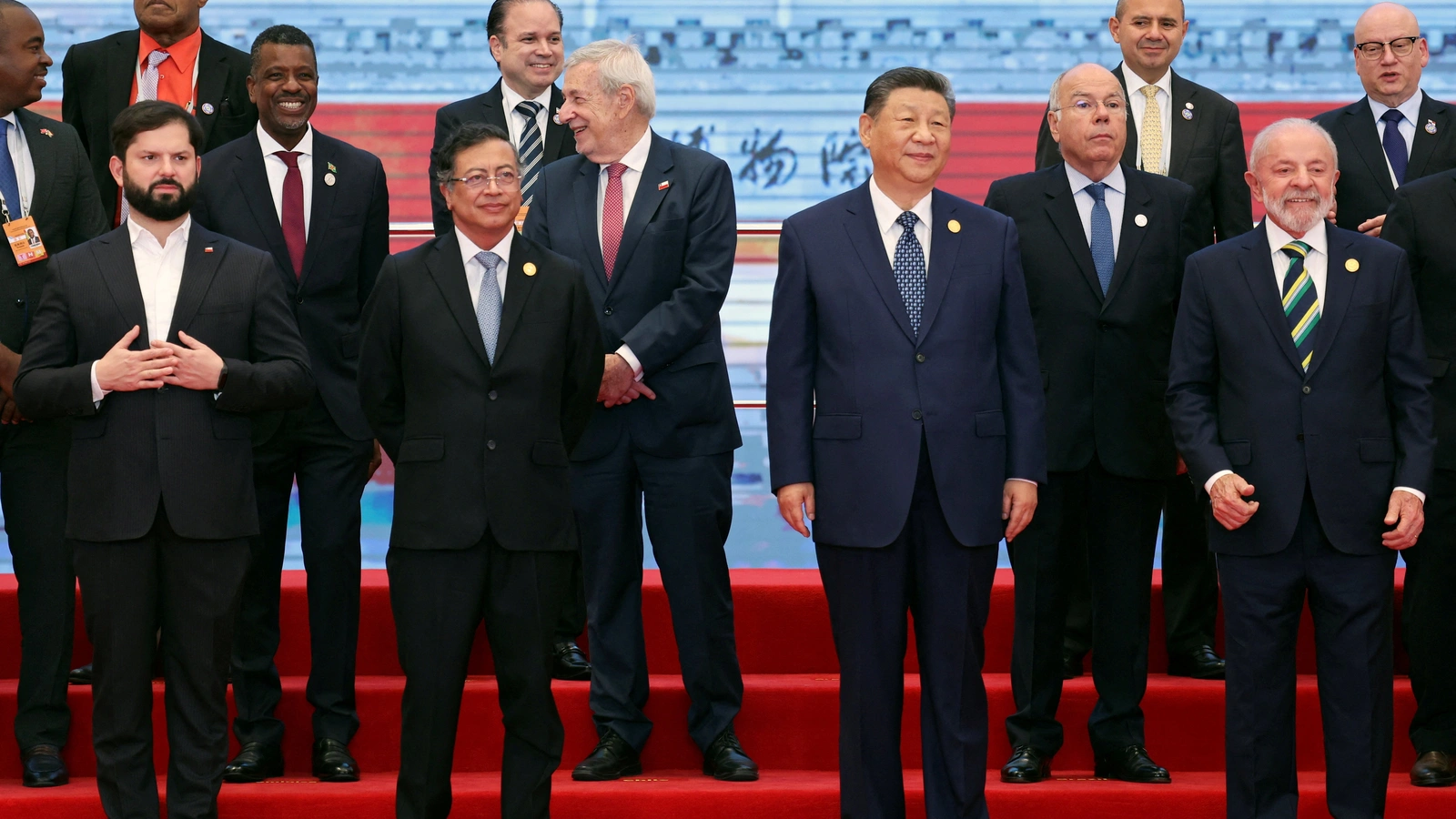
In a ceremony held on Tuesday (10) at the Ministry of Foreign Affairs in Beijing, China released the third Policy Paper on China–Latin America and the Caribbean, reaffirming its intention to deepen strategic relations with the region.
The event brought together representatives from Latin American and Caribbean governments and highlighted Beijing’s approach to cooperation based on shared gains, sustainable development, and respect for sovereignty.
During the launch, China’s Assistant Foreign Minister Cai Wei said the document aims to implement the directives presented by President Xi Jinping, strengthening the “Five Programs” of solidarity, development, civilization, peace, and people-to-people connectivity. “The goal is to inject new momentum into the development of relations between China and the region,” he stated.
The document, widely referred as “White Paper” in China, is used by Beijing to outline foreign policy, development strategies, and international cooperation priorities, offering transparency on objectives and proposals for engagement across different world regions.
This is the third policy paper of its kind for Latin America and the Caribbean. The first two were released in November 2008 and November 2016, helping guide and expand Beijing’s relations with the region.
Shared gains and independent development
Cai Wei emphasized that China’s policy toward Latin America and the Caribbean is rooted in respect for the independence and sovereignty of regional countries. “These relations are not directed against any third country and should not be interpreted as external interference,” he said, reinforcing that cooperation is aimed at mutual benefit and strengthening independent development.
The minister also noted that Beijing intends to share China’s modernization experience and support the region in expanding its capacity for sustainable development. “We will ensure the proper use of the credit line announced by President Xi Jinping, valued at the equivalent of 66 billion yuan (approx. US$ 9,34 billion),” he said. The funds will be directed toward infrastructure, clean energy, 5G telecommunications, the digital economy, artificial intelligence, food production, culture, and mining.
Education, science, and cultural exchange
The policy paper also outlines investments in education and professional training, including government scholarships, technical capacity-building, and cultural and sports exchanges. Cai Wei stressed the importance of deepening intercivilizational dialogue and breaking down cultural barriers, promoting “harmonious coexistence and mutual flourishing among civilizations.”
Among the initiatives announced were the creation of new direct air routes, the China–Latin America and Caribbean Tourism Dialogue, the China–Latin America and Caribbean People’s Friendship Forum, and the Subnational Government Cooperation Forum. “The goal is to strengthen mutual understanding and people-to-people connectivity,” he said.
Social cooperation and reducing inequality
Cai Wei noted that China will continue supporting Latin American and Caribbean countries in improving medical facilities, training health professionals, and expanding health cooperation programs. The document also highlights goals such as reducing poverty, strengthening social policies, and modernizing public services, particularly in more vulnerable nations and small island states.
“We must strengthen exchanges at all levels, broaden dialogue on governance and social development, and work together to generate concrete benefits for the region’s peoples,” he stated.
Defending regional peace and sovereignty
In a more political tone, the minister reiterated China’s commitment to peace and the sovereignty of Latin America and the Caribbean. “China reaffirms its support for the Proclamation of Latin America and the Caribbean as a Zone of Peace, the Treaty for the Prohibition of Nuclear Weapons in the region, and the peaceful resolution of international disputes,” he said.
On Taiwan, Cai Wei was unequivocal: “The Taiwan question is China’s most vital interest and the red line that cannot be crossed. We believe Latin American and Caribbean countries will continue to firmly uphold the One-China Principle.”
Historical memory and international solidarity
The launch also recalled the importance of historical memory. In September, China marked the 80th anniversary of victory in the War of Resistance against Japanese Aggression and the global victory over fascism, emphasizing the need to safeguard history and value peace. “We must jointly defend international justice and fairness and prevent anyone from attempting to reverse the course of history,” Cai Wei declared.
A shared future for China, Latin America, and the Caribbean
Cai Wei concluded by calling on countries in the region to translate the policy paper into concrete cooperation. “Let us unite our efforts and move forward hand in hand, turning this document into practical results and jointly writing a new chapter in building a community with a shared future between China and Latin America and the Caribbean,” he said.
For Beijing, the initiative represents not only the strengthening of bilateral relations, but also the consolidation of a broader South–South cooperation agenda capable of offering alternatives to the global North’s dominance while promoting sustainable development, justice, and sovereignty across the region.
White Paper is organized around five strategic programs:
- Solidarity: includes high-level exchanges, support for China’s core interests (such as the One-China Principle), intergovernmental dialogue, and trilateral cooperation. China seeks to strengthen the region’s influence in international forums and support regional integration platforms like the China–Celac Forum.
- Development: covers Belt and Road Initiative implementation, cooperation in trade, investment, infrastructure, energy, manufacturing, agriculture, science and technology, innovation, space, environment, and climate action. China supports sustainable, people-centered projects and encourages technology transfer.
- Civilization: promotes cultural, educational, sports, and academic exchanges; preservation of cultural heritage; scholarships; Confucius Institutes; digital education; athlete exchange programs; media and think-tank cooperation.
- Peace: includes regional and global security, military cooperation, combating transnational crime, cybersecurity, and nonproliferation. China supports peaceful dispute resolution, nuclear-weapon-free zones, and inclusive internet governance.
- People-to-People Connectivity: focuses on social governance, poverty reduction, health, tourism, cooperation among local governments, youth and women’s exchanges, and civil society initiatives. The goal is to improve quality of life, strengthen local capacity, and foster cultural and economic exchange.