
China’s Xinjiang Uyghur Autonomous Region recorded economic growth of 5.5% in 2025, above the national average, despite sanctions imposed by the United States and the European Union since 2020 on key sectors such as cotton and tomato industries.
The data were presented on Tuesday (27) by Xinjiang governor Erkin Tuniyaz during the annual session of the regional People’s Congress. According to the report, the region’s gross domestic product (GDP) reached 2.15 trillion yuan (around US$ 300 billion), while foreign trade grew 19.9%. Annual per capita income for rural residents surpassed 20,000 yuan for the first time, reaching 20,793 yuan (about US$ 2,900), an increase of 7% compared to the previous year.
The annual sessions of the Chinese People’s Political Consultative Conference (CPPCC) and the People’s Congresses, collectively known as the “Two Sessions”, began in China in January 2026. They take place at four levels: county, municipal, provincial and national.
These meetings represent the final stage of reviewing and approving the government’s work from the previous year and setting guidelines and priorities for the following period. Local-level sessions also serve to prepare issues for the national sessions, scheduled for early March.
As the 14th Five-Year Plan concluded in 2025, the sessions also provided an overall assessment of that period while outlining initial directions for the next planning cycle.
Sanctions and economic pressure
In 2020, during Donald Trump’s first administration, the U.S. passed the Uyghur Human Rights Policy Act, imposing sanctions on regional officials over allegations of human rights violations and initiating economic boycotts of local products. These measures were later followed by Canada, the United Kingdom and the European Union, significantly affecting exports of cotton, tomatoes and polysilicon from Xinjiang.
Between 2018 and 2023, more than 40 companies and three non-commercial entities in Xinjiang were sanctioned under allegations of “forced labor,” leading to the suspension of operations of over 100 companies in the region, according to official regional government data. As a result of measures initiated under the Trump administration, the average annual workforce in Xinjiang’s textile, garment and accessories industries fell by 28.6% in 2023, also according to government figures.
Tourism and response to Western narratives
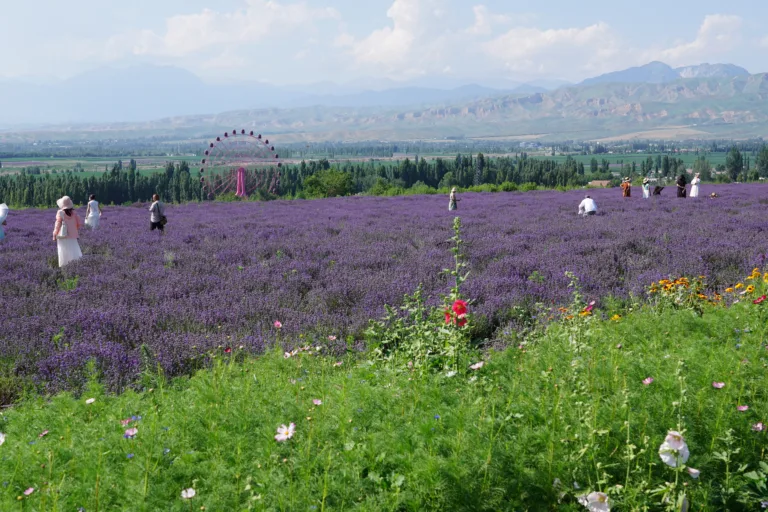
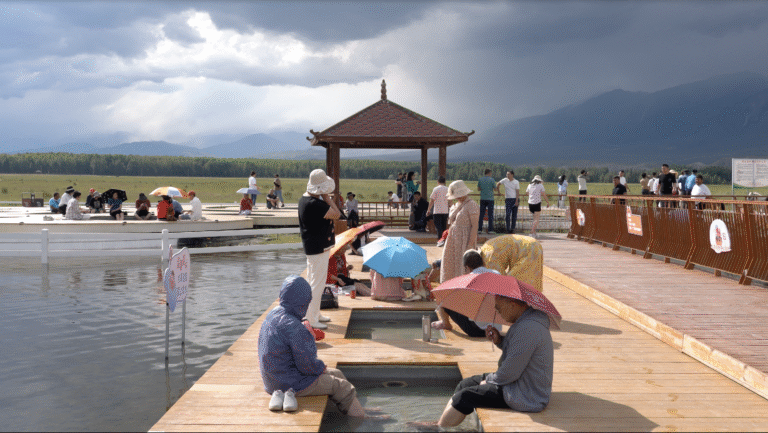
Xinjiang received 323 million tourists in 2025, an increase of 8% compared to the previous year, generating 370 billion yuan (around US$ 52 billion) in revenue, according to official data. The government report highlights tourism as a tool to promote exchanges among different ethnic groups. Xinjiang is the only region in China where all 56 officially recognized ethnic groups are present.
The expansion of tourism is also presented as a response to narratives promoted in the Global North regarding alleged human rights violations, allowing domestic and international visitors to directly observe local conditions.
Rural revitalization and focus on southern Xinjiang
During the 14th Five-Year Plan period (2021–2025), 222,400 families received support through the rural revitalization strategy to prevent large-scale returns to poverty, according to Governor Erkin Tuniyaz’s report.
Xie Yingzhou, deputy director of Xinjiang’s Department of Agriculture, told Brasil de Fato that more than 60% of rural revitalization funds were allocated to strengthening small agro-industries. “To ensure farmers benefit from the entire value chain, we implemented mechanisms such as production contracts with guaranteed prices, profit-sharing and equity participation,” Xie explained.
The village of Yaozhan, in Qitai County, Changji Prefecture, illustrates the model. Farmers formed a cooperative focused on wheat cultivation that distributed over 50 million yuan (about US$ 7 million) in dividends, generated 4.25 million yuan (around US$ 600,000) in profits in 2025, and paid more than 22 million yuan (approximately US$ 3.1 million) in wages, bonuses and social security contributions.
Development policies have focused primarily on southern Xinjiang, historically poorer due to water scarcity, fragile soils and other structural factors. “We will concentrate efforts on key counties and cities in southern Xinjiang and implement routine, targeted assistance measures. All monitored households will be fully included in our support system, ensuring precise and effective interventions so that no farmer falls back into poverty or becomes poorer,” Xie said.
Environmental and technological advances
In 2025, Xinjiang completed the afforestation of 3.09 million mu (about 206,000 hectares), improved 4.8 million mu (320,000 hectares) of grassland and treated 6.91 million mu (461,000 hectares) of desertified land, according to the government report.
The containment project around the Taklamakan Desert, known as the “green scarf,” expanded by 9.38 million mu (625,000 hectares) and was selected as one of the “Top 10 Global Engineering Achievements of 2025.” The ecological belt surrounding the desert, stretching 3,046 kilometers, was fully completed in 2025.
The region added 63.33 million kilowatts of renewable energy capacity, while green electricity transactions reached 3.17 billion kilowatt-hours, representing a 52.8% increase compared to the previous year.
Cui Tao, deputy director of Xinjiang’s Department of Industry and Information Technology, highlighted the launch during the last five-year plan of a hydrogen-enriched carbon-cycle industrial blast furnace with a capacity of 2,500 cubic meters. “This single facility reduces carbon emissions by 600,000 tons annually and improves conversion efficiency by over 40%. Fundamentally, this technology can be applied to approximately 90% of China’s steel industry, representing a significant contribution to global decarbonization,” Cui said.
Outlook for 2026–2030
For the 15th Five-Year Plan (2026–2030), Xinjiang has outlined nine major objectives, including high-quality development, strengthening national security, deepening reforms and expanding external openness. The GDP growth target for 2026 has been set between 5.5% and 6%.
For 2026, the regional government projects 7.5% growth in industrial value added, an 8% increase in fixed-asset investment, 6% growth in retail sales and 10% expansion in foreign trade. Targets also include the creation of 470,000 new urban jobs and maintaining the urban unemployment rate at 5.5%.