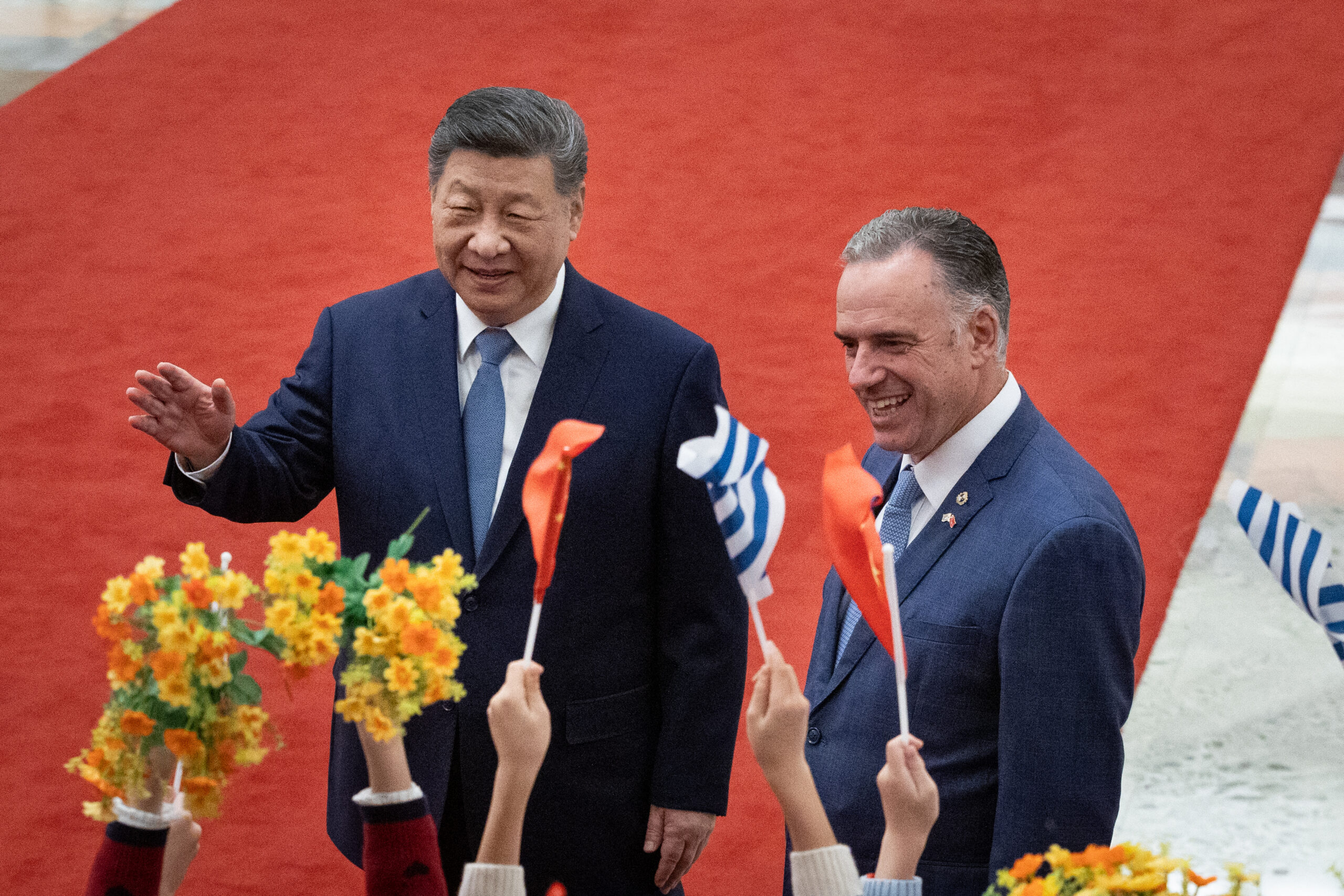
Chinese President Xi Jinping on Tuesday (3) warned of the rise of “unilateral bullying practices” in international affairs during a meeting with Uruguayan President Yamandú Orsi, who is on a state visit to China. The remarks come amid heightened global geopolitical tensions and reinforce Beijing’s long-standing defense of a multipolar international order.
Speaking at the Great Hall of the People in Beijing, Xi said “the world is undergoing changes unseen in a century, the international situation is volatile and turbulent, and unilateral bullying practices are becoming more rampant.” He added that China is willing to work with Uruguay to “strengthen solidarity and cooperation across the Global South.”
Orsi, who took office in March 2025, echoed the multilateral stance. He said Uruguay is ready to work with China to uphold the purposes and principles of the United Nations Charter, defend multilateralism, protect the international trading system, deepen China-Latin America and Caribbean ties, and safeguard the shared interests of the Global South.
Uruguay currently holds the rotating presidency of the Community of Latin American and Caribbean States (Celac) and also chairs the Group of 77 plus China (G77+China).
China-Uruguay relations
Diplomatic relations between China and Uruguay, established on February 3, 1988, marked a major shift in Uruguay’s foreign policy. For nearly four decades after the 1949 Chinese Revolution, Montevideo maintained diplomatic ties with Taiwan and only limited contacts with the People’s Republic of China. Following Uruguay’s return to democracy in 1985, the government of Julio María Sanguinetti reassessed the costs of not engaging with China amid global economic opening. In 1988, under Foreign Minister Enrique Iglesias, Uruguay formally recognized Beijing as the sole legitimate government of China, severing ties with Taipei.
After China joined the World Trade Organization in 2001, bilateral trade expanded rapidly. By 2013, China had overtaken Brazil as Uruguay’s main trading partner and today absorbs nearly 30% of Uruguayan exports, primarily beef, pulp, soybeans and wool. The relationship evolved from commercial to political-strategic: in 2016, during the government of Tabaré Vázquez, the two countries established a Strategic Partnership; in 2018, Uruguay became the first Mercosur member to join the Belt and Road Initiative; and in November 2023, under President Luis Lacalle Pou, ties were elevated to a Comprehensive Strategic Partnership during a state visit to Beijing.
In recent years, Uruguay has emerged as a leading advocate for a free trade agreement between China and Mercosur, a position that has generated internal tensions within the bloc. Montevideo has pushed to advance bilateral trade talks with Beijing, while opposition from Argentina and Brazil, citing Mercosur rules against unilateral agreements, has slowed progress. China has signaled openness to such a deal, which would speed Uruguayan access to the Chinese market and position the country as a logistics hub in the South Atlantic and a platform for Chinese firms in Latin America. The proposed free trade agreement remains a central item on the bilateral agenda and a flashpoint in regional integration debates.
Xi noted that the approval of recommendations for China’s 15th Five-Year Plan, endorsed at the fourth plenary session of the 20th Central Committee of the Communist Party of China, will open new opportunities for Uruguay and countries around the world. He also called for closer alignment of development strategies and deeper cooperation in infrastructure, trade, finance and agriculture.
For his part, Orsi said that relations with China are now a state policy in Uruguay, enjoying broad support across political parties and society. The visit set a diplomatic record for Montevideo, representing the largest delegation Uruguay has ever assembled for a state visit to any country.
The talks took place exactly 38 years after the establishment of diplomatic relations on February 3, 1988. Xi observed that despite the geographical distance, China and Uruguay share similar ideals and a deep friendship. “Under the new circumstances, the two countries should carry forward past traditions, deepen the comprehensive strategic partnership, and let the tree of China–Uruguay friendship continue to grow and flourish,” he said.
Orsi stressed that the comprehensive strategic partnership is at its strongest point in history. He reaffirmed Uruguay’s firm support for the One China policy and the “One Country, Two Systems” principle, and expressed a desire to elevate bilateral cooperation further.
Priority areas identified by both leaders include emerging sectors such as green development, the digital economy, artificial intelligence and clean energy, alongside traditional fields of trade, investment, science and technology, poverty reduction, and cultural, educational and sports exchanges.
Following the talks, the two heads of state witnessed the signing of eleven cooperation documents, with details not yet released nut that are said to be covering investment and trade promotion, among other areas. China and Uruguay also issued a Joint Declaration on Deepening the Comprehensive Strategic Partnership.