
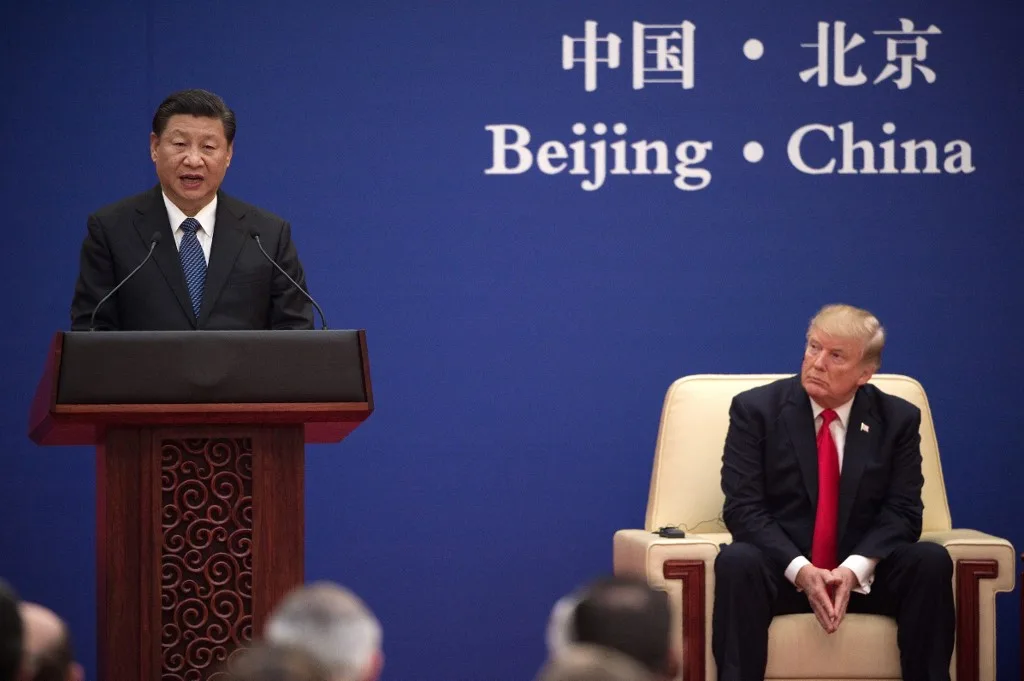
U.S. President Donald Trump has accepted an invitation from Chinese President Xi Jinping to visit Beijing in April 2026, according to an announcement posted by Trump on Monday night (24) on his social media accounts. The confirmation came after a phone conversation in which Trump also recognized the importance of the Taiwan issue for China, amid a recent escalation of tensions over the island involving Japan.
According to an official statement from the Chinese government, Xi Jinping reiterated China’s “principled position on Taiwan,” emphasizing that “Taiwan’s return to China is an integral part of the postwar international order.” Xi noted that China and the United States “fought shoulder to shoulder against fascism and militarism” during World War II.
Chinese Foreign Ministry spokesperson Mao Ning said on Tuesday that the call had been requested by the United States and described it as “positive, friendly, and constructive.” Mao added that communication between the two heads of state is “very important for the stable development of China–U.S. relations.”
In response, Trump said that “the United States understands how important the Taiwan issue is to China,” according to the Chinese readout of the call. He also praised Xi as “a great leader” and said he had greatly enjoyed their meeting in Busan, South Korea, last month. Trump noted that he had invited Xi for a state visit to the United States later in 2026, though neither side has confirmed whether the Chinese leader accepted the invitation.
The day after the call, on November 25, Trump spoke by phone with Japanese Prime Minister Sanae Takaichi to brief her on his conversation with Xi. According to Takaichi, who spoke to reporters after the roughly 25-minute exchange, the two leaders “confirmed the close cooperation between Japan and the United States” and discussed strengthening the bilateral alliance and addressing challenges in the Indo-Pacific region. The call was reportedly initiated by Trump.
Xi Jinping said the Busan meeting had “recalibrated the course of the great ship of China–U.S. relations and provided new momentum for it to sail forward steadily.” The Chinese leader stressed that both nations should “maintain this momentum and continue moving in the right direction based on equality, mutual respect, and shared benefit.” Both presidents agreed on the need for frequent communication. “We agreed that it’s important to keep in touch often, and I look forward to doing so,” Trump said.
Trade and agriculture back on the table
The leaders’ phone conversation also covered cooperation on the war in Ukraine, efforts to combat fentanyl trafficking, and agricultural trade. Trump said that a “good and very important deal” had been reached for U.S. farmers.
Following their meeting in Busan on October 30, the American Soybean Association (ASA) hailed new trade commitments as one of the summit’s key outcomes. According to the ASA, the agreement includes minimum Chinese purchases of 12 million metric tons of U.S. soybeans for the remainder of the current export season (through January 2026) and at least 25 million tons annually through 2028.
The details were later confirmed by Treasury Secretary Scott Bessent, while the Chinese side said only that both countries had agreed to “expand agricultural trade.” The ASA noted that China has historically imported between 25 and 30 million tons of U.S. soybeans annually and described the new commitments as “a solid foundation for returning to traditional volume levels.”
Xi characterized the recent trajectory of bilateral ties as positive, saying that “what has happened once again demonstrates that China–U.S. cooperation benefits both sides, while confrontation harms both sides, a common understanding repeatedly proven by experience.”
Trump described the relationship as “extremely strong” and said the phone call had been “very good.” He added that both governments are now “implementing all the elements agreed upon in Busan,” which will allow them to “focus on the bigger picture.”